Batur vs Agung vs Rinjani: Choosing Your Sunrise Trek
Should I trek Batur, Agung, or Rinjani?
Batur is the accessible option — a few hours, moderate fitness, widely available guided groups, and a genuinely rewarding sunrise view. Agung is considerably harder — Bali's highest and most sacred peak, a longer and steeper climb, and closures around religious ceremonies. Rinjani, on Lombok, is in another category entirely: a multi-day trek at real altitude that needs proper preparation, gear, and time. Match the trek to your fitness and schedule rather than picking based on the most dramatic photos.
Bali and Lombok’s three best-known volcano treks get lumped together in a lot of trip planning as interchangeable “sunrise hikes,” and that framing does a disservice to how differently these three mountains actually behave. Mount Batur is genuinely accessible — a moderate few-hour climb that most reasonably fit travellers can complete with a pre-dawn start and a guide. Mount Agung, Bali’s highest and most sacred peak, is a considerably harder, longer climb with real elevation and a steeper, more technical upper section. Mount Rinjani, across the water on Lombok, isn’t in the same category as either — it’s a multi-day trek at genuine altitude that demands proper gear, fitness, and time.
Choosing between them isn’t really about which offers the best view, since all three deliver a memorable sunrise from height. It’s about matching each specific trek honestly to your own current fitness, the time you actually have available, and how much risk and discomfort you’re prepared to sign up for before you commit to one.
Two travellers with the same interest in a memorable sunrise can reasonably end up on completely different mountains once fitness and available time are factored in honestly. This guide breaks down what each trek actually asks of you, so the choice is based on a realistic picture rather than a photo that doesn’t show the climb behind it. It also flags the practical differences in cost, guiding, and seasonal access that don’t always make it into a quick trip-planning search.
Batur vs Agung vs Rinjani at a glance
| Mount Batur | Mount Agung | Mount Rinjani | |
|---|---|---|---|
| Difficulty | Moderate | Hard | Very hard |
| Duration | A few hours, single pre-dawn push | A long day, steep upper section | Multi-day, typically 2–4 days |
| Elevation | Around 1,700m | Bali’s highest peak, well over 3,000m | Second-highest volcano in Indonesia |
| Guide required | Yes, widely available | Yes, essential given difficulty | Yes, essential — licensed guide mandatory |
| Best for | Most reasonably fit travellers wanting a sunrise trek | Experienced hikers wanting a harder Bali challenge | Serious trekkers with time for a multi-day expedition |
Mount Batur: the accessible sunrise trek
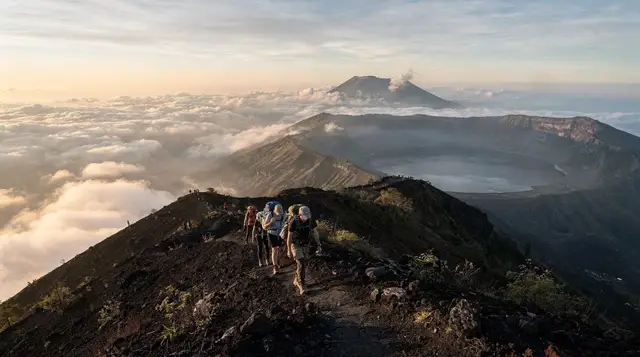
Batur is the trek most visitors picture when they hear “Bali sunrise hike,” and it earns that popularity honestly — a pre-dawn start, a few hours of steady climbing on a well-established trail, and a summit view over Lake Batur and, on a clear day, across to Agung and beyond. It doesn’t require technical climbing or serious mountaineering fitness, just reasonable stamina and sturdy footwear, which makes it the default choice for travellers wanting a genuine trekking experience without committing to something harder.
A guided option like the Mount Batur sunrise trek via Pasar Agung or a Batur sunrise trek combined with a jeep tour through Bangli’s bamboo forest covers the logistics — guide, transport, and often breakfast at the top — in a single booking.
Mount Agung: Bali’s hardest and most sacred peak
Agung sits in a different tier of difficulty from Batur. It’s Bali’s highest point and, as the mountain Besakih temple sits on the slope of, its most spiritually significant, which means access can be restricted around major religious ceremonies — checking current access conditions before planning a trip around this trek matters more here than for Batur.
The climb itself is longer, steeper, and considerably more physically demanding, with a rougher, more exposed upper section that calls for real fitness and sure footing rather than just stamina. Sunrise from Agung’s summit, once you’ve earned it, is widely considered more dramatic than Batur’s, precisely because of how much harder the climb is to reach it. It is not the trek to attempt as a spontaneous add-on to an otherwise relaxed holiday; treat it as its own dedicated, carefully planned day.
Mount Rinjani: the multi-day expedition
Rinjani is Indonesia’s second-highest volcano and sits in a completely different category from either Bali trek — this is a genuine multi-day expedition, typically spanning two to four days depending on the route, involving camping, a demanding summit push in the dark, and real altitude that affects breathing and stamina in ways neither Batur nor Agung require you to manage.
A licensed guide and porter team is mandatory, not optional, and proper gear — a good sleeping bag, layered clothing, sturdy boots — genuinely matters given the multi-day exposure to cold at altitude. This is a serious undertaking that needs dedicated planning, time, and a realistic assessment of your own fitness, not a trek to book on a whim during a broader Bali-Lombok holiday.
What isn’t worth the detour
Don’t attempt Agung or Rinjani purely because Batur felt easy — the jump in difficulty between the three is substantial, and treating them as a simple progression from “easy” to “hard” undersells how much harder Agung specifically is, let alone Rinjani’s multi-day demands. It’s also not worth skimping on a licensed guide for any of them to save money; route-finding in the dark on volcanic terrain is genuinely hazardous, and the guide fee is a small part of the overall cost of the experience regardless of which mountain you choose. And don’t chase all three on one trip out of a completionist instinct — each deserves its own properly planned day or days, and rushing between them undersells the actual experience of any single one.
What to pack for the cold
All three treks share one commonly underestimated factor: it gets genuinely cold at altitude in the pre-dawn hours, regardless of how warm Bali or Lombok feels at sea level. Layered clothing, a warm hat, and gloves are worth packing even for Batur’s shorter climb, and become essential for Agung’s longer exposure and non-negotiable for Rinjani’s multi-day, higher-altitude conditions.
Sturdy, broken-in footwear matters on all three — volcanic scree and loose rock are unforgiving on unfamiliar shoes, and a blister or twisted ankle partway up any of these mountains turns a hard day into a genuinely difficult one. A headtorch with spare batteries is essential for the pre-dawn sections of all three, and trekking poles are worth considering for Agung and Rinjani specifically, where the steeper, longer descents put real strain on the knees.
Budget across the three
Batur is the most affordable of the three, with widely available guided group treks at a modest, fixed price that usually includes transport and a simple breakfast at the summit. That combination of low cost and manageable difficulty is exactly why it remains the default choice for the vast majority of Bali visitors who want a single sunrise trek during their trip.
Agung’s guided treks cost more, reflecting the greater guide expertise, smaller typical group sizes, and longer day required. Rinjani is by far the most expensive given its multi-day nature — guide and porter fees, camping equipment, and park permits all add up across several days, though multi-day packages typically bundle these costs into a single upfront price that’s easier to budget against than piecing it together separately. Comparing a few different operators before booking Rinjani is worth the time, since package inclusions — tent quality, meal standards, group size — vary more between operators than the headline price alone suggests.
Seasonality and access
All three treks are weather-dependent and typically closed or discouraged during the wettest months for safety reasons — trails become genuinely dangerous in heavy rain, particularly on steeper sections. The dry season, roughly April through October, is the reliable window for all three, with Rinjani specifically often having an official closure period during the wettest months that’s worth checking directly before planning a trip around it.
Agung’s access can additionally be affected by both weather and religious ceremony schedules, given its status as Bali’s most sacred mountain, so checking current conditions close to your travel dates matters more for Agung than for Batur. A local operator or guide service will usually know the latest status well before it appears in general travel advice, so confirming directly with them shortly before your trip is the most reliable check.
How this fits into a longer trip
Batur fits naturally into almost any Bali itinerary as a single early-morning add-on — a Bali 5 days itinerary or Bali 7 days itinerary can absorb a Batur sunrise trek without disrupting the rest of the schedule, especially paired with something relaxed like an authentic Bali villages and coffee tour around Mount Batur or a Mount Batur 4WD jeep tour with a natural hot spring stop afterward to recover.
Agung, given its difficulty, is better treated as a standalone focus day rather than squeezed between other activities — building in a rest day either side, especially the day after, helps the body recover from a genuinely demanding climb. Rinjani needs its own dedicated multi-day block, best planned as part of a Bali and Lombok 2 weeks itinerary rather than squeezed into a shorter trip, since arriving under-rested for a multi-day trek at altitude makes an already hard undertaking considerably harder.
For a deeper look at each mountain individually, the Mount Batur sunrise trek guide, Mount Agung trek guide, and Mount Rinjani trek guide go into route-specific detail this comparison doesn’t cover. The what to pack for a volcano trek guide is also worth reading regardless of which mountain you choose, since the core packing list overlaps heavily across all three.
Fitness levels honestly assessed
Batur requires reasonable, everyday fitness — someone who walks regularly and doesn’t have significant mobility issues can typically complete it, and the guided groups pace themselves accordingly.
Agung requires genuine hiking fitness beyond casual exercise — regular cardio training and some prior experience with steeper, longer climbs makes a real difference to how manageable the day feels, and attempting it with only Batur-level fitness is a common source of underprepared, miserable summit attempts.
Rinjani demands the most: multi-day stamina, the ability to keep moving at altitude where the air is thinner, and genuine comfort with sustained physical exertion over consecutive days rather than a single push. Being honest with yourself about which category you actually fall into, rather than which one you’d like to believe, is the single most useful thing you can do before booking any of the three. Guides on all three mountains have seen plenty of overconfident trekkers turn back partway up, and there’s no shame in choosing the trek that genuinely matches your current fitness rather than the one that photographs best.
The guide and group experience
All three treks are typically done with local guides who know the terrain, and the experience of being guided differs meaningfully between them. Batur’s guided groups are large and well-practised, moving at a steady, predictable pace suited to first-timers, with well-marked trails that make the whole experience feel more like a structured group activity than a wilderness trek.
Agung’s guiding tends toward smaller groups given the trail’s difficulty, with guides who pay closer attention to pacing and safety on the more exposed sections. Rinjani’s guide and porter teams are a core part of the multi-day experience itself — carrying camping equipment, preparing meals at camp, and managing the logistics of a several-day expedition that would be genuinely difficult to arrange independently even for experienced trekkers.
Tipping guides and porters at the end of a Rinjani trek is customary and appreciated, given the physical demands of their work supporting trekkers over multiple days at altitude.
Frequently asked questions about Batur vs Agung vs Rinjani
Which trek is best for a first-time hiker?
Mount Batur, by a wide margin — it’s the most accessible of the three in terms of both fitness demands and logistics, and it’s specifically designed around guided groups suited to first-timers.
Do I need previous trekking experience for Rinjani?
Strongly recommended, though not always formally required. The multi-day duration, altitude, and physical demands are a significant step up from a single sunrise hike, and previous multi-day trekking experience makes a real difference to how much you enjoy it.
Is Mount Agung more dangerous than Batur?
It’s considerably harder and more physically demanding, with a steeper, more exposed upper section, but with a qualified guide and proper preparation it’s a manageable, if serious, undertaking for a fit hiker.
Can I do Batur and Agung on the same trip?
Yes, though not on the same day — they’re commonly done as separate outings within the same broader Bali trip, ideally with a rest day or two between them given how much harder Agung is.
How cold does it actually get at the summit?
Noticeably colder than daytime temperatures at sea level, especially in the pre-dawn hours before sunrise on all three mountains. Layered clothing is essential rather than optional, even though it might feel unnecessary the evening before when packing in warm coastal heat.
Is Rinjani closed at certain times of year?
Yes — the trek typically has an official closure period during the wettest months for safety reasons. Check current dates directly before planning a trip specifically around this trek.
Do all three require a guide?
Yes, effectively — Batur and Agung both strongly recommend or require a local guide for safety and route-finding, and Rinjani mandates a licensed guide and porter team as a condition of trekking.
Which has the best sunrise view?
All three deliver a genuinely memorable sunrise, but they differ in character — Batur’s view over Lake Batur is more accessible and crowd-friendly, Agung’s is higher and more dramatic for the effort involved, and Rinjani’s, after days of trekking, is widely considered one of the most rewarding volcano sunrises in Indonesia.
Volcano & sunrise trekking on GetYourGuide
Verified deep-linked GetYourGuide tours. Book through these links and we earn a small commission at no cost to you.
These are our own photographs of Bali, not the operator's pictures of this tour — open the tour page to see those.