Besakih Mother Temple: A Complete Guide
What makes Besakih different from every other temple in Bali?
Its position at the top of the island's temple hierarchy. Besakih is not one temple but a complex of more than twenty, arranged in terraces up Mount Agung's slope, and traditional Balinese Hindu cosmology treats every village and clan temple on the island as conceptually connected back to this one. That scale and status, more than any single architectural feature, is what sets it apart from Bali's other major temples.
Besakih holds a position in Balinese Hinduism that no other single temple on the island shares: it sits at the top of a conceptual hierarchy in which every village and clan temple across Bali is understood to connect back to it, making it the closest thing the island’s religious geography has to a central point. Understanding that hierarchy, and the layout of the complex built to reflect it, changes how a visit reads compared with treating Besakih as simply the largest temple on a checklist of Balinese sights.
Physically, Besakih is not a single building or even a single temple in the way Tanah Lot or Uluwatu are. It is a complex of more than twenty separate temples, spread across terraces climbing the southwestern slope of Mount Agung, each historically associated with a different caste, region, or aspect of worship. The scale alone sets it apart from anywhere else on the island, and this guide focuses on understanding that scale and layout properly, alongside the practical planning — timing, ceremony calendar, and access — that makes a visit worthwhile rather than overwhelming.
If your priority is purely the practical logistics of dealing with the guide-fee situation at the entrance, the dedicated Besakih destination page covers that in detail. This guide goes deeper into the complex’s structure, its role in the wider religious calendar, and how to plan around it.
Besakih at a glance
| Where | Southwestern slope of Mount Agung, Rendang district, East Bali |
| Cost | Entrance ticket plus sarong rental; an unofficial guide fee is often pushed but not compulsory |
| Time needed | A couple of hours for the main terraces; longer if combining with a Mount Agung trek |
| Access | Private driver or organised tour from South Bali, Ubud, or Sidemen; a genuine drive from anywhere on the south coast |
| Best time | Early morning, both for cooler temperatures and the clearest view of Mount Agung before cloud builds |
The complex’s layout, temple by temple
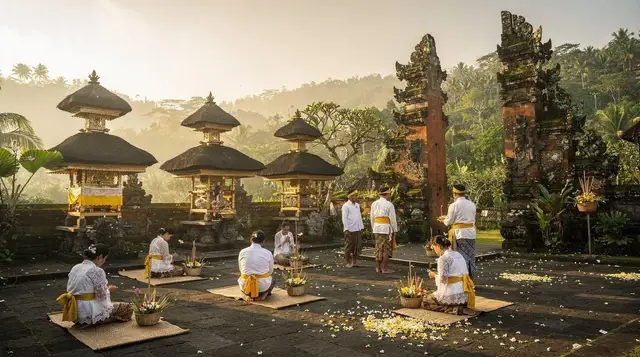
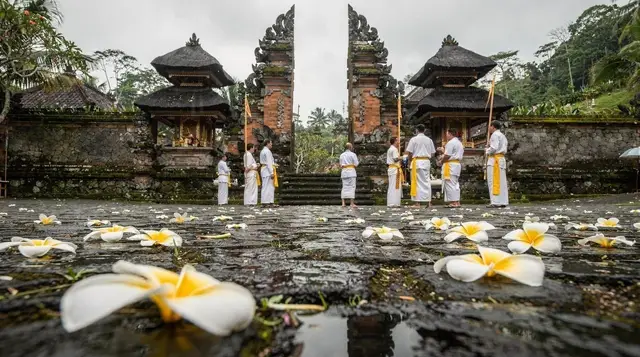
At the centre of Besakih sits Pura Penataran Agung, the largest and most visually dominant of the complex’s temples, built across a series of ascending terraced courtyards connected by candi bentar split gateways, climbing directly toward the mountain. Around and below it, the remaining temples in the complex are historically associated with different Balinese clans, castes, and regional groups, each maintaining its own smaller shrine within the wider sacred landscape.
Most visitors see only a fraction of the full complex — access to many of the smaller temples is restricted to their associated worshipping communities rather than open to general visitors — but the Penataran Agung’s terraces alone give a genuine sense of the site’s scale and significance.
Why Besakih sits at the top of the hierarchy
Traditional Balinese Hindu cosmology organises temples into a structured hierarchy based on their scope of worship — household shrines, then banjar (neighbourhood) temples, then desa (village) temples, and so on up to temples with island-wide significance. Besakih occupies the top tier of this structure, conceptually connected to every temple below it regardless of how far away or how small. This is why some of the largest and most heavily attended ceremonies in the Balinese Hindu calendar happen here rather than at a single congregation’s local temple — Besakih functions as a shared spiritual anchor for the whole island’s Hindu population, not a parish temple serving one community.
The meru towers and what their tiers mean
The tiered, black-thatched meru towers are Besakih’s most visually distinctive architectural feature, and the number of tiers on each one is not decorative — it signals the relative significance of the deity honoured at that particular shrine, with the highest tier counts reserved for the most important. Recognising this pattern at Besakih gives a useful reference point for understanding the same architectural language at smaller temples elsewhere on the island, where the same tiered-roof logic applies at a smaller scale. Very little of this is explained through on-site signage, which is part of why a guide with genuine architectural knowledge, rather than simply someone working the car park, adds real value here.
Besakih’s role in the annual ceremony calendar
Besakih hosts some of the largest annual ceremonies in Balinese Hinduism, drawing worshippers from across the island rather than a single local congregation, and access to certain courtyards can be restricted or the atmosphere considerably more intense during these periods compared with an ordinary day. If your trip happens to coincide with one of these major ceremony dates, either by planning or coincidence, the visit becomes a genuinely different experience — busier, more devotional, and less oriented around casual sightseeing. The Balinese ceremonies guide covers what to expect if you find yourself visiting during one of these periods.
Visiting as part of an organised tour
Given the complex’s scale and the well-documented guide-fee pressure at the entrance, many first-time visitors find an organised tour the more straightforward way to see Besakih properly. The Besakih Great Temple tour with a waterfall and rice terrace stop pairs the temple with two other East Bali staples in a single coordinated day, while the Eastern Bali and Pura Besakih temple tour takes a broader look at the wider region around the complex.
Climbing Mount Agung via Besakih
Besakih also functions as one of the starting points for treks up Mount Agung, Bali’s highest and most sacred volcano, which rises directly behind the temple complex. This is a serious undertaking rather than a casual add-on to a temple visit — it is a genuine predawn summit trek requiring real fitness — but for travellers specifically interested in combining the mountain and the temple, a guided Mount Agung sunrise trekking tour via Besakih Temple is the standard way to do both. See the Mount Agung trek guide for the detail on what the climb itself demands.
A quieter alternative combination
For travellers who want to pair Besakih with a different kind of East Bali stop than the standard Lempuyang-and-Tirta-Gangga loop, a route combining the complex with Pura Kehen and the Toyo Bulan waterfall offers a somewhat quieter alternative, covered by the Pura Kehen, Toyo Bulan waterfall and Besakih Temple tour. It trades some of the more famous stops for a lower-key day, which suits travellers who have already done the classic East Bali temple circuit on a previous visit or simply prefer smaller crowds.
The pilgrimage route and how Balinese worshippers use the site
Unlike a tourist attraction designed around a single viewing experience, Besakih is built around movement — worshippers travel between the complex’s various temples as part of an ongoing pilgrimage practice, carrying offerings from one shrine to the next depending on their clan affiliation and the specific ceremony being observed.
Watching this movement, if you happen to visit while worshippers are present, gives a far better sense of how the complex actually functions than a static description of its layout ever could. It is worth remembering, while observing, that this is someone else’s active religious practice rather than a performance staged for visitors, and treating it with the same quiet respect you would extend to any place of active worship elsewhere in the world.
A note on Besakih’s history and rebuilding
Besakih’s structures, like many Balinese temples, have been rebuilt and restored repeatedly over centuries, following damage from earthquakes and, notably, a major volcanic eruption of Mount Agung in the 1960s that came close to the complex without destroying its core structures — an event still referenced in some local accounts of the temple’s resilience. This history of restoration is part of why the site should be understood as a living, continuously maintained place of worship rather than an untouched ancient ruin, a distinction worth keeping in mind if you arrive expecting the kind of static archaeological site found elsewhere in Southeast Asia.
What isn’t worth the detour
Do not attempt to see every one of the complex’s twenty-plus individual temples in one visit; most are not open to general visitors, and chasing a complete tour adds walking time for little additional insight beyond the main Penataran Agung terraces. It is also not worth engaging at length with unofficial guides pressuring you at the car park entrance — buy your ticket at the official booth and treat further approaches with polite firmness, as covered in more practical detail on the Besakih destination page.
Understanding the complex without a guide
For independent travellers who prefer to skip a guided tour, some basic preparation goes a long way toward appreciating Besakih’s layout without local narration. Knowing in advance that the Penataran Agung is the central, largest temple; that the meru tower tiers signal relative importance; and that most non-Hindu visitors see the site from outer terraces rather than inner sanctums, covers the core context that a guide would otherwise provide, letting you focus on absorbing the atmosphere and architecture at your own pace.
How this fits into a longer East Bali trip
Besakih works best as part of a dedicated East Bali day rather than a rushed stand-alone stop, paired naturally with Mount Agung, Tirta Gangga, and Sidemen on the same route. The East Bali, 4 days itinerary threads all of these together without the backtracking that catches a lot of self-planned trips.
Before you go, read the Bali temple etiquette guide, and if your route also includes Lempuyang or Tirta Empul, the Lempuyang Gates of Heaven guide and the Tirta Empul purification ritual guide cover East Bali’s other major temple stops.
Is Besakih worth visiting if I have limited time in East Bali?
If you can only choose one East Bali temple stop, Besakih is a reasonable default given its unmatched significance within the island’s temple hierarchy, though Lempuyang and Tirta Empul offer more specific single-image or ritual experiences if that is more your priority.
Frequently asked questions about Besakih Mother Temple
Is Besakih the most important temple in Bali?
In terms of the island’s traditional temple hierarchy, yes — it sits at the top, conceptually connected to every other temple on the island. Other temples, like Tanah Lot and Uluwatu, hold significance as part of the coastal sea-temple network but do not occupy the same hierarchical position.
How many of Besakih’s temples can I actually visit?
Most visitors see the central Penataran Agung’s terraces and a handful of the more accessible surrounding temples; many of the smaller temples within the complex are restricted to their associated worshipping communities rather than open to general tourism.
Do I need a guide to understand the site properly?
Not strictly, but a knowledgeable guide adds real value given how little on-site signage explains the architecture and hierarchy. Some preparation beforehand can substitute for this if you prefer an independent visit.
Is Besakih affected by Mount Agung’s volcanic activity?
The temple sits on the volcano’s flank, and access can be affected during periods of elevated volcanic activity. Check current conditions before travelling if Agung has been active recently.
How does Besakih compare to Lempuyang for photography?
Besakih is less about a single iconic photo composition and more about scale and atmosphere across a large terraced complex, whereas Lempuyang is known for one specific, heavily queued viewpoint. Both are worth visiting for different reasons rather than as substitutes for each other.
Can I combine a Besakih visit with climbing Mount Agung?
Yes, some guided treks use Besakih as a starting point for a Mount Agung summit attempt, though this is a serious undertaking requiring real fitness and preparation, not a casual add-on to a standard temple visit.
What is the best time of day to visit Besakih?
Early morning, both for cooler temperatures on the terraces and for the best chance of a clear view of Mount Agung before cloud typically builds later in the day.
Temple & culture tours on GetYourGuide
Verified deep-linked GetYourGuide tours. Book through these links and we earn a small commission at no cost to you.
These are our own photographs of Bali, not the operator's pictures of this tour — open the tour page to see those.