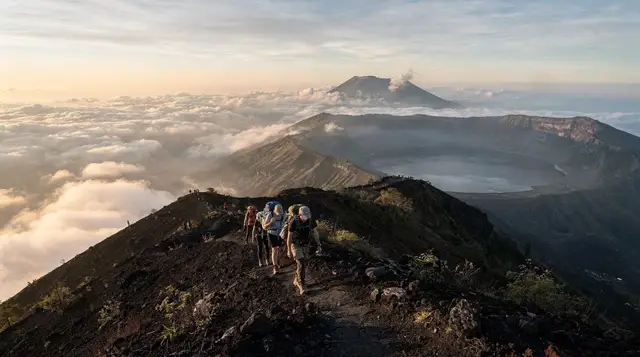
Mount Agung is Bali’s highest point and, in the traditional Balinese cosmology, the most sacred: it is considered the abode of the gods and the spiritual axis around which the island’s orientation is built, which is part of why Besakih temple sits directly on its slopes. It is also an active volcano with a documented history of eruptions, including a period of unrest in the late 2010s that closed the mountain and the surrounding area to climbers for an extended stretch. Both of those facts should shape how you plan a visit far more than most trip-planning content admits.
Compared with Mount Batur, the sunrise trek that has become something close to a checklist activity for first-time visitors to Bali, Agung is a different proposition entirely. It is taller, the trail is steeper and longer, the terrain is rougher and more exposed in places, and a certified local guide is not optional — it is required, both by convention and increasingly by regulation given the mountain’s sacred status and volcanic activity. If you are choosing between the two purely on the basis of “which sunrise hike should I do,” Agung is the answer only if you have genuine hiking fitness and want something harder than a photogenic checklist item.
There is also a religious dimension that deserves respect beyond a safety note. Certain routes and periods of access can be restricted around major ceremonies at Besakih and elsewhere on the mountain, since summiting during some of these periods is considered inappropriate. A reputable local guide will know the current status and will not take you up during a restricted period; treat any operator who seems vague on this as a red flag rather than a minor detail.
Mount Agung at a glance
| Where | East Bali, rising directly above Besakih temple and the Rendang/Selat area |
| Cost | Guide fee (mandatory), transport, and typically a packed breakfast; multi-day camping options cost more |
| Time needed | A pre-dawn start (climbing begins in the middle of the night to reach the summit for sunrise) through to mid-morning descent for the standard route; two-day options add an overnight camp |
| Access | Guided trek only — solo climbing is neither advisable nor, on the routes that matter, realistically possible to arrange |
| Best time | Dry season, April to October; always confirm current access status given the volcano’s activity and ceremonial calendar |
Why the trek starts in the middle of the night
Like Bali’s other sunrise volcano treks, Agung’s standard route begins hours before dawn, typically from a village on the mountain’s flank, so that climbers reach the summit or a high viewpoint as the sun comes up over the eastern horizon, often with Mount Rinjani visible across the strait on a clear morning. The appeal is real — a sunrise from Bali’s highest point, above the cloud line more often than not, is a genuinely different experience from a lowland sunrise. The cost is a night with little or no sleep and a climb undertaken in the dark and cold, which catches out more travellers than any other single factor on this route.
The 2017–2019 eruptions, in context
Agung’s most recent significant period of volcanic unrest ran from late in one year through the following two, prompting evacuations of surrounding villages and a full closure of climbing access for an extended period. It is a useful data point for how seriously to take current advisories: this is not a dormant tourist-brochure volcano, and the closures were not overcautious theatre — they reflected genuine, monitored risk. The mountain has since reopened to climbers under normal conditions, but the episode is worth knowing about specifically because it explains why reputable operators are cautious and quick to pause trips when monitoring agencies raise the alert level, rather than pushing ahead regardless of a booking calendar.
Choosing a route and a guide
Several villages on Agung’s flanks serve as trailheads, and the specific route matters for both difficulty and the views on offer. A trek like the summit trek via the Edelweiss trail is one of the more established options, named for the wild edelweiss flowers found at altitude along the way. Others route through or near Besakih itself, such as the sunrise trek via Besakih temple, which combines the climb with a pass by the mother temple’s lower grounds.
For travellers who want the experience without an extreme pre-dawn slog, some operators offer a gentler pacing with a more relaxed start, like the sunrise hiking package with an experienced local guide — worth asking about directly if you are uncertain about your fitness level, since “sunrise trek” covers a wide range of actual difficulty depending on operator and route.
The multi-day option
For travellers who would rather not do the climb as a single brutal overnight push, a two-day version with a camp partway up spreads the effort out and adds a more contemplative, less rushed pace, closer to what a mountain of Agung’s cultural significance arguably deserves. The two-day sacred climb and camping trek is built around exactly this idea — a slower ascent, a night on the mountain, and a summit push the following morning rather than one continuous overnight slog. It costs more and requires an extra day in your itinerary, but for anyone who has struggled with an overnight sunrise trek elsewhere, it is worth the trade.
Physical demands, honestly
Expect a climb of many hours in each direction, on a trail that alternates between packed earth, tree roots, and increasingly loose volcanic gravel and rock as you gain altitude, with a genuinely steep final push to the summit ridge. Altitude itself is not extreme by global mountaineering standards, but combined with the physical exertion, the cold, and the early-hours timing, it adds up to a trek that regularly causes less-prepared climbers to turn back before the top. Guides are generally patient and will adjust pace, but they cannot substitute for a baseline level of fitness you should have built before arriving in Bali, not during the climb itself.
What isn’t worth the detour
Skip any tour advertising Agung as suitable for beginners or families — it genuinely isn’t, and operators who market it that way are either downplaying the difficulty or routing you to a much shorter, lower viewpoint rather than the true summit. Also skip attempting the climb without a guide to save money; beyond the safety and route-finding issues, this is one of the few treks in Bali where going without a licensed local guide is both genuinely risky and, in practice, difficult to arrange at the trailheads that matter.
Guide etiquette and tipping
Balinese trekking guides on Agung typically work in small teams, sometimes with a lead guide and one or two support staff carrying food and water for the group, especially on the two-day camping route. Tipping at the end of the trek is customary and appreciated, separate from whatever fee you paid to book — treat it the way you would tip a mountain guide anywhere else in the world, scaled to what you can reasonably afford rather than a fixed rule. Many guides also double as informal cultural interpreters for the mountain’s significance, and asking questions along the way, rather than treating the climb purely as a physical challenge, tends to make for a noticeably better experience.
What it costs
A standard guided sunrise trek costs meaningfully more than the equivalent Batur climb, reflecting the longer route, the more experienced guiding required, and the smaller group sizes typical of Agung tours compared with Batur’s larger operations. The two-day camping version costs more again, given the additional guide time, camping equipment, and food. Across all options, transport to and from your accommodation is usually included, but tipping your guide at the end is customary and worth budgeting separately.
When to go
Dry season, roughly April through October, is by far the more sensible window — wet-season trails on Agung’s steep, loose upper slopes become genuinely hazardous, not just uncomfortable. Beyond seasonal weather, always check current access status directly with a reputable operator before committing to dates. Volcanic activity has closed the mountain to climbers before and can do so again with limited notice, and ceremonial periods around Besakih can also restrict specific routes even when the volcano itself is calm.
Getting there and getting around
Trailhead villages sit on Agung’s slopes in East Bali, a long transfer from the southern resort areas — most guided treks include hotel pickup in the very early hours (often close to midnight) to reach the trailhead in time for a summit sunrise. There is no independent public transport option that makes sense here; every reputable route to the summit runs through a licensed local guide and organised transport, which is as much about respecting the mountain’s status as it is about safety.
How Mount Agung fits into a longer trip
Because of the early start and the physical toll, most travellers treat their Agung trek day as a standalone day with minimal other plans either side of it — expect to want an easy, low-key day immediately after. If you are building a wider East Bali itinerary, the Mount Agung trek guide and the what to pack for a volcano trek guide are worth reading well before booking. For comparison against Bali and Lombok’s other major sunrise climbs, see Batur vs Agung vs Rinjani.
Pair the trek with a quieter recovery day at Besakih, Tirta Gangga, or Sidemen rather than another physically demanding activity, and check the East Bali, 4 days itinerary for how to sequence a summit day with the region’s slower stops.
Frequently asked questions about Mount Agung
Do I really need a guide, or can I hike Agung independently?
Yes, a licensed local guide is required in practice — trailhead access, route-finding through genuinely difficult volcanic terrain, and respect for ceremonial restrictions near Besakih all depend on it. This is not a mountain to treat as an independent hike.
How does the fitness level compare to Mount Batur?
Meaningfully harder. Batur suits most reasonably fit travellers with no hiking background; Agung suits people who hike regularly or who are prepared for a genuinely strenuous, multi-hour scramble on loose volcanic scree in the dark.
What happens if the mountain is closed when I want to go?
Closures happen periodically due to volcanic activity or ceremonial restrictions. A reputable operator will tell you honestly if access is currently restricted rather than taking your booking regardless — check directly before finalising plans, especially if Agung has shown any recent activity.
Is the two-day camping option worth the extra cost?
For most people without serious hiking experience, yes. Spreading the ascent over two days with an overnight camp is dramatically less punishing than the single overnight push, and it makes the experience feel more like the significant undertaking it actually is.
What should I pack?
Warm layers for the pre-dawn cold at altitude, proper closed hiking shoes with grip, a headtorch, and more water than you think you need. See the dedicated volcano-trek packing guide linked above for a fuller list.
Can I see Mount Rinjani from the summit?
On a clear morning, yes — Rinjani across the Lombok Strait is one of the more striking sights from Agung’s summit, alongside views back down over East Bali and, cloud cover permitting, Mount Batur to the northwest.
Is climbing Agung disrespectful to Balinese Hindu beliefs?
Not inherently, provided you go with a licensed local guide who respects current restrictions and you behave with basic reverence given the mountain’s sacred status — this isn’t just a scenic hike to Balinese Hindus, and treating it that way, loudly or dismissively, will be noticed.
How far in advance should I book?
Book at least a few days ahead where possible, since group sizes are kept small and guides need to check current conditions and any ceremonial restrictions before confirming a date. Last-minute bookings are sometimes possible but limit your choice of route and operator.
Is there phone signal or safety infrastructure on the mountain?
Coverage is inconsistent to non-existent for much of the route, which is another reason a licensed guide with proper local knowledge and emergency procedures matters more here than on more heavily trafficked, infrastructure-backed hikes elsewhere in Bali.