Jungle Trekking in Bali: Beyond the Rice Terrace Walks
Is Bali good for jungle trekking, or is it mostly rice terrace walks?
Both exist, and they're genuinely different experiences. Rice terrace walks like Tegalalang or Campuhan Ridge are open, gentle, and largely flat. Real jungle trekking around Ubud involves denser forest, river crossings, and often waterfalls, and ranges from independent walking trails to guided ATV routes that cover more ground with less physical effort. Knowing which kind you want before booking avoids a mismatch between expectations and what you actually get.
“Jungle trekking” gets applied loosely to a lot of Bali’s Ubud-area activities, and it’s worth separating what actually fits the description from what’s really a rice terrace walk with better marketing. Tegalalang’s valley paths and the Campuhan Ridge Walk are genuinely pleasant, but they’re open, largely gentle terrain, not dense jungle. Real jungle trekking around Ubud — thick forest canopy, river crossings, waterfalls reached only by walking or riding through genuinely rough terrain — is a different category, and it comes in two broad forms: guided walking treks on foot, and ATV or quad bike routes that cover more ground through the same terrain with a vehicle doing most of the physical work.
Both are legitimate ways to experience Bali’s jungle interior, and which suits you depends on what you’re after. Walking treks are slower, quieter, and let you actually notice the forest — birdlife, plant life, the sound of water before you see it. ATV and quad routes trade that quiet for speed and a different kind of adrenaline, splashing through rivers and mud tracks that would take considerably longer and more effort on foot, and they’re a genuinely popular choice for visitors who want the jungle scenery without a multi-hour hike.
Neither form of jungle trekking here compares in scale to somewhere like East Java’s more remote forest treks, and that’s fine — Bali’s version is accessible, generally half a day or less, and doesn’t require the kind of preparation a genuine multi-day wilderness trek would. It’s adventure activity packaged for a holiday, not an expedition, and going in with that framing sets the right expectations.
Bali jungle trekking at a glance
| Where | Concentrated around Ubud’s surrounding countryside and river valleys |
| Cost | Guided walking treks and ATV/quad tours are priced separately, with vehicle-based tours generally costing more |
| Time needed | Half a day for most guided options |
| Access | Scooter, Grab, or private driver to the starting point; tours often include pickup |
| Best time | Morning for cooler conditions; dry season for easier, safer river crossings |
Walking treks vs ATV routes
The clearest way to think about the choice is physical effort versus ground covered. A walking trek moves slower and covers less distance, but it’s quieter and gives you more time to actually take in the forest rather than focusing on driving. An ATV or quad route covers considerably more ground in the same amount of time, splashing through rivers and mud tracks that would be a genuine slog on foot, at the cost of the noise and focus required to actually drive the vehicle rather than just look around.
Neither is objectively better — a family with young children or anyone wanting a calmer, more contemplative activity is usually better served by a walking trek, while anyone chasing adrenaline and a broader sense of the terrain in a shorter window tends to prefer the vehicle-based option.
The ATV and quad bike routes
Bali’s Ubud-area ATV routes are genuinely popular, and for good reason — they combine river crossings, jungle tracks, and often a waterfall stop into a single, accessible half-day activity that doesn’t require prior riding experience given the guided, low-speed nature of most tours.
A quad bike tour through Ubud’s jungles, rivers, waterfalls, and caves covers a genuinely varied cross-section of terrain in a single trip, while an ATV adventure combining a jungle swing with Poh Gading waterfall pairs the muddy, river-crossing thrill of the ride with a stop at one of the area’s smaller, lesser-known waterfalls.
Buggy tours: a middle ground
For those wanting more ground coverage than walking but a bit more comfort and less physical involvement than an ATV, buggy tours offer a genuine middle option. An ultimate Ubud buggy jungle waterfall adventure covers similar terrain to the ATV routes — rivers, jungle tracks, and a waterfall stop — from within a more enclosed, side-by-side vehicle rather than an exposed quad bike, which some visitors find both more comfortable and less physically demanding while still delivering the same sense of covering rugged terrain quickly.
Combining jungle activities with a calmer stop
Because both ATV and buggy routes are physically involved, several tours balance the adrenaline with a calmer stop, typically a waterfall or rice terrace, built into the same day. A combined tour covering Ubud’s waterfalls, a jungle swing, and a rice terrace is a practical example of this format, mixing an active jungle component with the calmer, more photogenic stops most visitors also want from an Ubud day.
Caves along the jungle routes
Some of the longer ATV and quad routes pass close to or through small cave systems carved into the volcanic rock beneath Ubud’s countryside, adding another dimension beyond the river crossings and jungle canopy that define most of these tours. These aren’t extensive cave networks requiring specialised caving equipment — more short, guided passages that add variety to an already varied route — but they’re worth knowing about if underground exploration is something that appeals to you, since not every operator’s route includes this element.
Checking the specific itinerary of a tour before booking is worth doing if a cave stop specifically matters to you, since routes vary enough between operators that not all of them include this feature even within the same general Ubud area.
What the terrain actually feels like
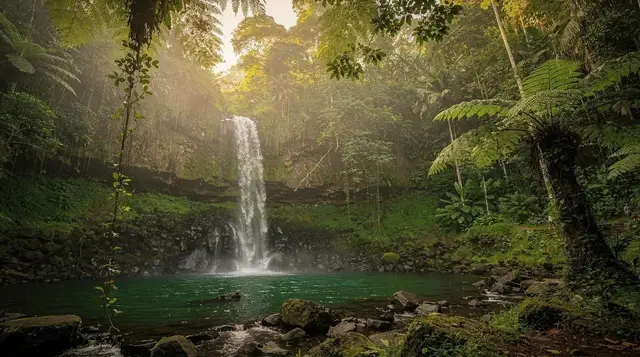
Unlike a groomed hiking trail, Bali’s jungle routes — whether walked or ridden — tend to alternate between dense, shaded canopy sections where little direct light reaches the ground, and more open river crossings where the vegetation briefly clears. This alternation is part of what makes the experience feel genuinely varied rather than a single uniform environment, and it’s also why conditions underfoot (or under wheel) shift constantly rather than settling into one predictable surface. Mud, loose rock, shallow water, and the occasional root system all feature within a single short route, which is part of the appeal for those seeking a more textured outdoor experience than a paved rice terrace path offers.
What isn’t worth the detour
Skip booking a “jungle trekking” tour without confirming whether it’s actually a walking trek or a vehicle-based route — the marketing language often blurs this distinction, and arriving expecting a quiet nature walk only to find yourself strapped into an ATV, or vice versa, is a genuinely common mismatch that a quick question to the operator avoids entirely. It’s also not worth choosing the most physically demanding option available if your group includes anyone with limited fitness or mobility concerns; ask specifically about terrain difficulty rather than assuming all jungle activities are calibrated for a general audience.
What to wear and bring
Clothes and shoes you don’t mind getting genuinely dirty are the baseline for any ATV, quad, or buggy route, given how central mud and water crossings are to the experience. Closed shoes are worth wearing rather than sandals, both for the vehicle-based tours and for walking treks, given uneven and sometimes slippery footing throughout. A change of clothes left with your driver or at your accommodation is a sensible piece of planning if you’re heading elsewhere afterward, since arriving at a restaurant or another activity covered in mud isn’t an unusual outcome of a good jungle trekking day.
For walking treks specifically, standard hiking essentials apply: water, sun protection for any open sections, and insect repellent given the denser vegetation these routes pass through compared to the more open rice terrace walks closer to central Ubud.
What it costs
Walking treks with a guide are generally the more affordable option, priced similarly to other half-day guided walks around Ubud. ATV, quad, and buggy tours cost more, reflecting the vehicle, fuel, and safety equipment involved, with buggy tours typically priced above ATV routes given the more substantial vehicle. Combined tours that add a waterfall or rice terrace stop to a jungle activity are priced as a package covering the full day rather than each element separately.
When to go
Morning is the best window for any jungle trekking activity, both for cooler, more comfortable conditions and to avoid the worst of any afternoon rain that can make river crossings and muddy tracks considerably more difficult. The dry season, roughly April to October, keeps trail and river conditions more predictable and generally safer for both walking treks and vehicle-based routes, though the ATV and buggy tours specifically are partly built around the mud and water crossings, so a bit of wet-season adventure is part of the appeal for some visitors rather than something to avoid entirely.
Getting there and getting around
Most jungle trekking and ATV/buggy operators are based a short drive from central Ubud, with pickup commonly included as part of an organised tour booking. If you’re arranging transport independently, a scooter or Grab is sufficient to reach most starting points, though confirming the exact location in advance is worth doing given that some sites sit down less obvious side roads.
How this fits into a longer trip
Jungle trekking activities fit naturally into a broader Ubud stay, and pair well with a calmer day covering Tegalalang or the Campuhan Ridge Walk if you want to balance an active day with a quieter one. The Bali ATV and quad guide covers the vehicle-based side of this activity in more depth, while the Ayung River rafting guide is worth checking if you want a water-based alternative to jungle trekking on the same trip.
For a broader look at Bali’s waterfalls, many of which are reached via jungle trekking routes, the best waterfalls in Bali guide is a useful companion to this page. Travellers planning a longer, adventure-focused stay should also look at the Bali canyoning guide for another physically active option in a similar part of the island.
Frequently asked questions about Jungle Trekking in Bali
Is jungle trekking in Bali suitable for beginners with no hiking experience?
Yes, most guided options, whether walking treks or ATV routes, are designed for a general audience without prior experience. Guides set the pace and handle navigation, so previous trekking experience isn’t a prerequisite for most tours.
What’s the difference between an ATV tour and a buggy tour?
An ATV or quad bike is a single-rider vehicle you drive yourself, more exposed to mud and water splashing directly. A buggy is a larger, more enclosed side-by-side vehicle, generally more comfortable and slightly less physically demanding while covering similar terrain.
Do I need a driving licence for the ATV tours?
Most operators don’t require a formal licence for their guided ATV routes, since they operate at controlled, low speeds with guide supervision, but it’s worth confirming specific requirements with the operator you book, since policies can vary.
Will I get muddy or wet on these tours?
Almost certainly, particularly on ATV and buggy routes that specifically cross rivers and muddy jungle tracks as part of the experience. Dress accordingly and don’t wear anything you’d be upset to get dirty.
Are walking jungle treks safer than ATV tours?
Both are reasonably safe with a reputable operator and standard precautions, though they carry different risk profiles — walking treks involve slips on uneven terrain, while ATV tours carry vehicle-related risks that a safety briefing and helmet use are designed to mitigate.
Can I combine jungle trekking with a visit to a waterfall?
Yes, many tours explicitly combine the two, since several of Ubud’s smaller, lesser-known waterfalls are reached via jungle tracks that suit either a walking or vehicle-based approach as part of the same outing.
How physically demanding are these activities really?
It varies significantly by specific tour, from gentle, short walking treks manageable for most visitors to more demanding routes with real distance and terrain difficulty. Asking the operator directly about difficulty level before booking is the most reliable way to match the activity to your fitness and preferences.
Waterfall & hiking tours on GetYourGuide
Verified deep-linked GetYourGuide tours. Book through these links and we earn a small commission at no cost to you.
These are our own photographs of Bali, not the operator's pictures of this tour — open the tour page to see those.