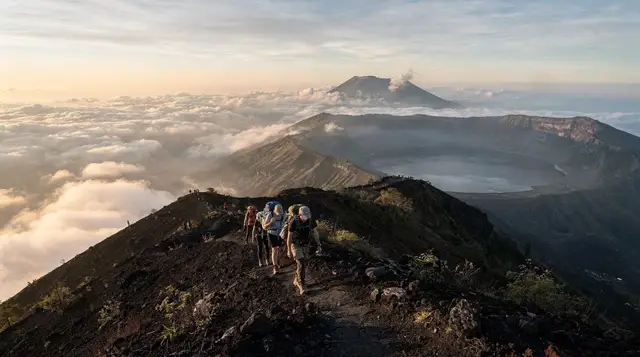
Kintamani is less a single place than a name attached to the string of villages strung along the rim of an ancient caldera in central Bali, with Lake Batur and the still-active Mount Batur cone sitting inside it. Most visitors arrive for one reason: the view down into the caldera, usually from one of a handful of restaurants and lookout terraces that line the ridge road. That view is real and, on a clear morning, one of the better panoramas on the island. It is also one of the most heavily coach-toured stops in Bali, which changes the experience in ways worth knowing before you go.
The area sits noticeably higher and cooler than the coast, which is part of the appeal in its own right. After days of sticky heat in Kuta or Canggu, the drop in temperature on the drive up is often the first thing visitors notice, well before the caldera comes into view. That cooler climate is also why this stretch of highland has long supported coffee growing, citrus orchards, and vegetable farming, giving Kintamani a working agricultural identity underneath the tourist stops.
The honest version of Kintamani is a mixed one. The caldera view can be spectacular or a wall of white cloud, the restaurant buffets along the ridge range from decent to overpriced and mediocre, and the road itself gets clogged with tour buses at predictable hours. None of that makes it not worth doing. It means the difference between a good visit and a forgettable one comes down almost entirely to when you go and what you expect once you arrive.
Kintamani at a glance
| Where | Caldera rim above Lake Batur and Mount Batur, central Bali |
| Cost | Free to view from public pull-offs; restaurant terraces with the best views usually require a meal purchase |
| Time needed | A couple of hours for the viewpoint and a village stop, more if combined with Batur or Ubud |
| Access | Self-drive scooter, private driver, or an organised day tour from South Bali or Ubud |
| Best time | Early morning, dry season, before cloud typically rolls in over the caldera |
Why the caldera view is the whole point
Lake Batur sits inside a much older, much larger caldera formed by a prehistoric eruption, with the younger, still-active Batur cone rising from its floor. The scale of this is hard to grasp from photos alone: the outer rim you are standing on when you look down at the lake is itself the remnant of a volcano that would once have dwarfed the one still smoking inside it. Understanding that layered geology makes the view read differently than a generic mountain lake vista, and it is worth having in mind before you arrive rather than reading a plaque afterwards.
Cloud cover is the single biggest variable. Central Bali’s highlands cloud over from around mid-morning for much of the year, and by early afternoon it is common for the lake to disappear behind white haze entirely. If the view itself is your priority rather than the drive or the food, treat “early morning” as a hard rule rather than a suggestion.
The buffet-restaurant strip, and why it has a poor reputation
A row of large restaurants lines the ridge road specifically to capture the caldera view, most running a fixed-price buffet lunch. This arrangement has a mixed reputation among travellers, and for reasonable cause: food quality is inconsistent, prices at the better-positioned restaurants run higher than the food alone would justify, and the pace can feel rushed when several coach groups arrive at once. You are, in effect, paying an admission fee dressed up as a meal.
If you would rather skip the buffet gamble entirely, several tours route through Kintamani’s viewpoints without anchoring the day around a set-menu lunch. The Kintamani and Ubud tour built around the volcano overlook is one option that pairs the caldera view with Ubud stops rather than a long restaurant sit-down.
Beyond the viewpoint: villages, temples and orchards
Kintamani’s identity runs deeper than the lookout strip if you give it time. Kehen Temple, on terraced steps shaded by a large banyan tree, is a quieter alternative to the coastal temples further south and rarely sees the same crowds. Nearby citrus and coffee smallholdings give a genuine look at the highland agriculture that supports the area economically, well away from any restaurant terrace.
A tour such as the Kehen Temple and orange farm experience around Kintamani covers this quieter side of the area directly, and is a reasonable way to balance out a day that would otherwise be entirely about the caldera view and lunch. It gives a sense of Kintamani as a place people actually live and farm, not just a scenic pull-off.
Coffee, and separating the genuine from the staged
Central Bali’s cooler highlands, including the slopes around Kintamani, produce a meaningful share of the island’s coffee, and roadside coffee stops are common on the route up from the south. Some of these are straightforward working plantations offering tastings; others are set up primarily as tourist stops with a heavy sales pitch, particularly around the more expensive civet-processed coffee. It is worth reading the Bali coffee and luwak truth guide before booking anything coffee-focused, since the ethics and authenticity of that particular product vary a great deal between operators.
Jeeps, waterfalls and a rougher side of the caldera
For travellers who want more than a scenic drive-by, 4WD jeep routes drop down from the rim toward lesser-visited corners of the caldera, including waterfalls that are not accessible by an ordinary car. The Kintamani 4WD jeep route to Goa Rang Reng waterfall is a way to see a rougher, less photographed side of the area than the ridge-road view most visitors settle for.
This kind of route suits travellers who already have a Batur sunrise trek or caldera viewpoint under their belt and want something with more texture on a return visit, rather than a first stop in the area.
Rice terraces and a lower-key alternative to the coach strip
Not every stop in the Kintamani area is about the caldera. A short distance from the main ridge, working rice terraces and quieter cafés offer a version of the “view with a coffee” experience without the buffet-hall crowds. A tour like the Kintamani cafe, rice terrace and Penglipuran village tour threads this quieter route together with a stop at Penglipuran, a well-preserved traditional village known for its uniform stone-walled lanes.
This combination works well for travellers who found Tegalalang’s rice terraces near Ubud too crowded and want a similar landscape with fewer people around it.
Kintamani vs a Batur sunrise trek
These two are often confused because they cover the same caldera, but they are genuinely different experiences and it is worth being clear about which one you actually want.
| Kintamani viewpoint | Mount Batur sunrise trek | |
|---|---|---|
| Start time | Mid-morning is typical | Well before dawn, in the dark |
| Physical effort | Minimal, mostly a scenic drive | A real uphill hike, several hours round trip |
| What you get | A view down into the caldera | A view from inside it, at the summit |
| Best for | Travellers who want scenery without exertion | Travellers wanting an active, memorable trek |
If you are weighing the two, the Mount Batur sunrise trek guide covers what the hike actually involves in far more detail than a caldera-rim lunch stop ever will.
Photography timing beyond the sunrise-or-nothing myth
Unlike a summit trek, Kintamani does not demand an alarm before dawn to get a worthwhile photograph. The clearest window tends to run from early morning through to roughly mid-morning, before cloud typically builds over the caldera, which gives a more relaxed timeline than a headtorch hike up Batur itself. That said, the light quality still shifts meaningfully across that window: the softer, angled light shortly after sunrise generally reads better in photographs of the terraced hillsides and lake than the flatter light of late morning, even on an equally clear day.
Cloud patterns here are also worth understanding rather than treating as pure luck. Because the caldera sits in a bowl surrounded by higher terrain, moisture tends to accumulate and rise through the morning, meaning a completely clear dawn can still cloud over within a couple of hours. Checking conditions from a viewpoint partway up, if your route passes one, before committing to the final drive can save a wasted trip on a day when the upper caldera is socked in even though the coast was clear when you set out.
Comparing a day tour to a self-drive visit
Travellers weighing whether to book an organised tour or drive up independently should weigh a few genuinely different trade-offs rather than assuming one is simply better. A self-drive visit offers more control over timing, letting you leave earlier or linger longer at a specific viewpoint without a group schedule to keep to. An organised tour, on the other hand, removes the parking and route-finding stress along the ridge road, and typically bundles in stops, like the rice terrace and village combinations mentioned above, that would take real extra planning to arrange independently.
For a first visit to the area, particularly if you are not confident navigating winding mountain roads or negotiating parking near the busiest viewpoints, the organised route tends to deliver a smoother morning. Return visitors who already know the area sometimes prefer the flexibility of self-driving, especially if they have a specific quieter viewpoint in mind rather than the standard ridge-road stops.
What isn’t worth the detour
The souvenir stalls clustered around the main viewpoints sell largely generic items at prices pitched at tour-bus visitors rather than locals, and there is little here you will not find cheaper elsewhere on the island. Similarly, skip any coffee stop that pressures you into buying the most expensive civet variety on the spot rather than letting you taste and decide; a stop that pushes hard on one specific, costly item rather than offering a genuine tasting is optimising for a sale, not for your interest in coffee. If your schedule is tight, a rushed thirty-minute stop purely for photos at a crowded midday viewpoint is arguably not worth the drive at all — the view needs clear morning air to earn the trip.
What it costs
Public viewpoints along the ridge road are generally free to pull off at, though the restaurants that command the best vantage points expect a meal purchase in exchange for their terrace seating, and that buffet price sits well above what the food alone would cost elsewhere. Temple entry at Kehen is a modest fee, and coffee tastings at genuine plantations are usually free or low-cost, with any purchase entirely optional despite the sales pressure some stops apply. Transport is the larger cost variable: a private driver or organised tour for a half or full day will run more than solo scooter fuel, but removes the parking and coach-timing headaches that come with self-driving the ridge road during peak hours.
When to go
Dry season, roughly April through October, gives the most reliable chance of a clear caldera view, and within any given day, morning consistently beats afternoon because cloud tends to build over the highlands as the day warms. The wet season from November to March brings short, heavy afternoon downpours rather than all-day rain, so a wet-season morning visit is still often workable, just less predictable than a dry-season one. Avoid arriving in the tightest window of coach-tour traffic, typically mid to late morning, if crowd levels bother you more than losing the earliest light.
Getting there and getting around
Kintamani sits on the caldera rim in central Bali, reached by a winding uphill road from either the south coast or from Ubud, with the drive from Ubud considerably shorter than from Kuta, Seminyak, or Canggu. There is no public transport serving the area in any way useful to tourists, so this is scooter, private driver, or organised tour territory, and the road itself narrows and curves enough on the final approach that first-time scooter riders should not underestimate it. Given the coach congestion at peak times and the navigation involved in finding a good, fairly priced viewpoint rather than the first one you pass, most first-time visitors get more out of a private driver or tour than a solo trip.
How this fits into a longer trip
Kintamani works naturally as a half-day add-on to an Ubud-based stay, or as one stop within a longer central Bali loop. If you are staying around Ubud, the Ubud day trip from South Bali guide covers how to sequence a caldera stop without an overly long day. Travellers building a fuller itinerary should look at how Bedugul, Munduk and Jatiluwih sit within the same central highlands corridor, since a loop connecting several of these avoids backtracking down to the coast between each one.
For those planning around the volcano itself rather than just the viewpoint, the Kintamani viewpoints guide goes into more detail on which specific spots along the ridge are worth prioritising. If a Batur sunrise hike is also on your list, read what to pack for a volcano trek beforehand, since the cold at altitude before dawn catches out a large share of first-time trekkers regardless of which volcano they are climbing.
Frequently asked questions about Kintamani
Is Kintamani the same place as Mount Batur?
Not exactly. Kintamani refers to the district and villages along the caldera rim, while Mount Batur is the active volcanic cone rising from the caldera floor below. Most Kintamani viewpoints look down at Batur and the lake beside it rather than being on the volcano itself.
Do I need to eat at one of the ridge restaurants to see the view?
No. Several public pull-offs along the ridge road offer a free view, though the angle and clarity vary. The restaurants simply control the best-positioned terraces and expect a meal purchase in exchange.
How early should I arrive for a clear view?
As early as your schedule allows within normal daylight hours. Cloud cover tends to build through the morning, so a view that is clear at sunrise can be gone by mid-morning, particularly outside the driest months.
Is the drive up from the south coast difficult?
It is a long, winding, uphill drive rather than a technically difficult one, but it takes considerably longer than the map distance suggests, and first-time scooter riders should treat the final approach roads with caution.
Can I combine Kintamani with a Batur sunrise trek in the same trip?
Yes, though not usually on the same morning given how early the trek starts. Many visitors do the sunrise hike on one day and a more relaxed Kintamani viewpoint visit, with lunch and villages, on another.
Is Kintamani worth it if I’ve already seen Tegalalang’s rice terraces?
Yes, for a different reason. Kintamani’s appeal is the caldera and volcano view rather than terraced rice fields, though the quieter rice terrace stops near the ridge offer a lower-crowd alternative to Tegalalang if that is also part of the draw.
Are the coffee tastings around Kintamani free?
Most genuine plantation tastings are free or low-cost with no obligation to buy, though some roadside stops apply real sales pressure, particularly around the more expensive civet coffee. A tasting with no pressure to purchase is a reasonable sign of a more genuine operation.