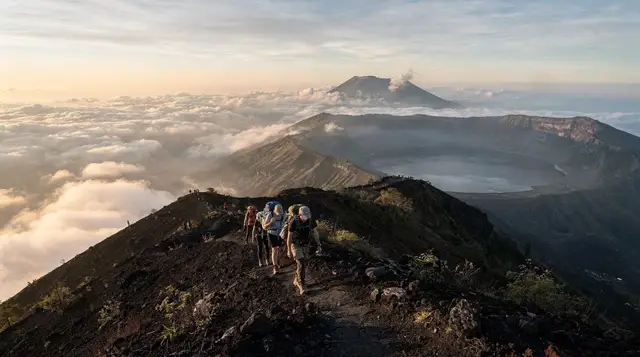
Mount Rinjani is Indonesia’s second-highest volcano, and the trek to its summit and crater rim is a genuinely serious multi-day undertaking, considerably beyond anything Bali’s shorter sunrise volcano climbs prepare you for. Routes typically run two to four days depending on how much of the mountain you want to cover, involving sustained steep climbing, cold high-altitude camping, and a demanding pre-dawn summit push on loose volcanic scree that tests even reasonably fit trekkers. This is not a casual add-on to a beach holiday; it deserves dedicated planning and honest self-assessment of your fitness before booking.
The reward matches the effort. Segara Anak, the crescent-shaped crater lake filling much of Rinjani’s caldera, is one of the more striking sights available anywhere in Indonesia, its deep blue water set against the volcano’s steep inner walls and, depending on route timing, a chance to soak in natural hot springs along the crater’s edge before continuing toward the summit. Multi-day routes generally include a night camped near the crater rim before the final summit push, giving trekkers time to properly experience the caldera rather than rushing past it.
Access runs primarily through villages on the mountain’s northern and eastern flanks, most notably Senaru and Sembalun, each offering a different route character and trailhead experience. A licensed guide and porter team is mandatory for the trek, both for safety on genuinely difficult terrain and as standard practice for managing the mountain’s popularity and environmental impact.
Mount Rinjani at a glance
| Where | Northern Lombok, within Mount Rinjani National Park |
| Cost | Guide, porter, and permit fees bundled into multi-day trek packages; camping equipment and meals typically included |
| Time needed | Two to four days depending on route; the crater rim can be reached faster than a full summit-and-crater combination |
| Access | Guided trek only, departing from Senaru or Sembalun village trailheads |
| Best time | Dry season, roughly April to October; check current trail status directly, since access can close seasonally for safety or environmental reasons |
Choosing a route: Senaru vs Sembalun
Whichever combination you choose, discuss the specific itinerary in detail with your operator beforehand, since “three-day” or “four-day” trek listings can vary meaningfully in exactly which sections of the mountain they cover.
The two main trailhead villages offer genuinely different route characters. Senaru’s approach tends to be steeper and more directly forested in its lower sections, while Sembalun’s route crosses more open savanna terrain before the final steep push, generally considered somewhat more gradual in its early stages.
Many multi-day itineraries combine both, entering via one village and exiting via the other, which avoids retracing the same path and gives a fuller sense of the mountain’s varied terrain. The three-day Mount Rinjani summit expedition with cultural orientation is one such combined-route option, pairing the trek with some context on local Sasak culture along the way.
The crater lake and hot springs
Beyond the physical relief, the hot springs setting itself, framed by the crater’s steep inner walls with the lake visible nearby, ranks among the more memorable rest stops on any multi-day trek in the region, a genuine highlight rather than merely a practical break.
Segara Anak’s crater lake is the trek’s centrepiece for many trekkers, even more than the summit itself for those who find the final steep scree climb genuinely daunting. Natural hot springs along part of the crater’s edge offer a chance to soak tired muscles partway through a multi-day itinerary, a welcome contrast to the physical demands of the climbing on either side of the stop. The three-day, two-night trek covering the summit, lake, and hot springs is built specifically around giving proper time to all three elements rather than rushing through any one of them.
Longer routes via Torean
A similar extended option, the four-day Mount Rinjani guided trek from Senaru, offers a comparable full itinerary for trekkers prioritising a thorough, unhurried exploration of the mountain over a faster, more condensed schedule.
For trekkers wanting an even more immersive, less-travelled route, some operators offer extended itineraries via the Torean trail, generally covering four days and reaching parts of the mountain that shorter standard routes skip. The four-day Mount Rinjani Torean trek from Senaru suits trekkers with both the time and fitness for a fuller exploration of the mountain beyond the standard summit-and-crater combination.
Porters, guides, and how the trek team works
Multi-day Rinjani treks typically involve a lead guide alongside a team of porters who carry camping equipment, food, and cooking supplies, allowing trekkers to hike with a considerably lighter daypack than a fully self-supported trek would require. This support system is standard practice on Rinjani given the terrain and multi-day duration, and tipping the full team, not just the lead guide, at the end of the trek is customary and genuinely appreciated given the physical demands of their work carrying heavy loads across the same difficult terrain trekkers cover with lighter packs.
The 2018 earthquake and trail recovery
A significant earthquake affected Lombok in 2018, causing damage across parts of the island including sections of the Rinjani trekking infrastructure, and the mountain closed to trekkers for a period of recovery and safety assessment afterward. Trails have since reopened under normal operating conditions, but the episode is worth knowing about as context for why safety monitoring and periodic access reviews remain a genuine, ongoing part of how the national park manages the trek, rather than an overly cautious formality.
Environmental impact and Leave No Trace practice
Given Rinjani’s popularity, environmental management has become an increasing focus for the national park authorities and reputable trekking operators alike, including waste management along the trail and designated camping areas rather than free camping wherever convenient. Choosing an operator who visibly follows these practices, rather than the cheapest available option, contributes to keeping the mountain in reasonable condition for future trekkers, an increasingly relevant consideration given how much foot traffic the more popular routes now see during peak season.
What isn’t worth the detour
Skip attempting Rinjani as a rushed single-day activity — unlike Bali’s shorter volcano sunrise treks, there is no legitimate one-day version of this climb that reaches the true summit, and any operator suggesting otherwise is likely referring to a much shorter viewpoint rather than the actual peak. Also skip cutting corners on gear to save weight or money; the combination of altitude, cold, and genuinely difficult terrain make proper boots, layers, and a good sleeping system non-negotiable rather than optional extras.
Recovering after the trek
Given how physically demanding the trek is, most trekkers benefit from planning at least a day or two of genuine rest immediately afterward rather than continuing straight into another demanding activity. A stay in Senaru or a transfer to one of the Gili Islands for some beach and snorkelling time works well as a deliberate recovery period, letting sore legs and general fatigue settle before continuing with a wider Lombok or Bali itinerary.
What it costs
Multi-day Rinjani trek packages bundle guide, porter, permit, camping equipment, and meal costs into a single price, generally scaling with trek length and route complexity — a two-day crater-rim-only trip costs less than a full four-day summit-and-Torean combination. Tipping guides and porters at the end is customary and worth budgeting separately, reflecting the genuinely demanding physical work they do supporting trekkers across multiple days.
When to go
Dry season, roughly April through October, is by far the safer and more comfortable window, with wet-season conditions making the already-steep, loose volcanic terrain considerably more hazardous. The trek is also subject to periodic closures for safety monitoring or environmental management reasons independent of season, so confirming current access status directly with a reputable operator before finalising dates is essential rather than optional.
Getting there and getting around
Trailhead villages Senaru and Sembalun sit on Rinjani’s northern and eastern flanks respectively, reached by road from Lombok’s main towns or, for many trekkers, as part of a package that includes transport from your Lombok or Gili Islands accommodation. There is no way to attempt the mountain independently without a licensed guide; this applies to every trekker regardless of prior experience.
How Mount Rinjani fits into a longer trip
Mount Rinjani pairs naturally with a stay in Senaru either side of the trek, and fits into a broader Lombok itinerary that might also include the Gili Islands for post-trek recovery time. Read the mount rinjani trek guide and the what to pack for a volcano trek guide before booking, and see Batur vs Agung vs Rinjani for how this climb compares to Bali’s own volcano treks.
Frequently asked questions about Mount Rinjani
How fit do I need to be for Mount Rinjani?
Genuinely fit — regular hiking experience and solid cardiovascular fitness matter considerably here, more than for any single-day Bali volcano trek. This is not a suitable first multi-day hike for someone with no prior trekking background.
Is a guide mandatory for Mount Rinjani?
Yes, without exception — licensed guides and porters are required for safety and park management reasons, and no legitimate route to the summit or crater exists without one.
How cold does it get at the summit and crater rim?
Considerably colder than anywhere else in Lombok or Bali, particularly overnight and during the pre-dawn summit push; proper cold-weather layers are essential rather than optional.
Can I do a shorter version of the Rinjani trek if I don’t have several days?
Yes, shorter two-day crater-rim-only itineraries exist for trekkers without the time for a full summit-and-lake combination, though the true summit itself requires the longer routes.
What happens if the trail is closed when I want to go?
Closures do happen periodically for safety or environmental reasons; a reputable operator will confirm current status honestly rather than taking bookings regardless, so check directly before finalising your dates.
Is the crater lake swimmable?
Yes, along with the nearby hot springs, swimming in Segara Anak is a popular part of the multi-day itinerary for trekkers who make it to the crater floor.
How does Rinjani compare to Bali’s Mount Agung?
Rinjani is taller and the standard treks are longer, multi-day undertakings compared with Agung’s single overnight climb, though both are genuinely serious volcano treks requiring real fitness and a licensed guide.
What should I pack that isn’t obvious?
Blister prevention supplies, a headtorch with spare batteries for the pre-dawn summit push, and trekking poles for the steep, loose descent sections, which put considerable strain on knees even for fit trekkers.
Is altitude sickness a real concern on Rinjani?
It can affect some trekkers given the elevation gained, though it’s generally less severe than at higher mountains elsewhere in the world; staying hydrated and pacing yourself on the ascent helps reduce the risk.