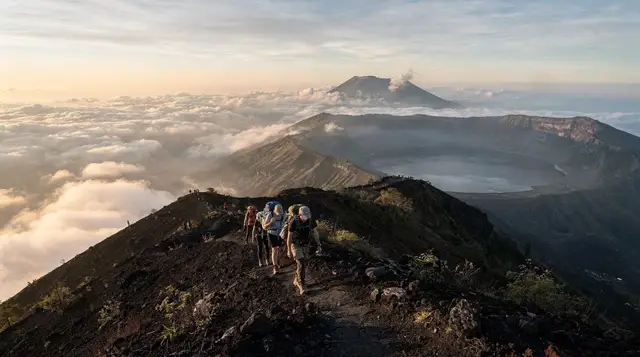
Mount Batur is the still-active volcanic cone rising from the floor of a much older, much larger caldera in central Bali, and its sunrise trek is one of the most heavily booked activities on the island. That popularity is a double-edged fact worth knowing before you commit: the trek itself is a genuinely satisfying, moderately demanding hike with a real payoff at the top, but you will be sharing that payoff with a long line of other headtorches making the same climb on the same morning.
The appeal is straightforward. Batur is climbable by most reasonably fit people without technical equipment, the round trip fits into a single very long morning rather than a multi-day expedition, and the reward, a caldera and lake view lit by sunrise from above the clouds, is one of the more memorable single mornings available in Bali. What trips people up is almost always preparation rather than fitness: the cold at altitude before dawn, the pace needed to beat the crowd to a good summit spot, and the loose volcanic scree underfoot in the dark.
This page treats Batur as a full destination rather than just a trek logistics page — the trek is the main event, but the surrounding area, including hot springs, jeep routes and highland villages, is worth understanding too if you are giving the caldera more than one rushed morning.
Mount Batur at a glance
| Where | Active volcanic cone inside the Batur caldera, central Bali, near Kintamani |
| Cost | Guide fee (treks here are effectively guide-only by local arrangement), plus transport |
| Time needed | Several hours overnight to mid-morning for the trek itself, longer with a hot spring stop after |
| Access | Organised tour with hotel pickup, or a private driver plus a local guide arranged on arrival |
| Best time | Dry season for the most reliable clear skies; any night with a favourable weather forecast otherwise |
Why the trek starts at 2am
The wake-up call is the single most common complaint about Batur, and also the one detail that most explains the whole experience. Guides schedule departure so that hikers reach the summit area with enough buffer before actual sunrise, since the climb takes longer than most visitors expect once you factor in loose scree, rest stops, and a group pace rather than a solo one. Starting late enough to sleep in properly means missing the sunrise entirely, which defeats the point of the whole exercise. The why your Bali sunrise trek starts at 2am guide goes into the scheduling logic in more depth if the wake-up time is what’s giving you second thoughts.
What the climb actually feels like
The trail is not technical in the sense of requiring ropes or climbing skill, but it is a real, sustained uphill hike over loose volcanic gravel and rock, done almost entirely in the dark by torchlight for the first stretch. Good closed shoes with real grip matter more here than almost any other activity in Bali; sandals or worn-out trainers make the loose surface considerably harder and more slip-prone than it needs to be.
A guided trek, such as the Kintamani and Mount Batur sunrise or sunset jeep tour, removes the biggest source of pre-dawn stress: you are not navigating an unfamiliar volcanic trail in the dark yourself, and pickup timing is handled for you.
Sunrise trek vs jeep tour: two very different ways up
Not everyone wants, or is physically able to do, the full hike, and Batur offers a genuine alternative for that reason.
| Sunrise hiking trek | 4WD jeep tour | |
|---|---|---|
| Physical effort | A real, sustained climb | Minimal — mostly seated |
| Vantage point | Summit, above the caldera | Rim roads and lower slopes |
| Typical duration | Several hours, overnight start | Shorter, still an early start for sunrise |
| Best for | Fit hikers wanting the full experience | Travellers wanting the view without the climb |
If a jeep suits your group better than a hike, the Mount Batur 4WD jeep tour with a natural hot spring stop covers a version of the sunrise experience without the ascent, and folds in a hot spring visit afterwards, which the hiking trek does not always include as standard.
The hot spring afterwards, and whether it’s worth it
Natural hot springs sit near the base of the caldera and are a common add-on once the trek is finished, offering a warm soak with a view back up at the volcano you just descended. Whether this is worth the extra time depends mostly on how tired you are: after a pre-dawn hike, some travellers find the soak genuinely restorative, while others just want to get back to the hotel and sleep. The Mount Batur 4x4 jeep adventure with an Ubud visit pairs the caldera morning with an Ubud stop later in the day for travellers who would rather push through than nap.
Coffee, breakfast, and the villages around the trek
Most guided treks include a simple breakfast eaten at or near the summit, sometimes cooked using the volcano’s residual heat as a novelty rather than a necessity. Beyond the trek itself, the villages ringing the caldera support the same highland coffee growing found around neighbouring Kintamani. The authentic Bali villages and coffee tour around Mount Batur is a lower-intensity way to spend time in the same area without the pre-dawn climb, useful as a second day in the region or for travellers in your group who are skipping the trek itself.
Group size, private treks and what changes the pace
Most bookings run as small shared groups, typically a handful of hikers assigned to one local guide, which keeps the price reasonable while still giving you someone experienced setting the pace and pointing out the trail’s trickier sections in the dark. If your priority is flexibility, arriving on your own schedule, stopping for photos without waiting on other hikers, or simply avoiding a group you didn’t choose, a private trek is worth the extra cost. The trade-off is mostly financial rather than experiential, since the trail itself and the summit view are the same regardless of group size.
Families or groups with a wide range of fitness levels tend to do better with a private arrangement, since a shared-group pace is generally set to the median hiker and can leave slower members feeling rushed on the steeper sections. If anyone in your party has real doubts about their fitness for a sustained pre-dawn climb, raising it with the operator before booking, rather than discovering it on the trail, makes for a considerably better morning for everyone involved.
What a typical trek morning actually looks like
Pickup usually happens from your accommodation in the very early hours, followed by a drive up to the trailhead village, a short briefing, and the start of the climb itself while it is still fully dark. The middle section is the most physically demanding, a sustained push up loose volcanic ground that tests legs and lungs more than any single technical move. Most groups reach a resting point below the true summit with enough buffer to catch their breath before the final push, timed so that the last stretch coincides with the sky beginning to lighten rather than full sunrise itself.
At the top, expect company: other trekking groups, a scattering of makeshift breakfast stalls run by local vendors, and a real crowd of headtorches and phone cameras all angled the same direction as the sky changes colour. The descent afterwards is faster than the climb but still demands attention on the same loose ground, now visible in daylight rather than torchlight, which some hikers find easier and others find more precarious once they can actually see the drop beside the trail.
Fitness realities, honestly assessed
Tour listings for Batur commonly describe the trek as suitable for “any fitness level,” which oversells it somewhat. The climb is achievable by most people who exercise even occasionally, but it is a sustained uphill effort of real duration on an uneven, sometimes loose surface, done at an hour when your body would normally be asleep. People who rarely walk long distances, or who have untreated knee or joint issues, often find the descent more taxing than the ascent, since the loose scree underfoot demands more careful footing on the way down than the steady uphill push on the way up.
None of this should discourage a reasonably active traveller from attempting the trek, but it is worth an honest self-assessment beforehand rather than assuming a “moderate” difficulty rating from a tour listing tells the whole story. Guides generally accommodate a range of paces within a group, but a slower hiker should expect the climb to take noticeably longer than the tour’s stated average, which matters for planning the rest of your day afterwards.
What isn’t worth the detour
Skip any operator offering a dramatically cheaper trek than the going range without a clear explanation — guiding on Batur is arranged through a local association, and unusually low prices are more often a sign of a larger, less attentive group or corners cut on safety basics like proper lighting. Also reconsider chasing a perfectly empty summit photo; on a popular morning this is simply not realistic, and arriving with that expectation tends to sour what is otherwise a good experience. If you already have limited days in Bali and cold pre-dawn hikes genuinely do not appeal to you, a jeep tour covers the same caldera scenery without forcing an activity you would not enjoy.
What it costs
Treks are arranged through a local guide association rather than freelance operators, and pricing reflects that structure rather than a simple per-person hiking fee — budget for a guide fee that covers the whole small-group experience, plus transport if you are arranging pickup separately from an organised tour. Hot spring entry, where included, is usually a modest add-on rather than a major cost. Booking through an established tour rather than negotiating with someone at the base tends to be more predictable in both price and quality, since informal arrangements at the trailhead vary considerably in what they actually include.
When to go
Dry season, roughly April to October, offers the best odds of a genuinely clear sunrise, though even in this window mornings are not guaranteed clear. The wet season from November to March brings a higher chance of cloud obscuring the sunrise entirely, though the short, heavy nature of Bali’s rain showers means dry mornings still happen regularly even then. Whatever the season, check the forecast the evening before rather than booking blind days in advance, since a clear-sky trek is meaningfully better than a cloud-bound one.
Getting there and getting around
Mount Batur sits within the same central Bali caldera as Kintamani, reached by the same winding highland roads from the south coast or Ubud. Nearly all trekkers arrive via organised tour with hotel pickup, given the very early departure time and the fact that most visitors are not driving unfamiliar mountain roads at 2am on a scooter. Getting to the trailhead independently is possible with a private driver, but arranging a licensed local guide on arrival without a pre-booked tour adds friction most travellers would rather avoid at that hour.
How this fits into a longer trip
A Batur sunrise trek pairs naturally with a slower day exploring Kintamani’s caldera viewpoints, since both sit in the same highland area and a second, less demanding day makes good use of the drive already made. Travellers building a broader central Bali loop should also look at Bedugul and Munduk further west, which round out a highlands itinerary without doubling back to the coast unnecessarily.
For trek-specific planning, read what to pack for a volcano trek well before your date, since the cold-weather gear question catches out more first-timers than the hike’s difficulty does. If you are weighing Batur against Bali’s other major trek, Mount Agung, the Batur vs Agung vs Rinjani comparison guide lays out how the three actually differ in difficulty and access. Those staying near Ubud will find the pickup logistics considerably easier than from the far south coast.
Frequently asked questions about Mount Batur
Do I need previous hiking experience for Mount Batur?
No prior technical experience is required, but a reasonable baseline fitness matters — this is a sustained uphill climb on loose ground, not a flat walk, and it takes real effort even for people who exercise regularly.
Can I do the trek without a guide?
In practice, treks here are arranged through a local guide association, and going without one is neither straightforward nor advisable given the dark trail conditions and loose volcanic scree.
How cold does it actually get at the summit?
Cold enough to catch most first-timers off guard, since it is a sharp contrast from Bali’s coastal heat. A proper light jacket, not just a t-shirt, is genuinely necessary rather than optional gear.
Is the trek suitable for children?
It depends heavily on the individual child’s fitness and tolerance for an early wake-up and sustained climb in the dark. Families should discuss this honestly with their tour operator rather than assuming any age group is automatically fine.
What happens if it’s cloudy on trek morning?
The hike still happens as booked in most cases, but the sunrise payoff is reduced or lost if cloud sets in. Checking the forecast the evening before, where possible, helps set expectations rather than guaranteeing a clear view.
Is the hot spring afterwards included in most tours?
Not always as standard — some trek packages include it, others treat it as a separate add-on. Confirm what is included before booking if the soak afterwards matters to your plan.
How does Batur compare to Kintamani if I only have time for one?
Kintamani is a scenic viewpoint reached with minimal effort; Batur is the active hike up into the same caldera. If you want the view without the climb, Kintamani covers that. If the trek itself is the goal, Batur is the one to book.