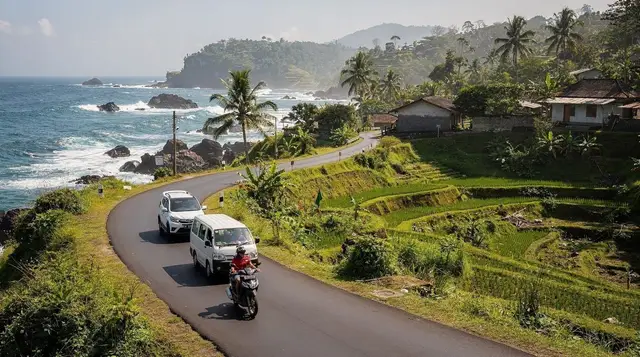
Four Days in North and West Bali
North and West Bali barely register on most first-time visitors’ plans, and that’s largely why it’s worth going. The drive up from the south is long enough that day-trippers rarely commit to it, which leaves Lovina’s dolphin-watching coast, Munduk’s waterfall trails, and Jatiluwih’s UNESCO-listed rice terraces noticeably quieter than their southern equivalents, even in peak season.
This itinerary treats the region as its own short trip rather than a single rushed day tour, moving from the cooler hill country around Munduk and Bedugul down to Lovina’s black-sand coast, with Jatiluwih’s terraces threaded in along the way. It’s a region defined by its temperature and its pace as much as by any single sight: mornings in Munduk are genuinely cool enough for a jumper, which surprises visitors expecting Bali’s usual heat.
The honest trade-off is the drive itself. Getting up here from South Bali or Ubud takes a real chunk of a day, and the roads through the central highlands wind more than the flatter south. That’s precisely why fewer people bother, and precisely why the region stays quieter — but it does mean this itinerary works best as a dedicated multi-day block rather than squeezed into a single day trip.
The four days at a glance
| Region | Munduk, Bedugul, Jatiluwih, Lovina, West Bali National Park |
| Base | One or two nights around Munduk or Bedugul, one or two in Lovina |
| Access | Private driver or rental car; a long drive from South Bali, shorter from Ubud |
| Best time | Dry season, April to October, for clearer mountain views and calmer coastal waters |
| Pace | One highlands day, one waterfall and rice-terrace day, two coastal days around Lovina |
Day one: into the highlands around Munduk and Bedugul
Leave South Bali or Ubud early and head straight into the hills. Bedugul’s Ulun Danu Beratan temple, perched on the edge of a lake with the water often still enough to mirror the temple’s tiered roofs, is the natural first stop and one of the more photographed sights in Bali outside the south. A tour combining Ulun Danu temple with a nearby waterfall is a reasonable way to structure the morning if you’d rather not plan the stops individually.
From there, continue on to Munduk itself, a hill town built around clove and coffee plantations with a noticeably cooler climate than anywhere else on this itinerary. The temperature drop is immediate once the road climbs above Bedugul, and it’s worth having a layer ready in the car rather than digging through a packed bag once you’ve already arrived.
Munduk’s waterfalls are the reason most visitors come specifically to this town, and a guided customised North Bali tour covering Munduk’s hidden spots is a good way to cover several stops without navigating unfamiliar back roads yourself. If you’d rather walk, the trails between the waterfalls are well-established and manageable for most fitness levels, just muddier in the wet season.
Day two: Jatiluwih’s rice terraces and the drive to Lovina
Jatiluwih’s UNESCO-recognised rice terraces, built and maintained under the same traditional subak irrigation system found across the island, are the quieter, arguably more impressive alternative to Tegalalang near Ubud. Walking paths thread between the working paddies rather than around a single viewpoint, and the scale of the terracing across the hillside is genuinely striking on a clear day.
From Jatiluwih, the drive north down to Lovina takes the rest of the day, winding through more of the highland scenery before dropping to the north coast. Break the drive at a coffee or clove plantation stop if you haven’t already done one around Munduk — this part of Bali produces a meaningful share of the island’s coffee, including the more expensive kopi luwak, and it’s worth understanding what you’re buying before any plantation visit rather than after.
Day three: Lovina’s dolphins, done with realistic expectations
Lovina is best known for early-morning boat trips out to see wild dolphins offshore, and it’s worth being honest about what that experience actually involves: a pre-dawn start, a flotilla of small boats converging on the same pod once dolphins are spotted, and sightings that are likely but not guaranteed, since these are wild animals rather than a managed attraction. A combined North Bali tour covering dolphins and hot springs pairs the early boat trip with a relaxing soak afterwards, which softens the very early start considerably.
Spend the rest of the day at a slower pace along Lovina’s black-sand coast, which suits swimming and snorkelling more than sunbathing on a picture-postcard beach — this stretch of coast doesn’t have South Bali’s white sand, and expecting it to is the most common disappointment among first-time visitors here.
Day four: West Bali National Park or a slow final morning
If time allows, West Bali National Park, at the island’s western tip, offers a genuinely different landscape from anywhere else on this itinerary: dry savannah forest, mangroves, and Menjangan Island’s reef just offshore, reachable by a short boat trip for snorkelling or diving. It’s a longer detour from Lovina than the other stops, so it’s worth treating as an optional extension rather than a fixed part of the four days if you’re tight on time.
If the park doesn’t fit, a slower final morning around Lovina, followed by the drive back to South Bali or on to your next destination, is a reasonable way to close out the trip without cramming in one more long excursion.
Where to actually stay
Munduk itself has a handful of small guesthouses built specifically to make the most of the views and cool air, and staying in the town rather than driving up from Bedugul each day makes the early waterfall walks far more pleasant before the day heats up. Bedugul is a reasonable alternative base if you’d rather be closer to Ulun Danu Beratan and Jatiluwih, with a slightly wider range of accommodation given its position on the main highland route. In Lovina, most visitors stay along the main beach strip, which puts hotels within easy reach of both the dolphin-boat departure points and the town’s restaurants.
None of these areas has anything close to South Bali’s density of accommodation options, so booking ahead matters more here than in Kuta or Seminyak, particularly for the smaller Munduk guesthouses that fill quickly in peak months.
Practical notes specific to this region
Fuel stations thin out considerably once you’re off the main highland road, so top up in a larger town before heading deep into the Munduk or Jatiluwih back roads. Phone signal is generally reliable along the main routes between Bedugul, Munduk and Lovina but can drop in pockets around the more remote waterfall trails. Cash remains the more reliable payment method throughout this region — smaller guesthouses, waterfall entrance fees and plantation stops are less likely to take cards than equivalent South Bali businesses.
If you’re prone to motion sickness, be aware the highland roads involve considerably more winding than the flatter south, which is worth factoring in in particular for anyone driving up shortly after a long-haul flight.
What isn’t worth the detour
Skip paying extra for a “VIP” or “front row” dolphin boat slot — the dolphins move unpredictably and no operator can guarantee a better vantage point than any other boat in the same flotilla. Also skip expecting Lovina’s beaches to match South Bali’s white sand; if that’s the priority, this isn’t the coastline for it, and the honest draw here is the dolphins and the slower pace, not the beach itself.
Why this region stays quieter than the south
The simplest explanation is distance. South Bali and Ubud sit close enough together that most visitors can base themselves in one and day-trip to the other without much cost in time; North and West Bali sit far enough from both that a proper visit requires committing real days to the region rather than squeezing it in around a South Bali base. That single fact filters out a large share of visitors before they even consider it, which is exactly what keeps Jatiluwih quieter than Tegalalang and Lovina calmer than Sanur, despite genuinely comparable scenery and activities.
It also means the region has developed differently. Instead of the dense strip of restaurants, bars and shops that lines South Bali’s tourist areas, Munduk, Bedugul and Lovina retain a working-town feel, with plantations, fishing boats and rice cultivation still forming the backbone of the local economy alongside tourism rather than having been replaced by it. That’s a large part of the appeal for travellers who’ve already spent time in the more developed south and are looking for a genuinely different pace, rather than a quieter version of the same experience.
Budget for four days
Accommodation in Munduk, Bedugul and Lovina runs noticeably cheaper than equivalent South Bali options, reflecting far lower visitor volumes outside peak periods. Transport is the main cost, since this region’s roads and distances make a private driver or rental car the practical choice for the whole four days rather than occasional local rides. The dolphin trip and any waterfall or plantation stops are priced individually rather than bundled, so budget for them as separate line items across the four days.
When to go
The dry season, April to October, gives clearer mountain views around Munduk and Bedugul and calmer coastal waters for the Lovina dolphin trips and any snorkelling at Menjangan Island. The wet season brings heavier rain to the highlands specifically, since Munduk and Bedugul sit at higher elevation than the coast, so waterfall trails can get significantly muddier and some viewpoints cloud over for longer stretches of the day.
Getting there and around
The drive from South Bali to this region takes a genuinely long stretch of a day, longer than most itineraries elsewhere on the island, which is the main reason it stays quieter than the south. A private driver is the easier choice for most visitors given the winding highland roads, though confident, experienced riders can self-drive with a rental car. Once you’re up in the region itself, distances between Munduk, Bedugul, Jatiluwih and Lovina are shorter than the initial drive up, but the roads remain winding rather than flat.
How this fits into a longer trip
This four-day block works well as a standalone highlands-and-north-coast trip or as one leg of a longer island-wide itinerary. For a broader look at the region’s viewpoints, read Kintamani viewpoints and Jatiluwih rice terraces UNESCO before you go, and subak irrigation explained if you want the context behind what you’re actually looking at in the terraces.
Divers and snorkellers curious about Menjangan Island specifically should also read menjangan island diving before deciding whether to add the West Bali National Park detour on day four. If you’re combining this with more of the island, the Bali 10 days and Bali 14 days itineraries both have room to fold in a highlands-and-north detour like this one.
Frequently asked questions about Four Days in North and West Bali
Is North Bali worth it if I only have a week in total?
If your week is otherwise focused on South Bali or Ubud, a full four-day detour is a big commitment. A shorter one- or two-day highlands loop, covering Bedugul and Munduk without the full push to Lovina, is a reasonable compromise.
Are the Lovina dolphin sightings guaranteed?
No — these are wild dolphins in open water, and while sightings are frequent, they’re never certain. Treat any operator promising a guaranteed sighting with scepticism.
How much cooler is it in Munduk compared to the coast?
Noticeably. Munduk sits at a meaningfully higher elevation, and mornings and evenings can feel genuinely cool, unlike almost anywhere else on the island. Bring a light layer.
Is the drive up here difficult or dangerous?
It’s winding and takes longer than it looks on a map, but it isn’t unusually dangerous for an experienced driver or rider. Less confident drivers are better served hiring a driver for this stretch.
Can I visit Jatiluwih without a full North Bali trip?
Yes, it’s reachable as a longer day trip from Ubud on its own, though combining it with the rest of this region makes better use of the drive.
Is West Bali National Park worth the extra detour?
If you have a full extra day, yes — it’s a genuinely different landscape from the rest of Bali. If your four days are already tight, it’s the easiest single stop to drop.
What should I pack specifically for this trip?
A light jacket for cool highland mornings and evenings, proper footwear for muddy waterfall trails in the wet season, and reef-safe sunscreen if you’re planning to snorkel at Menjangan Island.
Is four days enough, or should I plan for longer?
Four days covers the main highlights at a reasonable pace. Adding a fifth day, mainly to properly cover West Bali National Park and Menjangan Island without rushing, is worth it if your schedule allows.
Can I do this region without a car or driver?
Not comfortably. Public transport across this part of Bali is minimal, and the distances between highlights are long enough that walking or relying on ride-hailing apps alone isn’t practical outside the towns themselves.
Is the coffee and clove plantation stop worth it if I don’t drink coffee?
The walk through the plantation itself and the explanation of how the crops are grown are worthwhile regardless, though the tasting stop at the end is obviously more relevant if you do drink coffee.
tours.4 days
Verified deep-linked GetYourGuide tours. Book through these links and we earn a small commission at no cost to you.
These are our own photographs of Bali, not the operator's pictures of this tour — open the tour page to see those.