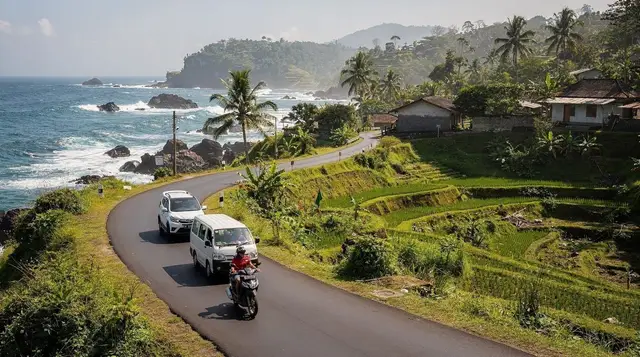
Jatiluwih is a stretch of terraced rice fields in the highlands of central Bali, recognised by UNESCO as part of the Cultural Landscape of Bali, specifically for the subak irrigation system that has shaped and sustained these terraces for centuries. Where a lot of Bali’s rice terrace stops are essentially a single scenic vantage point with a few swings and photo props nearby, Jatiluwih is a genuinely large working agricultural landscape, with marked walking routes running through and around the fields rather than just past them.
The subak system itself is the real substance behind the UNESCO listing, and it is worth understanding before you arrive rather than treating the terraces as simply a pretty backdrop. Subak is a community-managed water-sharing network, rooted in Balinese Hindu philosophy, that governs how irrigation water moves between fields owned by different farmers. It is a functioning social and agricultural institution, not a historical relic, and Jatiluwih is one of the clearest places on the island to actually see it at work across a wide, largely unbroken expanse of terraces.
Compared with Tegalalang near Ubud, Jatiluwih trades convenience for scale and quiet. The drive is longer and the surrounding infrastructure is more modest, but the terraces themselves stretch far further than Tegalalang’s compact, road-adjacent fields, and the crowds thin out considerably once you’re a short walk from the entrance.
Jatiluwih at a glance
| Where | Terraced highlands near Mount Batukaru, central Bali, within Tabanan regency |
| Cost | A modest entrance/conservation contribution at the gate; walking the marked trails costs nothing further |
| Time needed | A couple of hours for a walk and the view, longer with a cycling or farming activity |
| Access | Self-drive scooter or car, private driver, or an organised tour |
| Best time | Morning, dry season, for the clearest light over the widest views |
Understanding subak before you walk the terraces
The subak system is built around water temples and a shared calendar that coordinates planting and irrigation across an entire watershed, so that upstream and downstream farmers alike get a fair share of water rather than the fields nearest the source draining it first. This cooperative structure, tied closely to Balinese Hindu ritual life, is precisely what UNESCO recognised when it listed the Jatiluwih landscape, rather than the terraces’ visual appeal alone. Reading the subak irrigation explained guide before your visit genuinely changes how the walk reads, turning a scenic backdrop into a visible, functioning system.
The walking trails, and why they’re better than a single viewpoint
Unlike a lot of terrace stops built around one photogenic overlook, Jatiluwih has marked walking trails of varying length that actually take you into and around the fields, past working farmers, irrigation channels, and small shrines tucked into the landscape. This is the area’s real strength: a slow walk here, rather than a five-minute photo stop, is what earns the UNESCO comparison.
A guided route such as the Jatiluwih cultural experience with lunch covers the walking trails with local context on the subak system and farming practices, which adds a layer of understanding that a solo walk alone does not always deliver.
Cycling and buggy routes through the terraces
For a faster-paced but still immersive way to cover the landscape, cycling and buggy routes run through parts of the terraced area, giving a wider sweep of the fields than walking alone in a similar amount of time. The private buggy journey through the Jatiluwih rice terraces is one option for travellers who want to cover more ground, particularly useful if time is limited or if walking long distances isn’t appealing to everyone in your group.
Farming and cooking, hands-on rather than observed
Beyond walking or riding through the landscape, some operators offer genuine hands-on farming or cooking experiences rooted in the local agricultural cycle rather than a staged demonstration. The Jatiluwih farming experience with lunch puts you directly into the planting and harvesting rhythm of the terraces, which is a considerably more textured way to understand subak than reading about it at a distance.
For a food-focused version of the same idea, the Jatiluwih eco farm cooking class with lunch combines a farm walk with cooking traditional dishes using ingredients grown on site, which suits travellers who want the landscape experience paired with something they can sit down and eat afterwards.
Jatiluwih vs Tegalalang: which rice terrace to prioritise
Travellers with limited time often ask which terrace stop is worth prioritising, and the honest answer depends on what you’re optimising for.
| Jatiluwih | Tegalalang | |
|---|---|---|
| Scale | Large, expansive, UNESCO-listed | Smaller, compact, roadside |
| Crowds | Noticeably quieter, especially on the trails | Busy, particularly midday |
| Access | Longer drive from South Bali | Short drive from Ubud |
| Best for | Travellers prioritising scenery and quiet | Travellers with limited time near Ubud |
If your itinerary is Ubud-centred and time is genuinely tight, the Tegalalang rice terrace guide covers that more accessible alternative in detail.
The rice cycle, and why the fields never look quite the same twice
Because subak coordinates planting across a whole watershed rather than every field working to its own private schedule, different sections of the Jatiluwih terraces are often at visibly different stages of the rice cycle at the same time — some freshly flooded and reflective, others deep green with young shoots, others closer to golden and ready for harvest. This staggered pattern is a direct, visible consequence of the shared irrigation system rather than a coincidence, and it means two visits at different times of year, or even different points in a single season, can look genuinely different from one another.
For photographers in particular, this variation is worth knowing in advance, since the classic flooded, mirror-like terrace shot depends on catching fields at a specific stage rather than being guaranteed on any given day. Asking a guide which sections are currently flooded, rather than assuming the whole landscape looks uniform, is a small step that meaningfully improves the visit for anyone chasing a specific kind of photograph.
Combining Jatiluwih with a nearby temple stop
Because the Jatiluwih terraces sit within reasonable driving distance of both the Bedugul highlands and coastal temples further south, several operators build multi-stop days around the rice terraces rather than treating them as a single isolated destination. This suits travellers who want to pair the physical, walking-focused terrace visit with a more contemplative temple stop on the same day, breaking up a highlands itinerary that might otherwise feel like one long drive between similar-looking green landscapes.
Why the UNESCO listing covers more than just Jatiluwih
The Cultural Landscape of Bali listing that includes Jatiluwih actually covers several linked sites across the island, including water temples and other subak-managed terrace systems, rather than Jatiluwih alone. Jatiluwih is generally considered the most accessible and visually striking of these for a general visitor, which is part of why it has become the default rice terrace stop associated with the listing, but it is worth knowing that the recognition reflects a wider, interconnected system rather than one isolated site. This framing matters if you are trying to understand Balinese rice cultivation as a whole rather than treating Jatiluwih as a self-contained curiosity.
Choosing between a self-guided walk and a booked activity
The marked trails at the entrance are genuinely walkable without booking anything in advance, and a straightforward self-guided loop is a reasonable choice for travellers on a tight budget or schedule who mainly want the view and a stretch of the legs. Where a booked activity, whether a cultural walk, cycling route, or farming experience, adds real value is in the context and access it provides: a guide can point out details of the subak system and farming calendar that are invisible to an unguided visitor, and some hands-on experiences simply are not available without prior arrangement.
For a first visit with reasonable time available, pairing a short self-guided walk near the entrance with one booked activity, rather than choosing exclusively one or the other, tends to give a fuller sense of the landscape than either approach alone. Travellers returning for a second visit, already familiar with the general layout, often lean toward the self-guided option since the novelty of the guided context has already been covered.
What isn’t worth the detour
Skip the pressure some roadside vendors near the entrance apply to buy overpriced snacks or drinks before you’ve even reached the ticket booth; better value exists just past the gate or brought with you. Also reconsider visiting purely for a single photo if you can’t spare at least an hour, since the point of Jatiluwih, unlike a quick roadside viewpoint, is genuinely in the walking rather than a single vantage point near the car park.
What it costs
The entrance fee functions partly as a conservation contribution supporting the ongoing subak system and terrace upkeep, and it is a modest amount rather than a significant expense. Beyond that, cycling, buggy or farming activities each carry their own separate cost on top of basic entry. Transport is again the larger variable, given the drive from South Bali or Ubud; a private driver or tour typically costs more than solo fuel but removes the need to navigate rural roads and parking near the entrance yourself.
When to go
Dry season, roughly April to October, gives the clearest light and firmest trail conditions for walking. The wet season from November to March keeps the terraces at their most vividly green, since rice cultivation continues year-round here, but expect muddier trails and a higher chance of short, heavy afternoon showers interrupting a walk. Morning visits consistently offer better light and cooler walking temperatures than midday, regardless of season.
Getting there and getting around
Jatiluwih sits in the Tabanan regency highlands of central Bali, near the base of Mount Batukaru, reached by a genuinely long drive from the southern resort areas and a shorter but still significant one from Ubud. There is no public transport serving the site usefully for tourists, so this is scooter, private driver, or organised tour territory, and the rural mountain roads on the final approach are narrower and less signposted than Bali’s main routes.
How this fits into a longer trip
Jatiluwih pairs naturally with Tabanan and Bedugul for a central highlands day that avoids doubling back to the coast between stops, and several tours already combine Jatiluwih with the Ulun Danu Beratan lake temple for exactly this reason. The north and west Bali, 4 days itinerary sequences these highland stops together in a workable order for travellers building a fuller route.
For deeper background on the terrace system itself, the Jatiluwih rice terraces UNESCO guide goes further into the listing’s history and criteria than a single-destination overview can. Travellers comparing Bali’s terrace options more broadly should also read the subak irrigation explained guide before choosing between Jatiluwih and other terrace stops on their route.
Frequently asked questions about Jatiluwih
How is Jatiluwih different from Tegalalang?
Jatiluwih is larger, less crowded and specifically UNESCO-listed for its subak irrigation system, while Tegalalang is smaller, more accessible from Ubud, and considerably busier. Both show terraced rice fields, but the scale and atmosphere differ substantially.
Do I need a guide to visit Jatiluwih?
Not strictly for a basic walk along the marked trails, but a guide adds genuine context on the subak system and local farming practices that a solo walk does not provide on its own.
Is Jatiluwih suitable for a full family day, including young children?
The main walking trails are relatively gentle, but they are also longer and offer less shade than a quick roadside stop, so plan around your children’s stamina and sun exposure rather than assuming it’s a brief visit.
What is the subak system, in simple terms?
It is a traditional, community-managed water-sharing network that governs how irrigation water is distributed fairly across the terraced fields, tied closely to Balinese Hindu ritual practice rather than being a purely technical arrangement.
Can I visit Jatiluwih on a scooter?
Yes, if you’re comfortable with rural mountain roads, though the drive from South Bali is long enough that many visitors prefer a private driver, particularly if combining Jatiluwih with other highland stops the same day.
Is Jatiluwih crowded like Tegalalang?
Generally no, particularly once you’re a short walk from the entrance and main car park. It sees meaningfully fewer visitors than Tegalalang despite being the more significant, UNESCO-listed site.
Can I combine Jatiluwih with a cooking class in the same visit?
Yes, several operators offer a cooking class as part of a combined farm and terrace visit, using ingredients grown on site, which is a reasonable way to extend a half-day stop into a fuller day without leaving the immediate area.
Is there shade on the walking trails?
Limited. The open terraces are largely unshaded, so sun protection and water matter more here than at forest-canopy waterfall walks elsewhere in Bali.
How far in advance should I book a guided activity at Jatiluwih?
For a straightforward walk, no advance booking is necessary since entry is available on arrival. Cooking classes and farming experiences, however, are worth arranging a day or so ahead where possible, since they depend on operator availability rather than simple gate access.