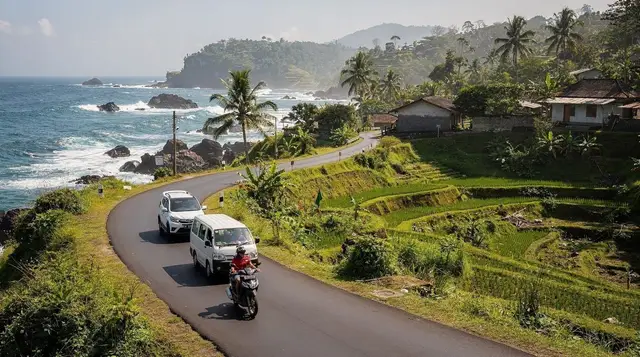
Four Days Exploring East Bali
East Bali gets treated as a checklist by most visitors: a single long day out from Ubud or South Bali, driven between Besakih, Lempuyang and Tirta Gangga by a hired car, and driven straight back the same evening. It works, in the sense that you tick off the well-known sights, but it also means several hours a day lost to driving on winding mountain roads, and it leaves no time at all for Sidemen’s rice terraces or Amed’s quieter coast, both of which sit further east again.
Four days based in the region itself changes that completely. Instead of one exhausting loop, you get two full days around the temples and photo spots most visitors come for, plus time in Sidemen — genuinely one of the least crowded, most scenic parts of inhabited Bali — and a stretch of Amed’s black-sand coast for diving, snorkelling, or simply slowing down by the water.
The trade-off is logistics: East Bali doesn’t have the concentration of transport options and infrastructure that Ubud or the south coast does, so this itinerary assumes either a hired driver for the block or a rental car if you’re comfortable with mountain roads. It’s a region that rewards patience with distances that look short on a map but take longer than expected in practice. Mobile coverage, restaurant options and ATM access all thin out the further east and uphill you go, which is part of why the region still feels comparatively undeveloped even as visitor numbers to Bali overall keep climbing.
The four days at a glance
| Region | East Bali: Besakih, Lempuyang, Tirta Gangga, Sidemen, Amed |
| Base | One or two nights in Sidemen, one or two in Amed |
| Access | Private driver or rental car; no meaningful public transport in this region |
| Best time | Dry season, April to October, for the clearest Mount Agung views from Besakih and Sidemen |
| Pace | Two temple- and photo-focused days, one rice-terrace and slow-travel day, one coastal day |
Day one: Besakih and the guide situation, done properly
Start with Besakih, Bali’s largest temple complex on the slopes of Mount Agung, and go early — cloud cover typically rolls in by mid-morning, and the car park guide situation, where self-appointed guides press visitors for inflated fees, is easier to navigate calmly before the site gets busy. An organised option such as the Eastern Bali and Besakih temple tour removes most of that friction, since your driver already knows the routine. Read the Besakih Mother Temple guide before you go, since knowing what to expect at the gate matters more here than at almost any other site on the island.
Spend the afternoon easing into Sidemen rather than rushing to a second major site — the drive itself, through terraced rice fields with Agung visible behind them on a clear day, is a big part of the point of basing yourself in this region rather than day-tripping through it.
Day two: Lempuyang and Tirta Gangga without the exhausting rush
Lempuyang’s so-called Gate of Heaven photo has a well-documented queue problem, and the honest advice is to accept it rather than expect to avoid it entirely — arriving as early as your tour allows is the only real lever you have. A combined Lempuyang temple and Virgin Beach tour pairs the queue with a genuinely worthwhile beach stop afterwards, which softens the wait considerably. Read the Lempuyang Gates of Heaven truth guide beforehand so you know exactly what the mirrored-pool photo actually involves before you queue for it.
Tirta Gangga, the former royal water palace with its stepping-stone ponds, makes a good slower stop for the rest of the day — far less queuing, more wandering, and a decent lunch stop nearby. It pairs naturally with Lempuyang on the same day since both sit close together on the same East Bali loop.
Day three: Sidemen’s rice terraces at a proper pace
This is the day this itinerary exists for. Sidemen has a fraction of the visitor numbers of Ubud’s rice terraces, with genuinely comparable or better scenery and none of the queuing for a photo spot. Spend the morning walking through the terraced paths rather than viewing them from a car window, and use the afternoon for something more active if you’re up for it, such as a tour built around the wider East Bali landscape that takes in Sidemen alongside the temple sites if you didn’t fully cover them on days one and two.
Sidemen is also a legitimate base for a night or two on its own merits, away from any temple itinerary at all — it’s worth reading as a slower-travel option even outside this four-day plan. Rice farming here still follows the traditional subak irrigation system found across Bali, and walking the paths between paddies gives a far closer look at how it actually works than viewing terraces from a roadside stop ever does. Many of the guesthouses in Sidemen are run by the same families who farm the surrounding land, which adds a genuinely local texture to a stay here that’s harder to find in more developed parts of the island.
Day four: Amed’s coast
Move on to Amed for the final day, a stretch of black-sand coast known for calm, accessible diving and snorkelling rather than beach clubs or nightlife. The wreck of the Liberty at nearby Tulamben, reachable from the beach without a boat, is one of the more accessible wreck dives anywhere, and worth the detour even for snorkellers who want to see it from the surface.
Keep expectations realistic about the beach itself: Amed’s sand is genuinely black volcanic sand rather than the white-sand look of South Bali, which surprises some visitors who haven’t read ahead. Sunsets over the water, with Mount Agung’s silhouette visible behind the coast on a clear evening, are a quieter, less crowded version of the sunset-watching that draws crowds to Uluwatu and Tanah Lot further west, and a good way to close out the four days before heading back.
If you only have three days, not four
| Priority | Keep | Cut |
|---|---|---|
| Temple-focused trip | Besakih, Lempuyang, Tirta Gangga | Amed (save it for a dedicated coastal trip) |
| Nature-focused trip | Sidemen, Tirta Gangga, one temple | Besakih’s full detour if pressed for time |
| Diving-focused trip | Amed, Tulamben, one East Bali temple on the way in or out | The full Lempuyang queue if time is genuinely tight |
Dropping a day means picking a focus rather than trying to compress all four days’ worth of driving into three. Temples and Sidemen sit reasonably close together geographically; Amed is a further push east again, so it’s the natural element to cut first if you’re short on time, and the easiest to come back to on a separate coastal-focused trip later.
Practical notes specific to this region
Fuel stations are sparser in East Bali than around Ubud or the south coast, so top up before heading deep into the Sidemen or Amed legs rather than assuming you’ll pass a station when you need one. Phone signal is generally fine along the main routes but can drop in the more remote stretches around Sidemen’s back roads, which matters if you’re navigating by map app rather than with a driver who already knows the way. Cash is worth carrying in larger amounts than you’d need on the south coast — smaller warungs and some temple ticket booths in this region are less likely to take cards.
If you’re travelling with young children, note that Besakih and Lempuyang both involve a fair amount of walking on uneven stone steps, and the Lempuyang queue in particular can be a long, hot wait that’s harder on small kids than adults.
What isn’t worth the detour
Skip trying to add Kintamani or Mount Batur onto this same four-day East Bali loop — they sit in a different direction entirely, and cramming them in adds a long detour that undoes the slower pace this region rewards. Also skip paying for a “professional photographer” add-on at Lempuyang beyond what’s already included in an organised tour; the mirrored-pool effect is created with a simple prop and reflective surface, not photography skill, and most tour drivers already know how to take the shot.
Budget for four days
East Bali costs less than South Bali or Ubud for accommodation, reflecting lower visitor density outside the main temple sites, though Amed and Sidemen both have a range from simple guesthouses to nicer villa-style stays. Transport is the main line item, since this itinerary assumes a private driver or rental car for the whole block rather than occasional Grab rides — either a full-day driver rate for the temple-heavy days, or a multi-day car rental if you’re confident driving yourself. Temple entrance fees and the informal guide-fee pressure at Besakih specifically are worth budgeting for as a separate, slightly unpredictable line item.
When to go
The dry season, April to October, gives the best odds of a clear Mount Agung view from Besakih and Sidemen, which matters more here than at most East Bali sites since the volcano itself is a major part of the scenery. The wet season brings short, heavy downpours rather than all-day rain, and East Bali’s roads can be more affected by these than mainland Bali’s better-maintained routes, so build slightly more buffer time into a wet-season version of this itinerary.
Getting there and around
There is no meaningful public transport across East Bali, and the winding, hilly roads make this one of the regions where a private driver is genuinely the easier choice over self-driving, even for confident riders. If you are self-driving or riding a scooter, note that some stretches, particularly around Besakih and up toward Sidemen, climb steeply and are narrower than mainland roads. Distances on a map understate real travel time throughout this region.
How this fits into a longer trip
This four-day block fits well either as a standalone regional trip or as the East Bali leg of a longer stay. For the shorter, single-day version of the temple highlights, read the East Bali day trip guide, and for a broader look at why the region deserves more time than most visitors give it, see East Bali is the Bali people miss. If you’re combining this with more of the island, the Bali 10 days itinerary threads East Bali together with Ubud and the south coast, and temple etiquette and dress code is worth reading before day one regardless of how the rest of your trip is planned.
Frequently asked questions about Four Days Exploring East Bali
Is four days too long for East Bali specifically?
Not if you want to include Sidemen and Amed alongside the temples. If you’re only interested in Besakih, Lempuyang and Tirta Gangga, two days is enough, and the extra time is what buys you the slower, less crowded parts of the region.
Do I need a private driver, or can I self-drive?
A private driver is the easier choice for most visitors given the winding mountain roads, especially around Besakih. Confident, experienced riders can self-drive, but it’s a more demanding region than South Bali.
Is the Lempuyang queue really as bad as people say?
It varies by day and season, but queuing for the mirrored-pool photo is a normal, expected part of visiting, not a rare inconvenience. Arriving early is the only real way to reduce it.
Can I skip Besakih and just do Lempuyang and Sidemen?
Yes, and it’s a reasonable choice if the guide-fee pressure at Besakih puts you off. Lempuyang, Tirta Gangga and Sidemen alone still make for a full, worthwhile few days.
Is Amed worth it if I’m not a diver?
Yes, though it’s a quieter, more low-key stop for non-divers — a place to slow down and enjoy the coast rather than a beach-club destination. Snorkellers can still see the Tulamben wreck from the surface.
What should I pack specifically for this region?
A light jacket or wrap for cooler mornings around Sidemen’s higher elevation, proper temple dress (sarong and sash, usually available on site) for Besakih, Lempuyang and Tirta Gangga, and reef shoes if you’re planning to snorkel at Tulamben’s rocky entry point.
Can this itinerary be done in reverse, starting from Amed?
Yes, and it can make sense if you’re arriving from Lombok or the Gili Islands via the eastern crossing points rather than from South Bali, in which case starting at Amed and finishing at Besakih is the more efficient direction.
Is it worth hiring a driver for all four days, or just some?
Most visitors find a driver for the full block simpler and not much more expensive than arranging transport day by day, since it removes the need to negotiate a new rate or route each morning. If your budget is tighter, a driver for the temple-heavy days one and two, with a rental scooter for the calmer Sidemen and Amed days, is a reasonable compromise for confident riders.
How does this itinerary handle Nyepi or other ceremony dates?
If your dates overlap with Nyepi, the island-wide day of silence, expect the whole trip to pause for 24 hours regardless of region — check the how Nyepi affects your trip guide well before booking. Smaller ceremony days tied to the Balinese calendar can also affect access to specific temples, including Besakih, so it’s worth checking current dates rather than assuming a normal visiting day.
tours.4 days
Verified deep-linked GetYourGuide tours. Book through these links and we earn a small commission at no cost to you.
These are our own photographs of Bali, not the operator's pictures of this tour — open the tour page to see those.