Bali Temple Etiquette and Dress Code
What is the actual dress code for visiting a Balinese temple?
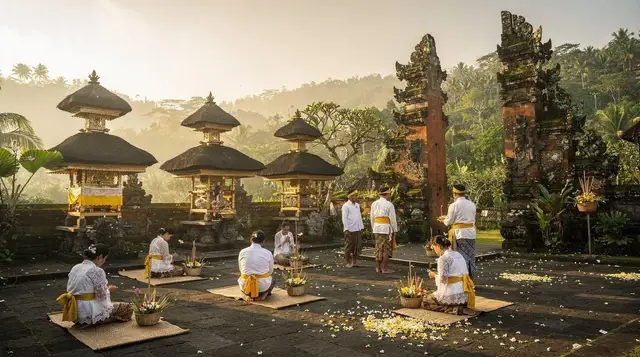
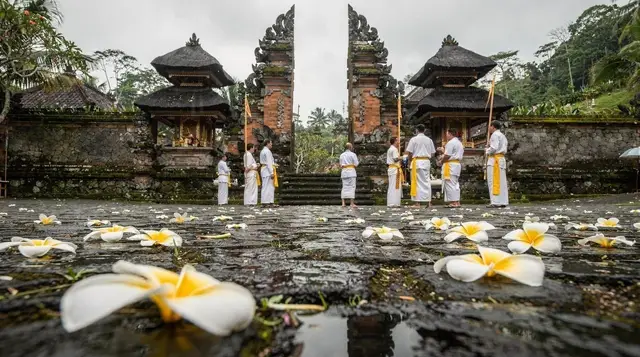
Shoulders and knees covered, plus a sarong tied at the waist and, at most temples, a sash tied around it — the sarong is almost always available to rent or borrow on site, so you rarely need to arrive with your own. Beyond clothing, the bigger etiquette points are about behaviour: not stepping on offerings, not standing higher than someone praying, and respecting areas reserved for worship rather than sightseeing.
Bali’s temples are active places of worship, not museum exhibits, and the etiquette that governs a visit reflects that distinction more than most first-time visitors expect going in. The sarong and sash requirement gets most of the attention in guidebooks and hotel handouts, and it matters, but it is really just the entry point to a wider set of behavioural expectations that determine whether your visit reads as respectful or oblivious to the people actually using the space for its intended purpose.
The good news is that almost none of this is difficult once you know it. Temples that receive regular tourist traffic are set up for it — sarongs are lent or rented at the entrance of nearly every temple that welcomes visitors, staff and guides are generally patient with genuine first-timers, and the core rules, once explained, are intuitive rather than arcane. The bad news is that nobody hands you a printed rulebook at the gate, so the gap between what visitors assume and what is actually expected is where most unintentional missteps happen.
This guide covers the dress code in full, but spends at least as much time on the behavioural side — offerings, body positioning, photography, and the handling of areas reserved for worship — since that is where genuine mistakes are more common than the clothing itself.
Temple etiquette at a glance
| Dress | Sarong and sash, shoulders covered; almost always rentable or loanable on site |
| Behaviour | No stepping on offerings, no standing higher than someone praying, respectful distance from active ceremonies |
| Photography | Fine for architecture; ask or keep discreet distance when people are actively worshipping |
| Access | Outer courtyards generally open to visitors; inner sanctums usually reserved for worship |
| Timing | Etiquette expectations tighten during major ceremonies and the run-up to Nyepi |
The dress code, in full
A sarong, wrapped and tied at the waist so it covers the legs to roughly the ankle, is required at almost every temple that receives visitors, along with a sash tied around the waist over it. Shoulders are also expected to be covered in most cases, though the strictness of this varies somewhat by temple and by how actively it is being used for ceremony at the time of your visit. The overwhelming majority of temples on any standard itinerary provide sarongs and sashes for rent or, in some cases, free loan at the entrance, so packing your own is a nice-to-have rather than a necessity, though bringing a lightweight sarong is never a bad idea for Bali generally given how often you will need one.
Offerings on the ground: do not step on them
Small woven-palm offerings called canang sari, filled with flowers, rice, and incense, are placed daily on the ground outside homes, shops, and temples across the island as part of ordinary Balinese Hindu practice. They are everywhere, including on pavements and temple walkways, and the single most common unintentional disrespect visitors commit is simply stepping on one without noticing. It is worth developing a habit of watching your feet more than you normally would on Bali’s streets and temple grounds, particularly in the morning hours when offerings are freshly placed and most numerous.
Standing and body position around worship
Balinese Hindu etiquette places real weight on relative body position during prayer — it is considered disrespectful to stand or sit higher than someone actively praying, particularly a priest conducting a ceremony, since height is symbolically tied to spiritual status in this context.
In practice, this means staying at ground level or lower, rather than standing on a raised platform or wall, if worship is happening nearby, and generally giving active ceremonies a wide, respectful berth rather than positioning yourself for a better view or photograph. Pointing your feet directly at a shrine, an offering, or a person praying is similarly considered disrespectful, echoing a wider Southeast Asian cultural norm around feet as the least respected part of the body.
Areas reserved for worship versus areas open to visitors
Most temples that welcome tourists have a clear, if not always obviously signed, distinction between outer courtyards open to general visitors and inner sanctums reserved for those actively worshipping. At larger complexes like Besakih, this distinction is more formally enforced; at smaller village temples, it may rely more on visitors reading the room and following local cues. When in doubt, following a guide’s lead or observing where local worshippers stop and pause is a reliable way to avoid inadvertently entering a restricted area.
Photography, with people in the frame
Photographing temple architecture is universally accepted, but photographing people actively praying or participating in a ceremony deserves more care — a discreet, respectful distance is generally fine, but approaching closely or using flash directly at someone mid-prayer crosses a line that most visitors would recognise as intrusive in any religious setting, not just a Balinese one. If a guide or temple staff member indicates a particular area or moment is not appropriate for photography, that instruction should be treated as final rather than negotiable.
Menstruation and temple entry
Traditional Balinese Hindu practice holds that menstruating women should not enter the inner areas of a temple, a custom rooted in local beliefs about spiritual purity rather than a judgement on the individual. This is not universally or strictly enforced at every tourist-facing temple, but it remains a genuine cultural expectation at many sites, and travellers who are aware of it in advance can make an informed choice about how to navigate it respectfully, whether that means visiting the outer areas only or simply being aware the custom exists even where it is not actively checked.
Combining temple visits with a guided tour
For first-time visitors unsure of the etiquette in practice, joining a guided tour rather than visiting independently removes much of the guesswork, since an experienced local guide will handle the practical details — sarong fitting, appropriate entry points, and timing around any ongoing ceremony — as a matter of course.
The authentic Ubud waterfalls, temples and artisan villages tour is a reasonable way to see several temples with this kind of guidance built in, and a similar Batuan Temple, Monkey Forest and Kato Lampo waterfall tour covers another common combination for travellers based around Ubud.
Etiquette at more remote or archaeological temples
Sites like Gunung Kawi, with its rock-cut candi carved directly into a river gorge, carry the same core etiquette as more famous temples even though they see fewer visitors and feel less overtly “managed” for tourism. A guided Gunung Kawi Temple and Pakerisan UNESCO guided tour is a good way to understand the site’s significance properly rather than treating it as simply an interesting rock formation, since the same dress code and behavioural expectations apply here as at any actively used temple, even where enforcement is more relaxed in practice.
What to wear underneath the sarong
Because the sarong and sash handle the legs, what you wear underneath and on top matters less than many first-time visitors assume, but it is not entirely irrelevant. A simple, modest top that covers the shoulders works well under any rented sarong, and swimwear or extremely revealing clothing worn underneath, even if technically covered by the sarong itself, tends to read as a poor-faith effort at the dress code rather than genuine compliance. Footwear has no formal restriction at most temples, though some require you to remove shoes before entering specific inner areas, which staff will indicate clearly if it applies.
Behaviour during an active ceremony
If your visit happens to coincide with an active ceremony rather than a quiet, ordinary day, the etiquette bar rises accordingly. Loud conversation, walking directly through a procession, or positioning yourself in the middle of a ceremonial space for a better photograph are all significant missteps during active worship, even where they might pass with a shrug on an ordinary quiet afternoon. The general rule of thumb — watch what local worshippers are doing, keep a respectful distance, and follow a guide’s lead if you have one — becomes considerably more important the more active and populated the ceremony you happen to encounter.
A heritage site worth combining with etiquette awareness
Sites that combine temple visits with rice terrace or waterfall stops, such as the Ubud heritage house, rice terrace, temple and waterfall tour, are a good format for first-time visitors specifically because they pair the temple etiquette lesson with lower-stakes natural sights on the same day, easing you into the more formal expectations of a working temple gradually rather than starting cold at the island’s most significant complex.
What isn’t worth the anxiety
It is easy to over-worry about temple etiquette to the point of genuine stress, and that is not the intent of any of this guidance. Staff at popular temples deal with first-time foreign visitors constantly and are generally patient and quick to gently correct rather than shame a well-intentioned but uninformed guest. A sincere effort to follow the core rules — sarong, sash, no stepping on offerings, respectful distance from active worship — covers the overwhelming majority of what matters, and minor missteps handled with a polite, apologetic response are rarely treated as a serious offence.
When temple etiquette matters most
Etiquette expectations tighten noticeably during major ceremonies, such as odalan temple anniversary celebrations or the lead-up to Nyepi, when temples are at their most actively used and local attendance is highest. If your visit happens to coincide with one of these events, either by planning or coincidence, it is worth reading the Balinese ceremonies guide and the how Nyepi affects your trip guide beforehand, since the standard etiquette described here applies with added intensity during these periods.
How this fits into your wider Bali trip
Temple etiquette is relevant to almost every stop on a Bali itinerary given how central temples are to the island’s identity, from Ubud’s smaller village temples to major complexes like Besakih. Reading this guide once at the start of your trip, rather than trying to figure out the rules fresh at each individual site, saves both stress and the risk of an unintentional misstep. Pair it with the Uluwatu temple and Kecak dance guide and the Tanah Lot sunset guide for site-specific detail on two of the island’s most visited temples.
Are children held to the same dress code?
Yes, in principle, though enforcement is generally more relaxed for young children than adults. A sarong scaled to a child’s size is usually available for rent alongside adult sizes at temples that see regular family tourist traffic.
Frequently asked questions about Bali Temple Etiquette and Dress Code
Do I need to bring my own sarong to Bali temples?
Not usually — the vast majority of temples that receive visitors provide sarongs and sashes for rent or free loan at the entrance. Bringing a lightweight one of your own is convenient but not essential.
Is the dress code different for men and women?
Broadly similar — both are expected to cover shoulders and legs with a sarong and sash. Men may additionally be expected to wear a headband during active ceremonies at some temples, though this is usually provided if required.
What happens if I accidentally step on an offering?
It is a common, understandable mistake, and nobody will be seriously offended by an isolated accident. A quick apology and more careful attention afterward is all that is expected — it is not treated as a grave insult.
Can I visit Balinese temples if I am not Hindu?
Yes, non-Hindu visitors are generally welcome at temples that receive tourists, typically in the outer courtyards and public areas rather than the innermost shrines reserved for worship.
Is it true that menstruating women should not enter temples?
This is a genuine traditional belief in Balinese Hindu practice, applied inconsistently across different temples in terms of active enforcement. It is worth being aware of the custom and making an informed choice about how to navigate it respectfully.
How strict is temple etiquette at heavily touristy sites like Tanah Lot or Uluwatu?
The core rules apply just as much at popular, heavily visited temples as at quieter ones — high visitor numbers do not relax the underlying expectations, even if the pace and crowd management feel more commercial.
Should I hire a guide specifically to help navigate temple etiquette?
It is not required, but a guide removes most of the guesswork around sarong fitting, appropriate entry points, and timing around ceremonies, which is genuinely useful for first-time visitors who want to focus on the experience rather than second-guessing every step.
Temple & culture tours on GetYourGuide
Verified deep-linked GetYourGuide tours. Book through these links and we earn a small commission at no cost to you.
These are our own photographs of Bali, not the operator's pictures of this tour — open the tour page to see those.