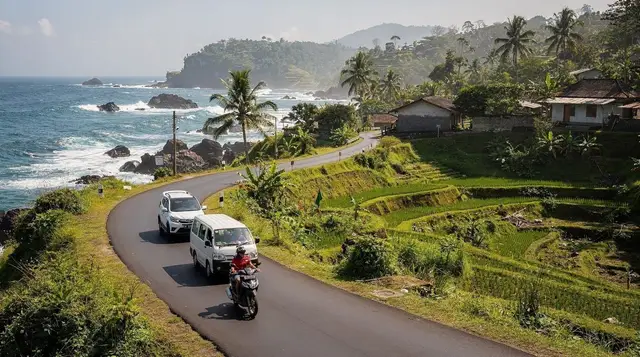
Sidemen sits in a highland valley below Mount Agung, defined by terraced rice fields that fold across the hillsides in every direction and a pace of life that has changed relatively little compared with more developed parts of the island. It’s often mentioned as what Ubud looked like before its rapid growth, and while that comparison is imperfect, the underlying point holds: this is rural Bali, still working, still quiet.
The valley draws a specific kind of traveller: digital nomads and long-stay visitors looking for a calmer base than Canggu or Ubud, trekkers using it as a launch point for Mount Agung, and anyone who wants rice-terrace views without the crowds that now come with Tegalalang or Jatiluwih. It’s not built for a quick day-trip tick-box visit, and trying to treat it as one tends to undersell what it offers.
Sidemen is also home to a traditional weaving craft, songket and endek textiles produced on backstrap and other traditional looms, giving the valley a cultural thread alongside its scenery that’s easy to miss if you’re only passing through.
Sidemen at a glance
| Where | Highland valley below Mount Agung, Karangasem regency |
| Cost | Lower than Ubud for accommodation and food, with villa-style stays common for longer visits |
| Time needed | A couple of days minimum to appreciate the valley; longer for trekking or a genuine slow stay |
| Access | Private driver or scooter from south Bali, Ubud, or the East Bali coast; no tourist public transport |
| Best time | Dry season, roughly April to October, for clearer views and better trekking conditions |
The rice terraces and valley views
Sidemen’s terraces are worked, active farmland rather than a preserved attraction, which is part of what distinguishes the valley from more visited rice-terrace sites elsewhere on the island. Walking paths thread between fields and small villages, giving genuinely quiet views over the valley without the queues or paid photo spots found at more famous terraces.
Trekking Duangga Hill and the surrounding countryside
A short sunrise trek up Duangga Hill is one of the more accessible ways to take in the valley’s terraced landscape without committing to a full Mount Agung summit attempt. The Duangga Hill sunrise trek in Sidemen covers this shorter route, aimed at travellers who want the classic rice-terrace-and-mountain view without an overnight commitment or the altitude of a full volcano trek.
For a broader walk through the valley itself, an option like Sidemen trekking: a walk from a different perspective takes a more general route through rice terraces and villages, useful if the summit trek isn’t your goal and you’d rather spend a few hours simply moving through the landscape at a slower pace.
Rafting the Telaga Waja River
Sidemen is also a starting point for whitewater rafting on the Telaga Waja River, one of the more consistently run rafting routes in Bali given its reliable water flow compared with some seasonal alternatives elsewhere on the island. The private Telaga Waja River rafting trip with lunch covers a half-day on the water followed by a meal, a reasonable way to add an active element to an otherwise slow-paced valley stay.
Cooking classes and local food
Away from trekking and rafting, Sidemen’s food culture is worth engaging with directly rather than just eating at your guesthouse. A class such as the Sidemen cooking class with a local family is run out of an actual home kitchen rather than a tourist-facing culinary school, giving a more direct look at daily Balinese cooking than a resort-style class typically offers.
For those who also want a market visit built into the experience, the Sidemen cooking class with market tour and meal adds a stop at a local market before the cooking itself, useful if you want context on the ingredients rather than starting straight at the stove.
Traditional weaving in the valley
Sidemen has a long-standing reputation for traditional textile weaving, particularly songket, a hand-woven fabric incorporating gold or silver thread, produced on backstrap looms by artisans working from home workshops rather than a centralised factory. Visiting a workshop, even briefly, gives a sense of the skill and time involved in a single piece of cloth, and buying directly supports the craft more meaningfully than purchasing the same style of textile from a general souvenir shop elsewhere on the island.
Where to stay in the valley
Accommodation in Sidemen leans heavily toward villas and guesthouses positioned for rice-field views, often set back from the main road along smaller access lanes rather than clustered in a single village centre. This spread-out layout is part of the valley’s appeal, since it means genuine quiet and space between properties, but it also means location matters more here than in a compact town.
Longer-stay visitors, including the remote workers the valley increasingly attracts, tend to favour villas with a proper kitchen and reliable internet over hotel-style rooms, given how much time is typically spent on-site rather than out exploring a dense restaurant or activity scene that doesn’t really exist here.
A base for remote work and longer stays
Sidemen has quietly become a preferred base for a small but steady population of digital nomads and long-stay travellers who want Bali’s slower, rural side without Ubud’s traffic and density. Reliable internet is more property-dependent here than in a purpose-built co-working hub, so it’s worth confirming connection speed directly with a villa or guesthouse before committing to a longer stay if remote work is part of the plan.
The trade-off for that quiet is fewer co-working spaces, cafes, and the kind of social infrastructure that’s grown up around nomad communities in Canggu or Ubud. Sidemen suits travellers who want solitude and scenery over a built-in social scene.
What isn’t worth the detour
Sidemen isn’t the place for nightlife, a dense restaurant scene, or organised shopping — none of that exists here in any real form, and travellers expecting Ubud’s amenities within a similarly rural setting will be disappointed. A day trip that only allows for a couple of hours in the valley also tends to undersell it; the appeal is largely about slowing down, which a rushed visit can’t really deliver.
Some accommodation listed as having “rice field views” turns out to be a partial glimpse rather than the sweeping panorama shown in marketing photos, so it’s worth checking recent guest photos rather than relying on a listing’s official images alone.
Comparing Sidemen and Ubud as a base
| Sidemen | Ubud | |
|---|---|---|
| Pace | Rural, quiet, spread out | Busier, more built-up, walkable centre |
| Restaurants and cafes | Limited, mostly guesthouse-attached | Dense, wide variety |
| Rice terrace views | Working farmland, uncrowded paths | Popular terraces, can be crowded |
| Transport | Private driver or scooter close to essential | Walkable core, with scooter for outer sights |
| Best suited to | Longer, quieter stays, trekkers | First-time visitors, shorter stays, more amenities |
Neither is a straightforward upgrade over the other; they suit different priorities. Travellers who’ve already spent time in Ubud and want a quieter counterpoint tend to get the most out of Sidemen, while first-time visitors often prefer Ubud’s greater range of restaurants and organised activities within easy reach.
What it costs
Sidemen runs cheaper than Ubud for both accommodation and food, and villa-style stays with kitchens are common here for travellers planning a longer, slower visit rather than a short hotel stay. Activities like trekking, rafting, and cooking classes each carry their own separate costs, and comparing operators is worthwhile since quality and group size vary between providers offering similar experiences.
Given the valley’s spread-out layout, private transport, whether a hired driver or your own scooter, is close to essential rather than optional, and is worth budgeting for as a near-daily cost if you’re staying more than a couple of nights.
Best time to visit
The dry season, roughly April to October, offers the clearest mountain views and the most reliable conditions for trekking, whether that’s the shorter Duangga Hill route or a full Mount Agung attempt. During the wet season, from November to March, expect the valley’s characteristic mist to linger longer into the morning and short, heavy downpours in the afternoons, which can affect both trekking plans and rafting conditions on the Telaga Waja River depending on water levels.
Getting there and getting around
Sidemen sits inland and uphill from Bali’s east coast, a meaningful but manageable drive from south Bali and a somewhat shorter one from Ubud. There’s no tourist-oriented public transport, so a private driver or your own scooter is the practical way to get here and move around once you’ve arrived, given how spread out accommodation, workshops, and trailheads are across the valley. The roads themselves are narrower and more winding than the main routes further south, which is worth factoring into your driving time estimate.
How this fits into a longer trip
Sidemen fits naturally into a wider East Bali route rather than a standalone stop. The East Bali, 4 days itinerary pairs it with Besakih, Tirta Gangga, and the coast toward Amed, and the East Bali day trip guide is useful for shorter visits.
For trekkers, the Mount Agung trek guide and what to pack for a volcano trek pages are essential reading before attempting the summit route from this side of the mountain. If Sidemen’s slower pace appeals more broadly, the Ubud versus Canggu comparison and the Bali yoga and wellness, 7 days itinerary are worth a look for how a valley base like this compares to other slow-travel options.
Rafters and adventure travellers might also check the Ayung River rafting guide for how the Telaga Waja route compares to Bali’s other main rafting river near Ubud, and the East Bali is the Bali people miss piece for more on why this side of the island draws repeat, slower-paced visitors.
Frequently asked questions about Sidemen
Is Sidemen worth visiting if I’ve already spent time in Ubud?
Yes, if you’re looking for a quieter, less developed version of a similar rice-terrace setting. The experiences differ enough in pace and amenities that it doesn’t feel repetitive.
Do I need a car or driver to get around Sidemen?
Effectively yes. The valley is spread out, and without private transport, getting between accommodation, trailheads, and workshops involves long walks or reliance on scooter hire.
Can beginners attempt the Mount Agung trek from Sidemen?
The full summit trek is a serious, physically demanding undertaking better suited to reasonably fit hikers with proper preparation, not a casual walk. The shorter Duangga Hill trek is a more accessible alternative for less experienced trekkers.
How does Telaga Waja rafting compare to other rivers in Bali?
It’s known for a more reliable water flow than some seasonal alternatives, making it a consistent choice for rafting regardless of exactly when in the season you visit, within reason.
Is Sidemen suitable for a family with young children?
It can work for families comfortable with a rural, activity-light pace, though the winding roads and lack of organised children’s activities make it better suited to families who want quiet time over structured entertainment.
What’s the best way to see the rice terraces without joining a formal tour?
Independent walking along the valley’s paths, either from your accommodation or a short scooter ride to a trailhead, is straightforward and doesn’t require booking anything, unlike some of Bali’s more managed rice-terrace attractions.
Is Sidemen a good base for a longer, slower stay?
Yes, it’s one of the more popular East Bali choices for travellers wanting a week or more away from a fixed itinerary, particularly those working remotely or prioritising quiet over convenience.
Can I visit a weaving workshop without buying anything?
Yes, most workshops are happy to have visitors watch the process without an obligation to purchase, though buying directly, if a piece appeals to you, is a meaningful way to support the craft over a general souvenir shop elsewhere.