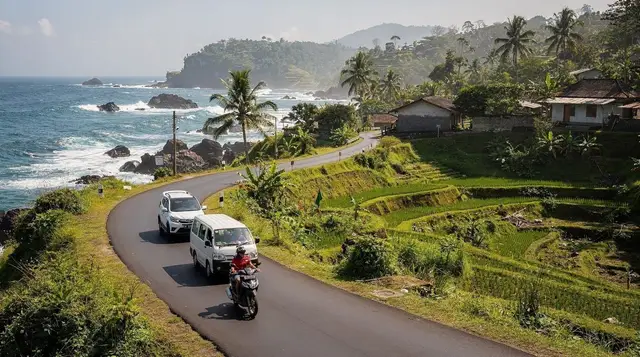
Amed is not one village but a loose string of them along Bali’s northeast coast, each one built around a black-sand beach and a small fleet of traditional outrigger fishing boats called jukung. The pace here is set by the fishing and salt-farming families who lived here long before diving tourism arrived, not by beach clubs or nightlife, and that shows in almost everything about the place.
What draws most visitors now is the diving and snorkelling directly off the coast, reachable without a long boat ride, plus the fact that Amed sits close enough to Tulamben’s famous wreck dive to be used as a base for it. But even travellers with no interest in diving tend to find the slower rhythm here a useful contrast after the busier south.
Getting here takes real time, which naturally filters out day-trippers and rewards people who commit to staying a night or two rather than passing through.
Amed at a glance
| Where | Northeast coast of Bali, Karangasem regency |
| Cost | Generally lower than south Bali for accommodation and food; dive packages are the main planned expense |
| Time needed | A couple of nights minimum to make the long drive worthwhile; longer for a dive course |
| Access | Private driver or scooter from south Bali or Ubud; no direct public transport aimed at tourists |
| Best time | Dry season, roughly April to October, for calmer seas and clearer underwater visibility |
The coastline, village by village
The name Amed technically refers to one specific village, but it’s commonly used to describe the whole stretch running from Amed itself through Jemeluk, Bunutan, Lipah, and further along toward Aas. Each has its own small bay and beach, and the character shifts gradually as you move along the coast, from slightly busier near Amed village itself to noticeably quieter the further east you go.
Jemeluk Bay is usually the most active stretch for snorkelling and shore diving, with a coral slope close to the beach that’s accessible without a boat. Further along, the villages thin out and the salt-farming activity becomes more visible, particularly in the morning when farmers are working the traditional evaporation troughs along the shore.
Where to base yourself along the strip
Amed village itself and Jemeluk Bay have the highest concentration of dive shops, warungs, and guesthouses, which makes them the practical choice if you want things within easy walking distance. It also means slightly more foot traffic and a livelier, if still modest, evening atmosphere compared to the rest of the coast.
Further east toward Bunutan, Lipah, and Aas, accommodation thins out and skews toward quieter guesthouses and small resorts, often with better direct beach access and fewer neighbours. The trade-off is that you’ll rely more on a scooter or driver to reach dive shops, restaurants, or a wider choice of food than what’s within your own bay.
Diving and snorkelling right off the beach
Amed’s underwater draw is largely about convenience: several good sites are reachable by wading in from the shore rather than needing a boat, which lowers the barrier for casual snorkellers as much as it benefits divers doing multiple sessions in a day. The reef slopes here support a good range of coral and reef fish, and the calm, sheltered bays make for comfortable conditions most of the year.
A multi-day option like the Amed 2-day snorkel adventure covering the USAT Liberty and a Japanese wreck is a reasonable way to see both Amed’s shore sites and the nearby wrecks without arranging separate logistics for each.
For certified divers and those getting certified
Amed and neighbouring Tulamben together form one of Bali’s most established diving hubs, largely because the water stays calm enough for reliable diving conditions across much of the year and the sites are varied enough to fill several days without repeating a dive. For divers who want a multi-day, multi-dive itinerary rather than single bookings, an option like the Amed-Tulamben fun dive safari over two days with four dives bundles the logistics into one package.
If you’re not yet certified but want to try diving, a short taster session removes the commitment of a full course. The Amed-Tulamben beginner discover scuba diving adventure over two days is built for exactly that, pairing an introductory dive with an overnight stay so you’re not rushing straight back to south Bali afterward.
For those short on time who just want a single taste of scuba before deciding whether to commit to a full course, the Amed-Tulamben discover scuba diving one-day trip with lunch covers the basics in a single day rather than an overnight stay.
Salt farming, still done the traditional way
Along parts of the Amed coastline, particularly toward the quieter eastern villages, you can still see traditional sea-salt production using black volcanic sand and simple wooden presses, a method that predates the tourism industry here by generations. Farmers carry seawater-soaked sand to filtering troughs, then evaporate the collected brine in hollowed coconut-log trays or shallow pools until crystals form.
It’s a genuinely working craft rather than a staged demonstration, which means visiting respectfully matters: watch from a reasonable distance, ask before photographing people directly, and consider buying a small bag of the salt if you want a low-key way to support the practice rather than just observing it.
Food and daily life along the coast
Amed’s food scene is built around small family-run warungs rather than a restaurant strip, and the better ones tend to be attached to guesthouses or dive shops rather than standing alone on the main road. Fresh fish, often caught by the same jukung boats visible from the beach, is a reliable order at most of them. Don’t expect the variety or polish of Seminyak or Canggu’s restaurant scene; the appeal here is simplicity and proximity to the water rather than choice.
Daily life along the strip still visibly runs on fishing and farming rhythms rather than tourism alone — boats going out at dawn, salt farmers working the shoreline through the morning, nets drying on the sand. It’s part of what makes Amed feel different from more purpose-built beach destinations elsewhere on the island.
The view across the strait
On a clear day, particularly early morning before haze builds up, you can see across to Lombok from parts of the Amed coast, with Mount Rinjani’s outline visible on the horizon. Looking the other way, inland, Mount Agung’s slopes rise behind the coast road, giving Amed a backdrop of two volcanoes rather than the flat horizon of a typical beach town.
It’s a genuine reason to have a camera ready in the early morning hours, particularly from the higher stretches of coast road between villages, where the elevation gives a cleaner view over the bays below than from beach level.
What isn’t worth the detour
Don’t come to Amed expecting a lively beach scene, restaurant strip, or nightlife comparable to Seminyak or Canggu — that’s simply not what this coast offers, and travellers expecting it tend to leave disappointed regardless of how good the diving was. Some of the beaches here are also narrower and rockier than the postcard image of a Bali beach, with grey-black volcanic sand rather than the pale sand of the south, which is worth knowing if a classic sunbathing beach is what you’re after.
A few dive operators along the strip cut corners on equipment maintenance and briefing quality, so it’s worth being selective rather than booking whichever dive shop is nearest your hotel; a little research on operator reputation goes further here than in most parts of Bali.
What it costs
Amed runs cheaper than south Bali for accommodation and food generally, which is part of its appeal for longer stays. The main planned expense is diving: single dives, multi-dive packages, and certification courses all carry their own separate cost structures, and prices vary meaningfully between operators, so it’s worth comparing a couple before committing, especially for a full certification course that spans several days.
Snorkelling gear rental is inexpensive and widely available if you don’t want to dive but still want to see the reef. Transport, given the distance from south Bali, is the other real cost variable — a private driver for the transfer costs more than a shared shuttle, but saves meaningful time compared to arranging your own multi-stop route by scooter.
Longer stays also change the maths in Amed’s favour: weekly or monthly guesthouse rates are common and noticeably better value than nightly bookings, which is part of why the town has a small but steady population of long-stay divers and remote workers who treat it as a base rather than a stop. If you’re weighing Amed against a shorter, more expensive south Bali stay, the total cost of a slower week here often comes out lower even after accounting for the extra transport to get up the coast.
Best time to visit
The dry season, roughly April to October, brings calmer seas and generally better underwater visibility, which matters more here than at a beach destination since diving and snorkelling are the main draw. The wet season from November to March can still be diveable, but choppier conditions and reduced visibility are more common, along with the short, heavy downpours typical of Bali’s rainy months. Whatever the season, mornings tend to have calmer water than afternoons, which is why most dive trips depart early.
Getting there and getting around
Amed sits well up Bali’s northeast coast, a genuinely long drive from the southern resort areas — plan for a substantial chunk of a day just in transit if you’re coming from Kuta, Seminyak, or Canggu, and a shorter but still significant drive from Ubud. There’s no tourist-oriented public transport that makes this practical without a private driver or your own scooter.
Once you’re there, the coast road running through the villages is manageable by scooter for getting between bays, though a permit is required and the road narrows and winds in places, particularly toward the quieter eastern stretch. Many guesthouses and dive shops can arrange scooter rental directly, which saves the hassle of sourcing one before you arrive.
How this fits into a longer trip
Amed pairs naturally with a longer East Bali stop rather than a rushed day trip from the south. The East Bali, 4 days itinerary threads it together with Tulamben, Tirta Gangga, and Sidemen without excessive backtracking, and the East Bali day trip guide is useful if you’re deciding how to sequence a shorter visit.
For divers weighing up where to base themselves, the Amed versus Tulamben comparison and the best diving in Bali overview cover the trade-offs in more depth than this page can. The dedicated Amed diving guide and learn to dive in Bali pages are worth reading before booking a course.
If you’re weighing Amed against a broader East Bali loop, Candidasa and Padangbai are worth considering as alternative or additional bases, useful if your dates fall outside the dry season and you’d rather split the trip between diving days and slower ones. Anyone building a full itinerary might also check the Bali diving trip, 10 days plan for how Amed slots into a dedicated diving-focused route.
Frequently asked questions about Amed
Is Amed good for non-divers?
Yes, though it’s a quieter stop than most Bali beach towns. Snorkelling straight off the beach, watching traditional salt farming, and simply slowing down are the main draws if diving isn’t your focus.
How far is Amed from south Bali?
It’s a genuinely long drive up the northeast coast, long enough that most visitors treat it as a multi-day stop rather than a day trip from Kuta or Seminyak.
Is Amed better than Tulamben for diving?
They’re complementary rather than competing — Amed offers several distinct shore-diving bays, while Tulamben is specifically built around the Liberty wreck. Many divers base themselves in one and visit the other as a day trip.
Do I need to be a certified diver to enjoy Amed?
No. Shore snorkelling is accessible to anyone comfortable in the water, and discover scuba sessions let beginners try diving with an instructor without a full certification course.
What’s the best time of year to dive in Amed?
The dry season, roughly April to October, generally offers calmer water and better visibility, though diving happens year-round with conditions varying more than the calendar alone.
Are the beaches in Amed good for swimming and sunbathing?
They’re serviceable but not the pale-sand postcard beaches of south Bali — expect black volcanic sand and a rockier shoreline in places, better suited to snorkelling entry points than lounging.
Is Amed suitable as a base for a whole trip, or just a stop?
It works well as a multi-night stop within a wider East Bali route rather than a single-destination trip, given the distance from the airport and the limited range of things to do beyond the water.
Where should I stay if I don’t have my own transport?
Amed village or Jemeluk Bay, since dive shops, warungs, and guesthouses are within walking distance of each other there, unlike the quieter stretches further east that rely more on a scooter or driver.