Besakih is not a single temple. It is a complex of more than twenty separate temples, stacked up the southwestern slope of Mount Agung in terraces, tied together as the spiritual centre of Balinese Hinduism. Locals call it the Mother Temple, and the name is not marketing: every clan and village temple on the island is, in the traditional cosmology, connected back to this one. That matters for how you should think about a visit. You are not walking into a museum piece built for tourists; you are walking into a site that is still fully in use, with active shrines, ongoing ceremonies, and a resident priesthood.
The complex also sits at the top of a strict temple hierarchy that shapes how Balinese Hindus themselves relate to it. Every banjar (neighbourhood) and desa (village) temple across the island is understood to connect conceptually back to Besakih, which is part of why the site hosts some of the largest and most heavily attended ceremonies in the Balinese Hindu calendar rather than functioning as a single congregation’s temple. Understanding that context changes how the visit reads: the crowds of worshippers you may see moving between courtyards carrying offerings are not there for you, and the visit works best when you treat yourself as a respectful guest at someone else’s ongoing religious life rather than the intended audience.
It also means Besakih has a reputation problem it has never quite shaken off. For years, visitors have reported being cornered by self-appointed “guides” near the car park who insist that entry is impossible without paying them, then push for donations well beyond anything reasonable once inside. None of this makes the temple less significant. It does mean you should arrive knowing the routine in advance, because the difference between a good visit and a bad one here comes down almost entirely to preparation rather than luck.
Most non-Hindu visitors see Besakih from the outer courtyards and walkways rather than entering the innermost shrines, which stay reserved for worship. That is normal, not a downgrade of the experience — the split-gate architecture and tiered black-thatched roofs (meru) are visible and photogenic from the areas open to the public, and on a clear day the site’s position on Agung’s flank is the real draw.
Besakih at a glance
| Where | Slopes of Mount Agung, Rendang district, East Bali |
| Cost | Entrance ticket plus mandatory sarong/sash rental (usually included in the ticket); a genuine local guide is optional but widely pushed as compulsory |
| Time needed | A couple of hours on site, longer with photography or a full loop of the terraces |
| Access | Self-drive scooter, private driver, or a coordinated day tour from South Bali, Ubud, or Sanur |
| Best time | Early morning for light and quiet; avoid arriving in the middle of a major ceremony unless you specifically want to witness one respectfully from a distance |
The guide situation, explained plainly
This is the single thing every visitor asks about, so it deserves its own section rather than a footnote. At the car park and approach path, you will very likely be approached by men offering to “guide” you, sometimes framing it as compulsory. It is not compulsory in any official sense — the temple itself does not require a private guide to enter the public areas. What happens in practice is that a mix of persistence, vague authority, and the fact that most travellers do not want a confrontation on their first minutes at a sacred site leads to people paying far more than they intended, sometimes for a walk of a few minutes.
The simplest way to sidestep the entire issue is to arrive as part of an organised tour rather than alone by scooter. A coordinated visit, such as the Besakih temple tour that pairs the complex with a waterfall and rice terrace stop, comes with a driver who already knows the local dynamics, which removes most of the friction. It is not the only way to do it well, but it is the lowest-stress one.
What you actually see once you are inside
The heart of the visit is the Penataran Agung, the largest and most central of the temple cluster, recognisable by its long run of stepped courtyards and candi bentar split gateways climbing toward the mountain. You will not walk through the innermost sanctum, but the outer terraces give a clear view of the tiered meru roofs, some with well over a dozen tiers, which signal the importance of the deity honoured there. Stone carving, offerings replenished daily, and the general sense of a site still doing its original job are the actual substance of the visit — there is very little in the way of curated exhibits or signage, which some visitors find refreshing and others find under-explained.
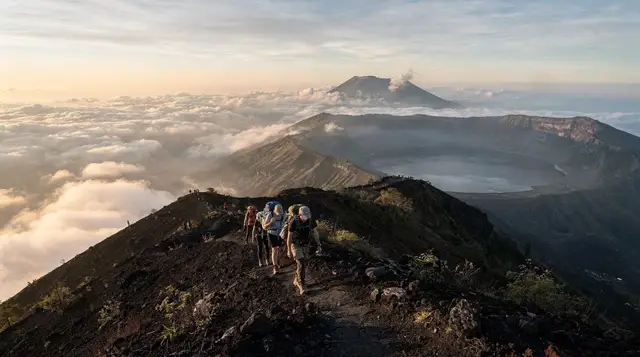
Because Besakih sits on the flank of an active volcano, the backdrop itself is part of the appeal on a clear day. Cloud cover rolls in from around mid-morning most of the year, so if a view of Agung matters to you as much as the temple itself, arriving early is not just about crowds.
Pairing Besakih with Lempuyang and Tirta Gangga
Almost every organised tour bundles Besakih with the Lempuyang temple complex (the so-called Gate of Heaven) and the Tirta Gangga water palace, since all three sit within a reasonable driving loop through East Bali. This is worth doing deliberately rather than by accident, because each site asks something different of you: Besakih is about scale and atmosphere, Lempuyang about a very specific (and heavily queued) photo composition, and Tirta Gangga about slower wandering through royal water gardens.
A tour like the Besakih, Lempuyang and Tirta Gangga day tour covers the logistics of stringing the three together, which is genuinely difficult to plan well on your own given the driving distances and the queue management needed at Lempuyang.
If you would rather add a natural stop instead of a second temple, several operators route through Tukad Cepung waterfall and the well-known village of Penglipuran on the same day, such as the combined Besakih, Tukad Cepung waterfall and Penglipuran village tour. It makes for a longer day but a more varied one, mixing temple architecture, a narrow-canyon waterfall, and a well-preserved traditional village street.
What isn’t worth the detour
Skip the pressure to buy overpriced “temple offerings” or trinkets from vendors positioned right at the entrance — these are aimed squarely at visitors who feel they need to do something ceremonial and don’t know the going rate for anything. A genuine offering, if you want to make one, is better arranged through your driver or guide from an organised tour, who can point you to a fair price. Also skip trying to see every one of the twenty-plus temples in the complex in one visit; most are not open to general visitors, and chasing a complete tour adds walking time for very little additional insight beyond the main Penataran Agung terraces.
Understanding what you’re looking at
The tiered black-thatched meru towers are the most recognisable feature of the complex, and the number of tiers is not decorative — it signals the relative status of the deity honoured at that particular shrine, with the highest counts reserved for the most significant.
The split gateway (candi bentar) design, which looks like a single gate cleaved in two, recurs at every threshold you cross and is one of the clearest visual markers of Balinese temple architecture generally, so Besakih is a useful reference point for recognising the same pattern at smaller temples elsewhere on the island. None of this is explained on site with much signage, which is part of why a guide who actually knows the architecture, rather than one just working the car park, adds real value if you want more than a walk-through.
What it costs
Budget for a modest entrance fee and sarong rental, which is usually bundled into a single ticket price at the official booth. Beyond that, the real cost variable is transport: a private driver or organised tour for a half-day covering Besakih and one or two additional stops will run more than a solo scooter trip, but it also removes the guide-pressure problem and the navigation stress of East Bali’s winding roads.
Treat any request for a large donation inside the temple grounds with scepticism — a genuinely small, discreet offering is customary, not a fixed tourist fee. Booking ahead through an organised tour also tends to work out closer in total cost to a well-negotiated self-drive trip than people expect, once you account for the guide-pressure tax that solo visitors so often end up paying without realising it until afterwards.
When to go
The dry season, roughly April to October, gives you the best chance of a clear view of Mount Agung from the temple terraces, since cloud and rain are more frequent and heavier in the wet months from November to March. Independent of season, early morning before the heat and the tour-bus arrivals is consistently the quietest window. If you want to witness Besakih at its most alive rather than its quietest, timing a visit around one of its major annual ceremonies is an option, though you should expect restricted access to certain areas and a much larger crowd of Balinese worshippers rather than tourists.
Getting there and getting around
Besakih sits well up the slopes of Mount Agung in East Bali’s Rendang area, which puts it a meaningfully long drive from the southern resort areas — plan for the bulk of a morning just in transit if you are coming from Kuta, Seminyak, or Canggu, and a shorter but still significant drive from Ubud. There is no public transport option that makes sense for tourists; this is scooter, private driver, or organised tour territory. Given the winding mountain roads, the queue-management issues at nearby Lempuyang if you combine the two, and the guide situation described above, most first-time visitors are better served by a coordinated tour than by self-driving, even if they are comfortable on a scooter elsewhere in Bali.
How Besakih fits into a longer trip
Besakih works best as one stop within a dedicated East Bali day rather than a rushed side trip from an already packed South Bali itinerary. If you are building out a longer stay, read the East Bali day trip guide for how to sequence it with nearby stops, or look at the Besakih Mother Temple guide for a deeper dive into the complex’s layout and etiquette.
Travellers assembling a full itinerary should check the East Bali, 4 days plan, which threads Besakih together with Tirta Gangga, Tenganan, and Sidemen without the backtracking that catches a lot of self-planned trips.
Before you go, it is worth reading the temple etiquette and dress code guide, since the rules at Besakih are stricter in practice than at more tourist-oriented temples closer to the south coast. If your visit might coincide with a major religious date, the Balinese ceremonies guide and the how Nyepi affects your trip page are worth a look, since East Bali’s temple calendar can reshape a itinerary around it more than visitors expect.
Frequently asked questions about Besakih Mother Temple
Is a guide really required to enter Besakih?
No. The entrance ticket at the official booth is what grants access to the public areas. Anyone insisting a private guide is compulsory at the gate is not speaking for the temple administration, even if they present it that way.
Can non-Hindus enter the temple at all?
Yes, but access is generally limited to the outer courtyards and walkways rather than the innermost shrines, which are reserved for worship. This is standard practice at active Balinese temples, not something specific to Besakih.
How long does the drive from South Bali actually take?
Long enough that Besakih is realistically a half-day-or-more commitment once you include the round trip, which is why most visitors pair it with other East Bali stops rather than treating it as a single-site outing.
Is Besakih affected by Mount Agung’s volcanic activity?
The temple sits on the volcano’s slope, and access can be affected during periods of elevated volcanic activity. Check current conditions before travelling if Agung has been active recently, rather than relying on older trip reports.
What should I wear?
A sarong and sash are required within the temple grounds; these are almost always available to rent or borrow on site or provided as part of an organised tour, so you do not need to arrive with your own, though bringing one is never a bad idea in Bali generally.
Is it worth visiting if I’ve already seen Tirta Empul or Uluwatu?
Besakih offers something different from either — it is about scale and the complex’s status as the island’s spiritual centre rather than a single dramatic setting. If temple architecture and atmosphere interest you rather than just photography, it holds up well even after seeing Bali’s more famous single temples.
Is Besakih crowded with tourists, or mostly local worshippers?
It varies by day. On an ordinary weekday you will see a mix, often with more Balinese worshippers going about ordinary temple business than foreign visitors. On major ceremony dates, the balance shifts heavily toward local worshippers, and the atmosphere is markedly different — busier, more devotional, and less oriented around sightseeing.
Can I combine Besakih with Mount Batur or Kintamani in one day?
It is physically possible since both sit in the wider central-to-east Bali highlands, but it makes for a very long day of driving on mountain roads. Most people get a better experience treating Besakih as part of an East Bali loop with Lempuyang and Tirta Gangga, and saving Kintamani and Batur for a separate day focused on the caldera.
Should I bring cash?
Yes. Ticket booths, sarong rental, and any legitimate offering are cash transactions, and East Bali is not an area to rely on cards.