Tetebatu does not appear on the Lombok highlight reel the way the Gili Islands or Kuta Lombok’s surf beaches do, and that is more or less the point. It is a farming village strung along the lower southern slopes of Mount Rinjani, built around rice terraces that are still worked rather than staged for photographs, a patch of forest with a resident troop of macaques, and a scatter of waterfalls reachable on foot. The pace here is set by the rice cycle and the mountain weather, not by a beach clubs schedule.
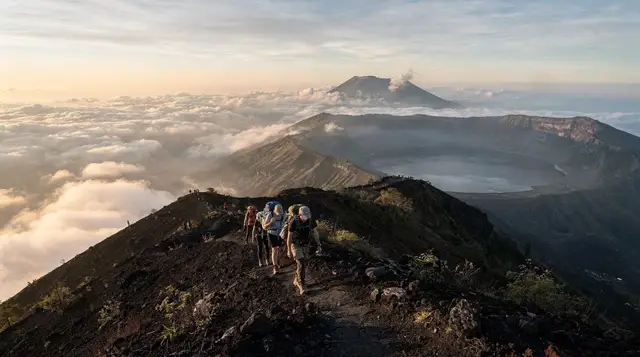
What draws people up here is partly the air. Tetebatu sits at enough elevation that the heat of the coast eases off, mornings are properly cool, and Rinjani’s summit is visible on a clear day rather than a distant rumour. For travellers who have already done a beach stretch on Gili Trawangan or Senggigi, or who are training legs and lungs before a Rinjani trek, a night or two here is a genuinely different register of Lombok.
It is not a place to expect polish. Homestays outnumber hotels, English is patchier than on the Gilis, and the roads narrow to single-lane village tracks the further you get from the main junction. That is exactly why some travellers find it the most memorable stop on their Lombok trip, and why others who wanted a swim-up bar find it underwhelming. Go in knowing which kind of traveller you are.
Tetebatu at a glance
| Where | Southern slopes of Mount Rinjani, East Lombok, roughly a two-hour drive from the west coast |
| Cost | Low; homestays and warungs are inexpensive, the main added cost is a driver or organised day tour |
| Time needed | A day trip is possible, but one night lets you catch the cooler morning light on the terraces |
| Access | Private driver, chartered car, or an organised day tour from Senggigi, Kuta Lombok, or the Gilis via the mainland |
| Best time | Dry season for reliable trail conditions; early morning year-round for the clearest Rinjani views |
The rice terraces, and why they photograph so well
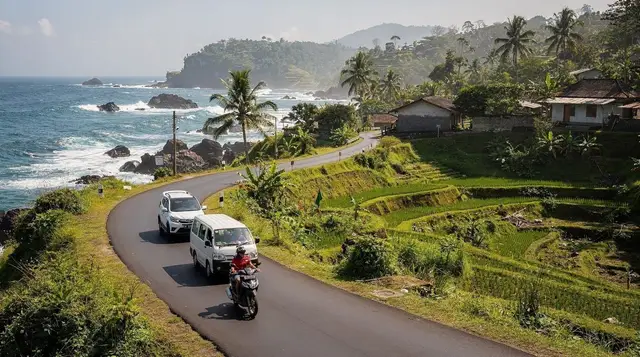
Tetebatu’s terraces climb the hillside in the tiered pattern familiar from Ubud’s Tegalalang, but with far fewer people standing in the way of the shot. The difference is scale and use: these fields still feed the village, farmers are out working them on an ordinary morning, and the paths that cut between paddies are functional footpaths rather than a curated walkway. Early light, before the haze builds up over the day, is when the water in the flooded terraces catches the sky and the whole hillside goes to green and silver.
A guided walk through the terraces, sometimes bundled with the monkey forest and a waterfall, is the easiest way to see the layout without getting lost in the maze of paths, and a local guide will usually explain the irrigation logic that keeps every tier fed from the one above. The rice terraces, monkey forest and river tubing day trip strings the three headline elements of Tetebatu together into a single half-day loop, which suits travellers who only have one day to spare here.
The black monkey forest, honestly
Tetebatu’s forest is home to a population of long-tailed macaques that locals refer to as the “black monkeys” for their darker colouring compared with the greyer troops elsewhere on Lombok and Bali. It is a genuine patch of forest rather than a fenced enclosure, and walking through it feels closer to a nature reserve than the more commercialised monkey forests further west. That said, the same rules apply as anywhere macaques and tourists mix: do not carry food in the open, keep sunglasses and loose items secured, and do not attempt to touch or feed the animals no matter how used to people they seem.
Waterfalls within reach
Two waterfalls sit within a manageable walk or short drive of Tetebatu village, both fed by streams running off Rinjani. They are smaller and less visited than Sekumpul or Tegenungan on Bali, which is either a plus or a minus depending on what you are after — quieter pools, but also less infrastructure around them. A private day trip built around the hidden waterfalls of Tetebatu is a reasonable way to see more than one without working out the trailheads yourself, particularly useful after rain when paths are less obvious.
The walk to either falls typically passes through more rice terrace and patches of forest, so even if the waterfall itself turns out modest by Bali standards, the walk in tends to be the more memorable part of the outing.
Using Tetebatu as a Rinjani staging point
Tetebatu is not the main trailhead for Mount Rinjani treks — that role belongs to Senaru on the northern side and Sembalun to the east — but its elevation and cooler climate make it a sensible place to acclimatise for a night or two before or after a summit attempt. Some operators run village and nature tours from Tetebatu that double as a soft introduction to the mountain’s lower slopes, such as the Tetebatu nature and culture experience toward Mount Rinjani, without committing to a full multi-day trek.
If the summit itself is the goal, plan your Rinjani logistics from Senaru or read the dedicated Mount Rinjani trek guide rather than trying to organise a serious ascent from Tetebatu itself.
ATV routes and village life
For a faster way to cover more ground than walking allows, several operators run ATV routes looping through the rice terraces, past waterfalls, and along village tracks. The Tetebatu ATV tour through waterfalls, jungle and village life is the option most travellers land on, and it suits anyone who wants the same scenery as the walking tours but with less time spent on foot. It is noisier and less contemplative than walking, which is worth weighing if quiet is part of why you came up here in the first place.
Where to stay and how it changes the visit
Tetebatu’s accommodation is almost entirely small homestays and a handful of modest guesthouses, most run by local families and set right against the rice fields. There is no resort strip here, and that absence is part of what keeps the village feeling lived-in rather than built for tourism. Staying overnight, even one night, changes the experience meaningfully: you get the terraces at the golden hour without a day-trip driver waiting, and you get an evening in a village that empties out almost entirely once the day-trippers head back to the coast.
The road in, and why it takes longer than the map suggests
Distances on Lombok look short on a map and then take considerably longer in practice, and the road to Tetebatu is a good example. The final stretch narrows from a two-lane provincial road to a single village lane winding between fields, and traffic thins to almost nothing beyond the last few kilometres — which is pleasant once you are there but means a driver unfamiliar with the area can lose time doubling back. Booking a driver who already knows Tetebatu, whether through a homestay or an organised tour, removes this friction entirely and is one of the few points on this trip worth paying a little extra to get right.
A quieter alternative to Ubud’s terraces
Travellers who found Tegalalang’s rice terraces near Ubud more crowded than they expected sometimes come to Tetebatu specifically looking for the version without the queue for a photo spot. The comparison holds up reasonably well: the terracing is similar in style, the walking paths are comparable, and the working nature of the fields is arguably more visible here since there is less tourism infrastructure layered on top. What Tetebatu does not have is Ubud’s density of cafes, swings, and viewpoint platforms, so go in expecting a plainer, more agricultural version of the same idea rather than a curated attraction.
What isn’t worth the detour
If your Lombok trip is genuinely short and centred on the Gili Islands, treating Tetebatu as a rushed half-day add-on undersells it — the drive alone can eat more time than the village itself gets in return on a tight schedule. It is also not the place to come looking for nightlife, beach clubs, or much in the way of restaurant variety; warung food and an early night are the norm. Travellers hoping for a full Rinjani summit experience without committing to the actual multi-day trek should also adjust expectations — Tetebatu offers a taste of the mountain’s lower slopes, not the crater rim.
Budget
Costs in Tetebatu run low relative to the Gilis or South Bali. Homestay accommodation, simple warung meals, and local guide fees for the forest or waterfall walks are all inexpensive by regional standards. The larger cost variable is transport: a private driver or organised tour from the coast covers a meaningful distance and takes a real chunk of the day, so factor that into any day-trip budget rather than assuming the village visit itself is where the money goes.
When to go
Dry season, roughly April through October, gives the most reliable trail conditions for the waterfall walks and the clearest chance of seeing Rinjani’s summit rather than cloud. Wet season showers on Lombok tend to be short and heavy rather than day-long, similar to Bali’s pattern, but paths through the forest and to the waterfalls do get more slippery, so a guide matters more if you visit outside the dry months. Early morning is the best light for the rice terraces regardless of season, before haze builds and before the heat of the day sets in.
Getting there and getting around
Tetebatu sits roughly a two-hour drive from Senggigi or the Lombok mainland ferry ports that connect to the Gili Islands, on inland roads that narrow considerably in the final stretch. There is no meaningful public transport option for tourists; a private driver, chartered car through a homestay, or an organised day tour are the realistic choices.
Once in the village, walking is the way to see the terraces and reach the nearer waterfall trailheads, with ATVs or a local guide’s motorbike useful for covering the ATV loop or reaching the farther waterfall. If you are coming from the Gilis rather than the Lombok mainland directly, budget time for the boat crossing on top of the overland drive; the fast boats to Nusa and Gili guide covers that leg.
How Tetebatu fits into a longer trip
Tetebatu works best slotted into a Lombok-focused stretch rather than bolted onto a single Bali itinerary, since the travel time to reach it only makes sense if you are already spending several days on Lombok. Pair it with a stay on Kuta Lombok for the surf and beach side of the island, or with time on Gili Trawangan, Gili Air, or Gili Meno if the islands are your main draw and Tetebatu is the inland contrast.
Travellers weighing up how much time Lombok deserves against Bali should read Bali vs Lombok, and anyone building a full route across both islands should look at the Bali and Lombok, two weeks itinerary, which has room to include an inland stop like this one.
If Rinjani itself is on your list, Tetebatu is worth visiting before or after the trek rather than instead of it — see the Mount Rinjani trek guide and the Tiu Kelep and Sendang Gile waterfalls guide for the northern-side alternative to the waterfalls described here.
Can I combine Tetebatu with a Gili Islands trip in a short stay?
It is possible but tight. The overland drive plus a boat crossing to the Gilis both take real time, so a Lombok trip of three days or fewer is better spent choosing one or the other rather than splitting a rushed day between them. On a longer stay of five days or more, pairing a night in Tetebatu with a few days on Gili Air or Gili Meno works well as a highland-then-island contrast.
Frequently asked questions about Tetebatu
How do I get to Tetebatu without a rental scooter?
A private driver or a seat on an organised day tour from Senggigi, Kuta Lombok, or one of the Gili Islands’ mainland ferry ports is the standard way in. Public transport does not run a practical route for tourists.
Is one day enough to see Tetebatu properly?
A single day covers the rice terraces, the monkey forest, and one waterfall if you move efficiently, but the drive eats a meaningful share of that day. An overnight stay lets you see the terraces in the best early light without a driver on the clock.
Do I need a guide for the waterfall walks?
It is not strictly required, but paths are unmarked and can be slippery, especially outside the dry season. A local guide is inexpensive and removes the risk of taking a wrong turn on unfamiliar trails.
Is Tetebatu suitable as a base for climbing Mount Rinjani?
Not for the summit trek itself — Senaru and Sembalun are the established trailheads. Tetebatu works better as a cooler, quieter place to acclimatise or unwind before or after the climb.
What is there to eat in Tetebatu?
Simple warung food built around Indonesian staples is the norm; there is no restaurant scene comparable to Bali’s tourist towns. Most homestays can also arrange meals directly.
Are the black monkeys dangerous?
They are wild macaques and should be treated with the same caution as any troop of monkeys near tourists: do not carry visible food, secure loose items like sunglasses, and keep a respectful distance rather than approaching them.