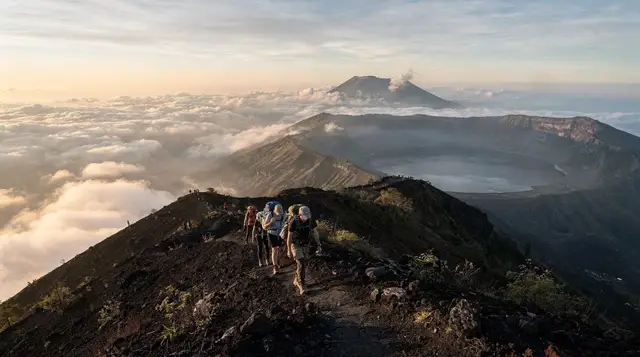
Senaru sits on Mount Rinjani’s northern flank, and for most travellers who make it here, the mountain is the primary reason — this is one of the two main trailhead villages for the multi-day Rinjani trek, alongside Sembalun on the eastern side. But treating Senaru purely as a logistics stop before a demanding climb sells it short. The village itself, a traditional Sasak settlement with its own distinct customs, sits at a high enough elevation to feel noticeably cooler than Lombok’s coastal towns, and its own set of waterfalls make it a worthwhile stop even for travellers not attempting the full Rinjani summit trek.
Sendang Gile and Tiu Kelep, a pair of waterfalls reachable via a moderate walk from the village, are genuinely rewarding on their own terms, offering a shorter, more accessible alternative to a full volcano trek for travellers who want a taste of the area’s natural scenery without committing several days to Rinjani. The walk between them passes through forest and past smaller cascades, a reasonable half-day activity that fits comfortably either side of the demands of a Rinjani trek.
Because of its cooler climate and traditional village character, Senaru also offers a genuinely different Lombok experience from the coastal towns and Gili Islands most visitors associate with the island — a highland, forest-adjacent atmosphere that stands in real contrast to the beach-and-boat rhythm found almost everywhere else on standard Lombok itineraries.
Senaru at a glance
| Where | Northern flank of Mount Rinjani, Lombok’s main northern trailhead village |
| Cost | Waterfall entry fees are modest; Rinjani trek costs are the larger expense if that’s part of your visit |
| Time needed | A day covers the waterfalls comfortably; add two to four days if trekking Rinjani |
| Access | Drive from Lombok’s main towns or the Gili Islands’ mainland ports |
| Best time | Dry season for trekking and waterfall safety; the elevation keeps temperatures cooler than the coast year-round |
Sendang Gile and Tiu Kelep waterfalls
Sendang Gile sits closer to the village and requires less walking, making it a reasonable option on its own if time is genuinely limited, while continuing further to Tiu Kelep adds a longer, slightly more strenuous stretch of trail rewarded by a taller, more dramatic cascade.
The walk to these two waterfalls is one of Lombok’s more accessible nature activities, requiring reasonable fitness but nothing close to Rinjani’s demands, passing through cool forest with several smaller cascades along the way before reaching each main fall. Both are swimmable under normal conditions, offering a genuinely refreshing stop given Senaru’s already cooler climate compared with the coast.
A one-day Rinjani taster
For travellers who want a genuine taste of the mountain without committing to the full multi-day summit trek, some operators offer a shorter one-day option covering part of the route from Senaru or the alternative Sembalun approach. The epic one-day Rinjani trek via Senaru or Sembalun is worth considering for trekkers with limited time or uncertain about committing to the full multi-day undertaking, though be clear that this reaches a lower point on the mountain rather than the true summit.
Village life and Sasak culture
Traditional thatched-roof homes and communal rice storage structures typical of Sasak highland villages remain visible in parts of Senaru, offering a quieter, less visited counterpart to the more frequently toured Sade village further south on the island.
Senaru’s traditional Sasak village sections offer a window into the same broader indigenous Lombok culture found in villages like Sade further south, with its own local customs around agriculture, community structure, and daily life shaped by the cooler highland environment. A guided visit, such as the Senaru village exploration with a women’s guide programme, offers particular insight into aspects of daily village life and craft that a standard mixed-guide tour might not cover in the same depth, alongside supporting local guiding opportunities specifically for women in the community.
Extended Rinjani treks departing from Senaru
For trekkers committing to the full multi-day Rinjani experience from this side of the mountain, several extended route options depart directly from the village. The four-day Mount Rinjani Torean trek departing from Senaru covers a fuller exploration of the mountain via the less-travelled Torean route, while the four-day guided Rinjani trek from Senaru offers a comparable full itinerary with a more standard route structure.
Both require the same level of fitness and preparation discussed on the dedicated Mount Rinjani page, and choosing between them comes down largely to how much you want to prioritise the less-crowded Torean trail specifically.
Coffee and produce from the highlands
Senaru’s elevation and cooler climate support a modest local coffee and produce growing tradition, distinct from the lowland tropical fruit farming found closer to Lombok’s coast. Small local stalls and warungs sometimes sell coffee grown in the immediate area, worth trying if you have an interest in how altitude changes what grows well in this part of Indonesia, a detail easy to miss if you pass through purely focused on the waterfalls or the trek ahead.
Accommodation style around the village
Senaru’s accommodation options range from simple guesthouses aimed primarily at trekkers needing a bed before an early start, to a small number of more comfortable stays that lean into the cooler climate and forest setting as their main appeal rather than purely functioning as trek logistics. Booking ahead is sensible during peak trekking season, given the relatively limited total capacity compared with Lombok’s larger coastal towns.
What isn’t worth the detour
Skip treating Senaru purely as a place to sleep before and after a Rinjani trek without setting aside any time for the Sendang Gile and Tiu Kelep waterfalls — they’re a genuinely worthwhile stop requiring only a few hours, not several additional days, and skipping them entirely undersells what the area offers beyond the volcano itself. Also skip underestimating how much cooler Senaru’s evenings are than the coast; travellers arriving directly from a Gili Islands stay are sometimes caught out without appropriate clothing.
The view back down toward the coast
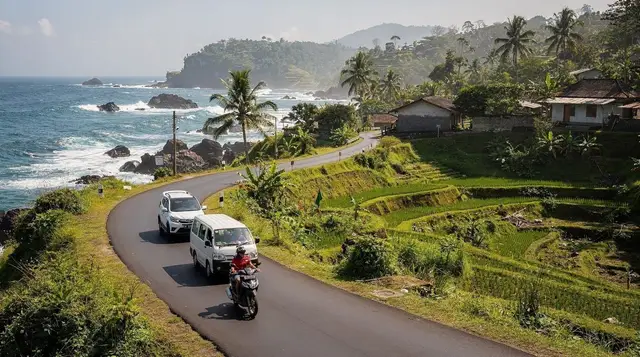
On clear days, several points along the road into Senaru and around the village itself offer sweeping views back down toward Lombok’s northern coastline and, further out, the silhouettes of the Gili Islands, a genuinely different perspective on the island’s geography than the sea-level views most visitors experience. It’s a reminder of just how much elevation separates Senaru’s cooler climate from the tropical beach towns most Lombok itineraries otherwise focus on entirely.
What it costs
Waterfall entry fees are modest, among the more affordable activities on a Lombok itinerary. The larger cost consideration for most Senaru visitors is the Rinjani trek itself, if that’s part of the plan, bundled separately as covered on the dedicated Mount Rinjani destination page.
Trail conditions and rainy season closures
Beyond general safety, the wet season’s heavier rainfall can make both the waterfall trail and the wider Rinjani route genuinely hazardous, with increased risk of landslips and swollen stream crossings on some sections. Reputable local guides and operators monitor these conditions closely and will advise against or postpone a specific walk or trek when conditions warrant it, which is worth respecting even if it means adjusting your plans on short notice.
When to go
Dry season, roughly April through October, is the safer and more comfortable window both for the waterfall walk, given slippery path conditions in wet weather, and for any Rinjani trek attempted from this base. Senaru’s elevation keeps temperatures meaningfully cooler than Lombok’s coast throughout the year, worth factoring into what you pack regardless of season.
Combining Senaru with Sembalun
Trekkers whose Rinjani itinerary enters via one village and exits via the other get a natural, if brief, chance to compare Senaru’s forested, village-focused character with Sembalun’s more open, savanna-adjacent setting on the mountain’s eastern side. Even travellers not trekking sometimes make a short visit to both villages as part of a broader Lombok highlands day, worth considering if the contrast between the two interests you beyond the standard waterfall stop.
Getting there and getting around
Senaru is reached by road from Lombok’s main towns or from ports serving the Gili Islands, generally as part of an organised transfer if trekking is on your itinerary, or independently by private driver for a standalone waterfall-focused visit. The village itself and the waterfall trail are best covered on foot once you’ve arrived.
How Senaru fits into a longer trip
Senaru functions as the natural base either side of a Mount Rinjani trek, and pairs well with time on the Gili Islands for pre- or post-trek relaxation given the relatively short onward transfer. Read the mount rinjani trek guide and the what to pack for a volcano trek guide for full trekking preparation, and use the Bali and Gili Islands, 7 days itinerary to plan the wider trip around it. Broader Lombok planning and the Bali vs Lombok guide are useful further reading before you commit to dates.
Frequently asked questions about Senaru
Do I need to be trekking Rinjani to visit Senaru?
No — the Sendang Gile and Tiu Kelep waterfalls, along with the traditional village, are worthwhile on their own, making Senaru a reasonable standalone stop even without the full volcano trek.
How difficult is the walk to the waterfalls?
Moderate — reasonable fitness and proper footwear are needed given some uneven terrain, but it’s considerably easier than any part of the Rinjani trek itself.
Is Senaru colder than the rest of Lombok?
Yes, noticeably, given its elevation on the volcano’s flank; pack a layer even for a short visit, particularly for evenings.
Which is the better Rinjani trailhead, Senaru or Sembalun?
Neither is objectively better — Senaru’s route tends to be steeper early on, while Sembalun’s crosses more open savanna before a steep final push; many multi-day treks combine both for a fuller experience.
Can I swim at Sendang Gile and Tiu Kelep waterfalls?
Yes, both are generally swimmable under normal conditions, offering a refreshing stop on the walk between them.
How far is Senaru from the Gili Islands?
A manageable drive to the relevant port, making it practical to combine a Senaru stay with Gili Islands time either side of a Rinjani trek or standalone waterfall visit.
Is Senaru suitable for a family visit even without trekking?
Yes, the waterfall walk is manageable for reasonably active families, though supervise closely on the uneven sections of trail and around the swimming areas at the base of each fall.
What’s the best time of day to visit the waterfalls?
Morning tends to be quieter and cooler for the walk, before any midday heat builds and before larger tour groups, if visiting independently of a Rinjani trek itinerary, typically arrive.
Do I need a guide for the waterfall walk specifically?
Not strictly required in the way the Rinjani trek demands one, though a local guide adds context on the surrounding forest and village, and the path is easier to navigate confidently with local knowledge on a first visit.