Tegalalang Rice Terrace: What to Expect Before You Go
Is Tegalalang Rice Terrace worth visiting given how touristy it's become?
Yes, with the right expectations. Tegalalang is Bali's most visited rice terrace precisely because it's close to Ubud and genuinely photogenic, but that also means tour buses, a running sequence of small donation requests along the walking paths, and paid swing and photo-spot operators competing for your attention. Go early, walk a little further than the first viewpoint, and it's still worth the stop.
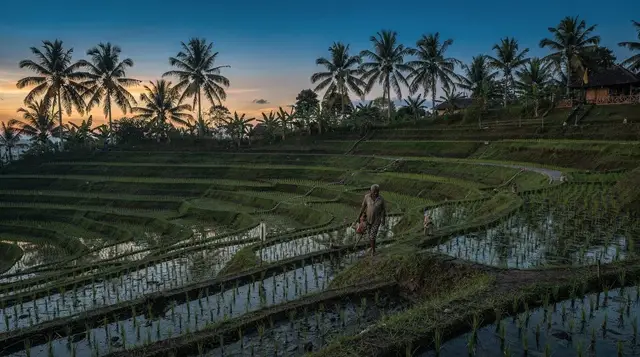
Tegalalang is the rice terrace most visitors picture when they imagine Bali, and it earns that reputation honestly: the tiered paddies step down a steep valley in a genuinely striking arrangement, close enough to Ubud that it’s an easy add-on to almost any itinerary through central Bali. It’s also, as a direct result of that convenience and photogenic quality, the single most crowded rice terrace on the island, with tour buses arriving steadily through the late morning and a road-side strip of cafés built specifically to catch the view.
None of that makes it not worth visiting. It does mean the experience differs a lot depending on when you arrive and how far you’re willing to walk past the first viewpoint. The terraces closest to the road and car park see the heaviest foot traffic and the most persistent donation requests from farmers maintaining specific sections of the paths. Walk fifteen or twenty minutes further down into the valley, and both the crowd and the request frequency drop noticeably, while the view arguably improves.
The other thing to understand going in is the informal economy that’s grown up around the site. Local farmers who maintain the paths and small bridges through the terraces often ask for a small donation as you pass, and separately, several swing and photo-platform operators charge for access to specific photo spots. Neither is a scam exactly — the terraces are still working farmland, and the swings are a legitimate paid activity — but knowing this in advance means you won’t be caught off guard by the steady stream of requests.
Tegalalang at a glance
| Where | North of Ubud, a short drive along the road to Tegalalang village |
| Cost | Free to view from the road; small donations expected on the walking paths; swings and photo platforms charge separately |
| Time needed | An hour for the main viewpoints, longer if you walk deeper into the valley |
| Access | Scooter, private driver, or Grab from Ubud; a short but genuine drive |
| Best time | Early morning before the tour buses, or late afternoon for softer light |
The main viewpoint and why it gets so crowded
The stretch of road overlooking the terraces from above is where nearly every visitor starts, and it’s also where the crowding is worst — a row of cafés with terrace-facing seating, a car park that fills fast by mid-morning, and a constant flow of people angling for the same handful of photo compositions. It’s a legitimate view and worth the stop, but treating it as the entire visit misses most of what makes Tegalalang worth the drive in the first place.
Walking into the valley
The paths leading down from the road into the terraces themselves are where Tegalalang actually delivers. Narrow dirt paths and small bamboo bridges cross between paddies, climbing and descending with the terracing itself, and the crowd thins with almost every step further from the car park. This is also where the ancient subak irrigation system, the UNESCO-recognised cooperative water-management network that makes Bali’s rice terraces possible, is most visible up close — channels of water moving between levels in a pattern that’s been maintained for centuries.
A guided walk through this system, such as a tour explaining the ancient subak secrets behind Tegalalang’s terraces, adds real context that’s easy to miss walking through independently — the terracing looks beautiful either way, but understanding how the water actually moves between levels changes what you’re looking at.
The swings, photo platforms, and whether they’re worth it
Tegalalang is one of the birthplaces of Bali’s now-widespread jungle swing trend, and several operators here offer paid access to swings and photo platforms positioned for a dramatic shot over the terraces. Prices and setups vary by operator, and quality ranges from well-built and genuinely safe-feeling to noticeably rougher. If a swing photo matters to you, look at the specific platform before paying rather than choosing the first one you pass, and don’t feel obligated just because you’re already standing there.
Combining Tegalalang with a wider Ubud day
Because Tegalalang sits just outside Ubud, most visitors fold it into a longer day covering several stops. A combined tour covering a waterfall, a temple, and the Tegalalang rice terraces is a common way to structure this without needing to arrange transport between each stop separately. If you’d rather add adventure than a temple, an Ayung River rafting trip combined with a Tegalalang rice terrace stop pairs the terraces with a genuinely different kind of activity, useful if a full day of temple-hopping isn’t what you’re after.
Rice cultivation and what you’re actually looking at
The terraces aren’t a static landscape maintained purely for visitors — they’re active farmland, and depending on when you visit you might see anything from flooded paddies reflecting the sky to bright green young rice or a golden field ready for harvest. This cycle runs on its own schedule independent of tourist visits, which is part of why two people visiting Tegalalang a few months apart can come away with quite different photos and impressions. None of these stages is objectively better than another; they’re just different, and it’s worth not being disappointed if the terraces don’t match a particular photo you’d seen online, since that photo was likely taken at a different point in the growing cycle.
The stepped construction itself follows the natural contour of the valley rather than a purely decorative pattern, engineered over generations to move water efficiently from the highest paddy to the lowest through the subak system. Understanding that the terracing is functional first and photogenic second is part of what separates a rushed drive-by stop from a visit that actually appreciates what’s in front of you.
What isn’t worth the detour
Skip paying for a photo platform or swing purely because it’s the closest one to the car park — walking even a short distance further usually reveals a better-built, better-positioned, and often cheaper option. It’s also not worth visiting Tegalalang specifically expecting a peaceful, uncrowded experience during peak season midday hours; if quiet matters more to you than convenience, Jatiluwih’s larger UNESCO-listed terraces or Sidemen’s quieter valley offer a genuinely calmer version of the same landscape, just further from Ubud.
The cafés along the road
The strip of cafés overlooking the terraces from the main road makes for a reasonable stop even if you’re not planning a full walk into the valley — several offer terrace-facing seating that gives a genuine view without the walk or the donation requests along the paths below. Prices at these cafés run a step above what you’d pay in central Ubud, which is the trade-off for the view, and it’s worth treating a coffee or lunch stop here as a bonus rather than the main event. Some visitors on a tight schedule use one of these cafés as their entire Tegalalang stop, and while that misses the more interesting walk into the valley, it’s a legitimate way to see the view if time is genuinely short.
What it costs
Viewing the terraces from the road is free, though car parks nearby often charge a small parking fee. Walking the paths into the valley involves passing several points where a small donation is expected from farmers maintaining that section — there’s no fixed rate, and a modest amount at each point is the norm rather than anything larger. Swings and photo platforms are priced separately by each operator and vary enough that it’s worth glancing at a couple of options before committing to one.
Photography tips beyond the obvious shot
The classic Tegalalang shot — a wide view down across the tiers with palm trees framing the edges — is genuinely worth getting, but it’s also the shot everyone else is trying to get from the same handful of spots, which means patience and a bit of timing help more than any particular camera setting. Walking down into the valley opens up closer, less crowded angles: a single terrace edge with water reflecting the sky, a farmer working a paddy, or the bamboo bridges crossing between levels. These tend to make for more distinctive photos than the wide establishing shot everyone already has a version of.
Overcast light, counterintuitively, often photographs better here than harsh midday sun, since it softens the contrast between the bright green paddies and the darker retaining walls. If your visit happens to coincide with a grey morning rather than clear skies, it isn’t the loss it might feel like for photography purposes.
When to go
Early morning, ideally before the main flow of tour buses arrives, gives you both a calmer visit and softer light for photos. Late afternoon is the second-best window, with a similar drop in crowd levels as the day tour groups move on to their next stop. The dry season from roughly April to October keeps the valley paths in better condition for walking; during the wet season, the same paths can turn slippery, and a sudden downpour with no shelter nearby is a real possibility.
Getting there and getting around
Tegalalang is a short drive north of central Ubud, easily reached by scooter, Grab, or a private driver, and close enough that it’s rarely worth a dedicated overnight stay purely for the terraces. Parking is available at several points along the road, with informal attendants directing vehicles into small lots. Once there, the walking paths through the valley are the main way to explore beyond the road-side viewpoint, and comfortable, closed footwear makes a genuine difference on the steeper, sometimes uneven sections.
How this fits into a longer trip
Tegalalang works best as a stop within a broader Ubud day rather than a standalone trip, easily combined with the Campuhan Ridge Walk or a visit to Tegalalang itself for those wanting to stay in the area longer. If the jungle swing experience specifically interests you, the dedicated is the Bali swing worth it guide covers that question in more depth than fits here.
For those wanting a quieter, larger-scale rice terrace experience afterward, the Jatiluwih UNESCO rice terraces guide and the subak irrigation explained guide are worth reading. Travellers planning a full Ubud day can check the Ubud day trip from South Bali guide or the broader Bali 5 days itinerary for how Tegalalang fits alongside the area’s other highlights.
Frequently asked questions about Tegalalang Rice Terrace
Is Tegalalang worth it if I’ve heard it’s too touristy now?
Yes, if you go early and walk beyond the main road-side viewpoint into the valley itself, where the crowds thin considerably. The road-side view alone, at peak midday hours, is the version people mean when they call it overrated.
How much should I donate on the walking paths?
There’s no official fixed amount, and requests are informal rather than ticketed. A small, genuine contribution at each point you’re asked is appropriate; you’re not expected to pay a large sum at every crossing.
Are the jungle swings safe?
Quality varies by operator, so it’s worth visually assessing a platform’s construction before paying rather than assuming all of them meet the same standard. Established operators with visible safety equipment are generally a safer bet than the most makeshift-looking setups.
How long should I budget for a visit?
An hour covers the main viewpoint and a short walk into the valley; two hours or more lets you walk further down and explore more of the terracing away from the crowds, which is worth doing if your schedule allows it.
Is Tegalalang better than Jatiluwih?
They’re different experiences. Tegalalang is smaller, closer to Ubud, and much busier; Jatiluwih is larger, UNESCO-listed, further away, and noticeably quieter. Many visitors do both, treating Tegalalang as the convenient stop and Jatiluwih as the deeper one.
Can I visit Tegalalang without a guide?
Yes, it’s straightforward to visit independently by scooter or Grab, and the paths are easy to follow without a guide. A guide adds context about the subak system and rice cultivation that you’d otherwise miss, but it isn’t necessary to see and enjoy the terraces themselves.
What should I wear?
Comfortable, closed footwear for the valley paths, sun protection for the exposed road-side viewpoint, and clothing you don’t mind getting a little dusty or muddy if you walk down into the working paddies after rain.
Rice terrace & countryside tours on GetYourGuide
Verified deep-linked GetYourGuide tours. Book through these links and we earn a small commission at no cost to you.
These are our own photographs of Bali, not the operator's pictures of this tour — open the tour page to see those.