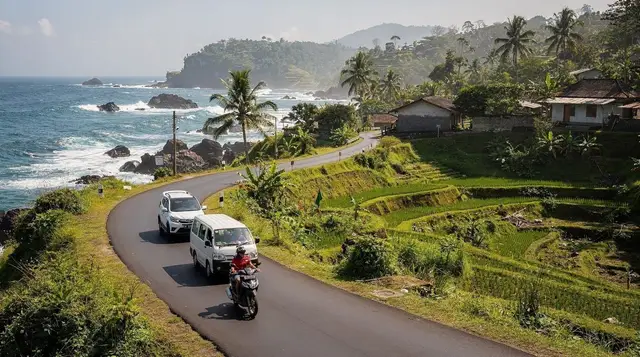
Tegalalang is a short drive north of Ubud and holds one of the most photographed rice terraces in Bali, a steep hillside of tiered paddies carved using the same subak irrigation system UNESCO recognised at Jatiluwih, further west. The scale and accessibility here are the draw: unlike some of Bali’s more remote terraces, Tegalalang sits close enough to Ubud to work as a half-morning outing rather than a dedicated day trip, which is exactly why it’s become one of the most visited single sights in central Bali.
That popularity has reshaped the experience considerably. The road running along the terrace’s edge is now lined with cafes, souvenir stalls, and operators offering swings and photo props positioned for a view over the paddies, and it’s easy for a visit to feel more like navigating a market than admiring a landscape if you arrive at the wrong time of day. None of this makes the terraces themselves less genuine — the subak system is still working agricultural infrastructure, not a stage set — but it does mean managing expectations about the surrounding commercial layer. Understanding that split in advance is really the whole point of reading a guide before visiting rather than just following an old photo you saw online.
This guide covers both the terraces themselves and the practical reality of visiting them today, including the swing operators, the donation requests, and the timing that makes the difference between a rushed, crowded stop and a genuinely enjoyable one.
Tegalalang at a glance
| Where | A short drive north of Ubud, central Bali |
| Cost | Some viewpoints request a small donation; swing and photo-prop operators charge separately per activity |
| Time needed | A couple of hours; longer if walking further into the terrace paths |
| Access | Private driver, Grab/Gojek, scooter, or organised tour from Ubud or further afield |
| Best time | Early morning, any season, before the heat and the crowds both build |
Walking the terraces properly
The most rewarding version of a Tegalalang visit involves walking down into the terrace itself rather than viewing it from the roadside cafes above. Paths wind between the paddies, some fairly narrow and uneven, giving a much closer look at the irrigation channels and the working rhythm of the rice cycle than the elevated road view offers.
Depending on the time of year, the terraces might show anything from freshly flooded paddies to mature green rice to a recently harvested field, since planting is staggered across different sections rather than happening all at once. That staggering is deliberate rather than accidental — farmers across the terrace plant on their own rotation, which means there’s rarely a single moment when every tier looks identical, and part of the visual interest comes from that patchwork of different growth stages rather than a uniform sea of green.
The swings, and whether they’re worth it
Tegalalang has become one of the epicentres of Bali’s swing and photo-prop trend — wooden swings suspended over the terrace edge, nests, and viewing platforms built specifically for a dramatic photo with the rice paddies as backdrop. Multiple independent operators run competing setups along the terrace edge, each charging separately, and the quality and safety of the rigging vary noticeably between them.
A Tegalalang jungle swing and Tirta Empul private tour bundles a specific, vetted swing experience with a temple visit, which removes some of the guesswork around picking an operator on the spot. If a swing isn’t the priority and you’d rather focus on the terraces and a broader tour of the area, the Tegalalang rice terraces and ancient subak secrets tour goes deeper into the irrigation history and how the terraced system actually functions.
Combining Tegalalang with nearby stops
Because Tegalalang sits close to several of central Bali’s other well-known sights, it rarely makes sense as a completely standalone outing. The Tegalalang rice terraces, waterfall, and zoo tour pairs the terraces with two very different additional stops for families or anyone wanting a fuller day. The waterfall, temple, and Tegalalang rice terrace tour takes a similar approach with a temple substituted for the zoo, better suited to travellers more interested in culture than animals.
For an evening option that adds a cultural performance to the day’s rice-terrace visit, the Barong dance show with ricefields and Tegalalang waterfall combines a traditional dance performance with the same rice-terrace scenery, useful if your schedule only allows a single combined outing rather than separate trips.
Getting a good photo without paying for a swing
The classic Tegalalang photo — tiered green paddies stretching down the hillside — doesn’t actually require a swing or a paid platform to capture well. Several free roadside viewpoints and the walking paths themselves offer comparable compositions, and a wide-angle shot from partway down one of the terrace paths often looks better than a tightly cropped swing photo anyway, since it shows the actual scale of the terracing rather than isolating a single prop against the paddies. Worth knowing if the budget for extras is tight or you’d simply rather not queue for a swing.
Cafes along the terrace road
The road running along the top of the terrace is now lined with a long run of cafes and restaurants, most positioned to take advantage of the same view that draws visitors to the paths below. Quality and price vary considerably, and the cafes closest to the main viewpoints tend to charge a premium for the position rather than for anything distinctive about the food. Walking a short distance further along the road, away from the busiest cluster, generally finds better value without losing much of the view.
Tegalalang versus Jatiluwih for rice terraces
| Tegalalang | Jatiluwih | |
|---|---|---|
| Distance from Ubud | Short, roughly 30-40 minutes | Considerably further |
| Crowd level | Busy, especially midday | Quieter, less commercialised |
| Facilities | Cafes, swings, souvenir stalls | More basic, fewer photo-prop operators |
| UNESCO status | Not listed itself | Listed for its subak system |
Jatiluwih is the quieter, less commercial alternative for travellers who want the rice-terrace experience without Tegalalang’s swing operators and roadside stalls, though it requires a considerably longer drive to reach. Many visitors choose based purely on time available: Tegalalang for a short trip from Ubud, Jatiluwih for a dedicated half or full day further afield.
The coffee plantation stops nearby
Several coffee plantation stops sit along the road between Ubud and Tegalalang, and many organised tours bundle a quick visit into the same itinerary as the rice terraces. These are worth going into with realistic expectations — most are set up primarily as tasting-and-souvenir stops for passing tour groups rather than working farms in the way the fish market at Jimbaran or the rice terraces themselves are genuine working sites. A free tasting is usually offered, but the harder sell comes afterward, in the attached shop.
What isn’t worth the detour
Skip paying for every swing or photo platform along the terrace edge — the setups look similar from stall to stall, and picking one considered option rather than several impulse purchases along the walk saves both money and the sense of being nickel-and-dimed at every turn. It’s also not worth arriving at midday expecting the quiet, contemplative rice-terrace photos you might have seen online; those are almost always taken early morning or with careful framing that excludes the crowd standing just out of shot.
Are the terraces still worth it despite the commercialisation?
What it costs
Viewing the terraces from most public vantage points is free or covers a small donation, generally requested by families maintaining specific paths through their land. Swings, photo platforms, and prop rentals are priced separately and vary by operator, and it’s worth agreeing a price before using any swing rather than assuming a fixed rate applies everywhere. Combined tours that bundle the terraces with a waterfall, temple, or dance performance cost more than a standalone terrace visit but save the logistics of arranging transport between several separate stops.
When to go
Early morning is the single most important timing decision for a Tegalalang visit, regardless of season — it beats both the heat and the bulk of the day’s tour groups. The dry season, roughly April to October, gives clearer skies and easier walking on the terrace paths, while the wet season from November to March still allows for a visit on most days, with rain arriving as short bursts rather than washing out the whole morning, though paths can turn slippery underfoot. The rice itself cycles through different stages across the year depending on which section of the terrace you’re looking at, so there isn’t a single “best” month for greenery the way there might be for a single-crop landscape elsewhere.
Getting there and getting around
Tegalalang sits a short drive north of Ubud, reachable by scooter, private driver, Grab, or Gojek, with the drive itself typically quick barring heavy traffic on the approach road. There’s no train or metro anywhere in Bali. Coming from further afield in south Bali, the drive to Tegalalang adds meaningfully to the day, which is part of why most visitors combine it with an Ubud stay or day trip rather than visiting from Kuta or Seminyak directly.
How this fits into a longer trip
Tegalalang works naturally as part of an Ubud stay, given the short drive between the two, and pairs well with a further push north toward Kintamani for travellers extending into the central highlands in the same day. Read the Tegalalang rice terrace guide for a deeper look at the paths and viewpoints, and the Jatiluwih rice terraces UNESCO guide if you’re deciding between the two for a quieter alternative. The subak irrigation explained guide is worth reading either way for context on what you’re actually looking at.
For travellers weighing whether the swing is worth the price and the queue, the is the Bali swing worth it guide covers that specific decision in more depth. The Ubud day trip from south Bali guide and a 5-day Bali itinerary both help place Tegalalang within a wider central Bali day or trip.
Frequently asked questions about Tegalalang Rice Terraces
Is Tegalalang free to visit?
Viewing from most public points is free or involves a small requested donation to whoever maintains that particular path. Swings, photo platforms, and guided extras are priced separately.
How early should I arrive to avoid the crowds?
As early as the terraces are accessible. Tour buses and the bulk of day visitors typically arrive from mid-morning onward, so an early start makes a real difference to both crowding and heat.
Is the swing at Tegalalang safe?
Quality and rigging vary between the many independent operators along the terrace edge. Choosing a vetted, bundled option rather than the first swing you pass reduces the uncertainty considerably.
Can I combine Tegalalang with other sights in one day?
Yes, and most visitors do — it pairs naturally with a wider Ubud day covering the Monkey Forest, a temple, or a waterfall, since the terraces alone typically only take a couple of hours.
Is Tegalalang better than Jatiluwih?
They’re different rather than strictly better or worse — Tegalalang is closer to Ubud and more developed with cafes and swings, while Jatiluwih is quieter, more remote, and holds UNESCO recognition for its subak system.
Do I need to book a tour, or can I visit independently?
Independent visits are entirely possible by scooter, driver, or Grab, and plenty of travellers do exactly that. A tour mainly adds value if you want the swing, waterfall, or temple stops bundled with transport handled for you.
What should I wear for walking the terrace paths?
Comfortable, closed shoes rather than sandals, since the paths can be narrow, uneven, and occasionally muddy, particularly if you’ve had recent rain.
Are the coffee plantation stops near Tegalalang worth visiting?
They’re a reasonable quick stop if bundled into a tour you’re already taking, mainly for the free tasting, but they lean heavily commercial and shouldn’t be the main reason to make the trip out to this part of central Bali.
Is Tegalalang suitable for young children?
With some care, yes — the main road-level viewpoints are straightforward, though the walking paths down into the terrace are narrower and less suited to strollers or very young children who need close supervision on uneven ground.
How long does it actually take to walk the whole terrace?
It depends how far into the paths you go, but a reasonably thorough walk covering the main viewpoints and a stretch of the lower paths takes a modest chunk of a morning rather than a quick five-minute stop, especially with photo breaks along the way.
Is Tegalalang worth it if I’ve already seen Jatiluwih?
It depends what you’re after — Jatiluwih covers the UNESCO-listed scale and quiet, while Tegalalang adds the swing and cafe culture that’s become its own part of the experience. Seeing both isn’t redundant if time allows, since they deliver genuinely different atmospheres despite both being rice terraces.