Ubud Cooking Classes: How to Choose One That's Worth It
What actually makes one Ubud cooking class better than another?
Whether it includes a genuine market visit to select ingredients, class size, and whether you're cooking in a dedicated school or a real home kitchen all matter more than price alone. A class that starts at the market and ends with you eating what you cooked, in a small group, tends to be the most rewarding version of the experience.
Ubud has become the default place to take a Balinese cooking class, and there are now enough options that choosing between them is its own small research project. The good news is that most follow a broadly similar structure — market visit, ingredient preparation, hands-on cooking, eating what you made — and the differences that actually matter are more about setting, group size, and how seriously the market component is taken than about which specific dishes end up on the menu.
This guide covers what separates a genuinely worthwhile class from a rushed, tourist-throughput version, and what to expect from the format itself if this is your first time taking a cooking class anywhere, let alone in Bali specifically.
Ubud cooking classes at a glance
| Typical structure | Market visit, ingredient prep, hands-on cooking of several dishes, then a shared meal of what you made |
| Length | Roughly half a day for most standard classes |
| Group size | Varies widely — ask before booking if a small group matters to you |
| Cost | Moderate; private or home-kitchen classes cost more than larger shared sessions |
| Best for | Anyone who wants to understand Balinese food, not just eat it |
Why the market visit matters more than people expect
The best classes treat the market visit as a genuine teaching moment rather than a token stop before the real cooking begins — a good instructor will walk you through unfamiliar ingredients like galangal, kencur, candlenut, and the base spice paste (bumbu) that underpins most Balinese savoury dishes, explaining what each contributes rather than just naming them. A class like the Ubud Balinese cooking class with a traditional market visit is built specifically around this structure, treating the market as the first real lesson of the day rather than a quick photo stop.
Home kitchen vs dedicated cooking school
| Home kitchen setting | Dedicated cooking school | |
|---|---|---|
| Atmosphere | More intimate, often family-run, smaller groups | More polished facilities, sometimes larger groups |
| What you learn | A closer sense of how the dishes are actually made day to day | Often a wider range of dishes taught with more structured technique |
| Best for | Travellers wanting a genuine, grounded experience | Travellers wanting a more comprehensive, structured lesson |
A class such as the Balinese kitchen culture cooking class leans toward the home-kitchen style, giving a more grounded sense of everyday cooking. For a more resort-adjacent, polished setting, the Kamandalu Ubud Balinese cooking class offers a more structured, hotel-quality environment, which some travellers prefer for comfort and consistency.
Organic farm settings and where the ingredients come from
A smaller number of classes take place at or near a working organic farm, letting you see (and sometimes pick) some of the produce used in the class before it’s even prepared. A class like the Pemulan Bali Balinese cooking class at an organic farm is built around this setting, which adds a layer of context beyond a standard market visit — understanding not just what an ingredient is but where and how it’s actually grown. This style tends to suit travellers with a particular interest in food sourcing and sustainability over a purely technique-focused class.
The bumbu: the one technique worth actually paying attention to
If you take away one genuinely transferable skill from a Balinese cooking class, it should be how to make bumbu — the pounded or blended spice paste combining ingredients like shallot, garlic, chilli, galangal, turmeric, candlenut, and shrimp paste in varying ratios depending on the dish. Nearly every savoury Balinese dish starts from some version of this base, and understanding how to build and balance it is far more useful long-term than memorising a single recipe’s exact steps.
A good instructor will explain not just the ratio for the specific dish you’re making that day but how the same base technique adapts across different recipes, which is the kind of transferable knowledge that separates a class worth remembering from one that’s forgotten within a week of getting home.
What a typical class schedule actually looks like
A standard half-day class usually starts with a market visit in the mid-morning, once the market itself is in full swing but before the day’s heat peaks, followed by a short transfer to the cooking venue. Ingredient preparation — grinding spice paste, chopping vegetables, preparing proteins — typically takes up the largest single block of time, since this is where most of the actual technique gets taught. Cooking itself often moves relatively quickly once the prep work is done, since many Balinese dishes rely on getting the bumbu right more than on complex cooking methods. The class usually wraps with everyone sitting down together to eat what’s been made, which is as much a social element of the day as a culinary one.
What you’ll actually cook
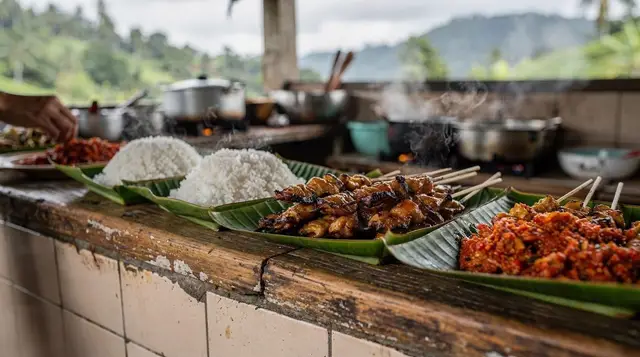
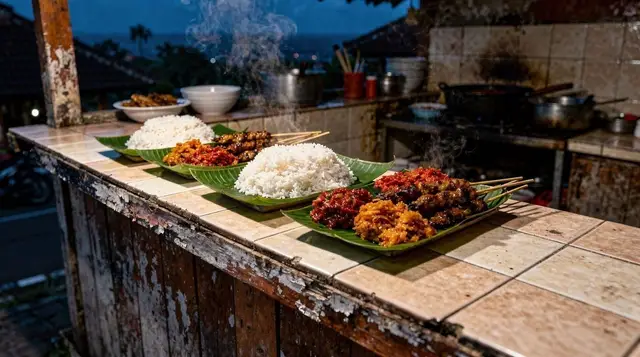
Most Ubud cooking classes teach a consistent core of dishes: a base spice paste (bumbu) used across several recipes, a chicken or tempeh satay variant, a vegetable dish like urap or gado-gado, and often a simple dessert like Balinese black rice pudding. Some classes let you choose from a slightly longer list to tailor the day to dietary preferences, which is worth asking about directly if you have restrictions, since Balinese cooking accommodates vegetarian adaptations reasonably well for most core dishes even though the most famous specialities, like babi guling, are meat-focused.
Sate lilit — minced, spiced meat wrapped around a lemongrass stalk before grilling — appears on the majority of class menus too, and it’s a genuinely useful dish to learn given how different the technique is from Western-style skewered satay. Because the meat is minced and shaped by hand around the stalk rather than threaded as cubes, it demonstrates a distinctly Balinese approach to spicing and texture that’s worth understanding even if you never recreate it exactly once home.
Private classes and hotel-based options
If you’d rather not join a shared group session, several operators run private classes, either at a dedicated venue or, in some cases, directly at your hotel or villa. A class such as the authentic Balinese cooking class at Adiwana Unagi is one example of a more contained, resort-based setting, useful if you’d rather not travel separately to a class venue. For travellers combining a market visit with a broader half-day, the Ubud Balinese cooking class with a rice field and market tour adds scenery to the itinerary alongside the cooking itself.
What isn’t worth the detour
Skip classes that promise an unusually large number of dishes in a short time frame — this is often a sign of a rushed, less hands-on format where an instructor demonstrates quickly and participants replicate with minimal actual guidance, rather than a properly paced lesson. It’s also not worth choosing purely on price without checking group size, since a very large class can mean long stretches watching rather than actively cooking, particularly if kitchen space is limited.
What it costs
Standard shared cooking classes are moderately priced and typically include the market visit, all ingredients, instruction, and the final meal. Private classes and home-kitchen or organic-farm settings generally cost more, reflecting smaller group sizes or a more curated setting. Hotel-based private classes at higher-end properties tend to sit at the top of the price range, trading convenience and exclusivity for a higher cost than a shared class at an independent cooking school.
When to go
Cooking classes run year-round and aren’t meaningfully affected by season, making them an easy addition to any Ubud-area itinerary regardless of timing. Morning classes that start with the market visit tend to offer the freshest ingredients and a cooler start to the day before the midday heat sets in, which is worth factoring in if you have a choice of start times.
Getting there and getting around
Most cooking classes are based in or near Ubud, where the concentration of both traditional markets and instructors catering to visitors is highest. Many operators include hotel pickup and drop-off as part of the booking, which is worth confirming when you book, since it removes the need to arrange your own transport to a market meeting point early in the morning.
How this fits into a longer trip
A cooking class pairs naturally with a wider food-focused day or as a standalone half-day within a longer Ubud stay. The Balinese food guide gives broader context on the dishes you’ll likely cook, and the where to eat babi guling guide and the Bali coffee and luwak truth guide cover related food and drink topics worth exploring the same trip. The warung etiquette and food safety guide is useful background if warungs and local markets are new to you.
If you’re still deciding whether a class is worth the time and cost, the choosing a Bali cooking class post goes deeper into comparing specific operators than fits here, and the Bali belly: what actually causes it post is worth a read if food safety concerns are part of your hesitation. For general orientation around the town itself, the Ubud destination guide covers where classes typically fit into a broader stay.
Frequently asked questions about Ubud Cooking Classes
Do I need any cooking experience to join a class?
No, most classes are designed for complete beginners and walk you through every step, including basic knife and preparation skills if needed.
How long does a typical Ubud cooking class last?
Most run roughly half a day, including the market visit, preparation, cooking, and the meal itself at the end.
Can vegetarians take a Balinese cooking class?
Yes, most classes offer vegetarian adaptations for the core dishes, though it’s worth confirming with the specific operator in advance if you have strict dietary requirements.
Is a private class worth the extra cost over a shared group class?
If a smaller, more personalised pace matters to you, yes. A shared class is a perfectly good option for most travellers and costs less, but a private class gives more individual attention and flexibility.
Will I actually get to cook, or mostly watch a demonstration?
This varies by operator and group size — ask directly before booking if hands-on cooking time matters to you, since larger classes can sometimes lean more toward demonstration with limited individual practice.
Do classes include a market visit as standard?
Many do, but not all — check the itinerary specifically, since the market component is one of the more educational and memorable parts of a well-run class.
Can I request recipes to take home?
Most classes provide a printed or digital recipe booklet covering the dishes taught that day, which is worth asking about if you plan to recreate the dishes once home.
Is it better to book a class near the start or end of my trip?
Either works, but booking one earlier in your trip means you’ll recognise more ingredients and dishes on menus for the rest of your stay, which some travellers find adds to their overall experience.
Bali food & drink tours on GetYourGuide
Verified deep-linked GetYourGuide tours. Book through these links and we earn a small commission at no cost to you.
These are our own photographs of Bali, not the operator's pictures of this tour — open the tour page to see those.