Choosing a Bali Cooking Class: What Actually Separates a Good One
Ubud alone has enough cooking classes on offer that picking one by star rating is close to useless — almost all of them sit within a narrow band of good reviews, because a half-day spent cooking and eating in a nice setting is hard to make genuinely bad. The differences that matter are quieter than the review scores: whether the class starts with an actual market visit or just a walk past some stalls, how many dishes you cook versus watch being cooked, and whether the person leading it treats the ingredients as worth explaining or just narrates a recipe card.
Most visitors book a class expecting to come away able to reproduce a few Balinese dishes at home, and the honest answer is that this only really happens with the classes built around hands-on cooking of a full spread rather than a demonstration with occasional participation. The two formats are marketed almost identically, so the difference isn’t obvious from a listing page, and that’s the gap this page is trying to close.
There’s also a real spread in setting. Some classes run in an open-air pavilion attached to a family compound, with the household’s own kitchen tools and a genuinely domestic feel. Others run in a purpose-built cooking school that is comfortable and well organised but has the atmosphere of a corporate training room. Neither is wrong, but they deliver a different kind of morning, and it’s worth knowing which one you’re booking.
At a glance
| Where | Mostly Ubud and surrounding villages, with a smaller number of options in South Bali |
| Cost | A modest half-day booking; private and market-inclusive classes cost more than group demonstrations |
| Time needed | Roughly half a day, longer if the market visit and a multi-course lunch are included |
| Access | Most classes include hotel pickup from Ubud or nearby; some require your own transport |
| Best time | Morning classes that start with the market are the most worthwhile, before the produce gets picked over |
The market visit is the real test
If a class description mentions a market visit, that single detail tells you more than the star rating does. Cooking with ingredients you’ve just seen sold, smelled, and had explained changes the whole session — you understand why a particular chilli or leaf is used rather than just following instructions. Classes that skip the market and start straight in the kitchen with pre-portioned ingredients are faster and more predictable, which suits some travellers fine, but they teach you less about the food itself.
A market-based option like the Celuk village cooking class with a local instructor builds this in as part of the format rather than an optional add-on, which is the model worth prioritising if you have to choose between two otherwise similar-looking bookings. It’s a small difference on paper but a large one in practice, since seeing an ingredient sold before it’s cooked tends to be the part people remember longest afterwards.
Group demonstration versus hands-on cooking
This is the split that matters most and is least visible in a listing title. A demonstration class has you watching an instructor cook most of the dishes, stepping in for a few simple tasks like slicing or grinding a spice paste. A hands-on class has you cooking each dish yourself, at your own station, with guidance rather than someone doing it for you. Both produce a good lunch. Only one teaches you to actually cook the food again later.
| Format | What you actually do | Best for |
|---|---|---|
| Group demonstration | Watch most steps, participate occasionally | Large groups, limited time, casual interest |
| Hands-on group class | Cook every dish yourself alongside others | Wanting to genuinely learn the techniques |
| Private hands-on class | Full control of pace, dishes, and dietary swaps | Small groups, dietary restrictions, serious interest |
A class such as this hands-on Balinese culinary adventure in Ubud is built around cooking every dish rather than watching most of them, which is the detail to look for in the description of any class you’re comparing. Some operators also let you request specific stalls or ingredient stops in advance if you have a particular interest, such as spices or tropical fruit, though this is worth asking about rather than assuming is on offer.
How many dishes is actually reasonable
Some listings advertise cooking eight or more dishes in a single morning, which sounds generous until you realise it usually means simplified versions and less time spent on each one. A tighter class that cooks four or five dishes properly — a base spice paste from scratch, a satay, a vegetable dish, and a dessert, say — tends to teach more than a rushed marathon through a long menu. If a listing’s dish count feels unusually high for the stated duration, that’s worth noticing before you book.
Private classes and dietary needs
If you have a real dietary restriction rather than a mild preference, a private class is worth the extra cost. Group classes generally cook a fixed menu with limited substitution, because adjusting eight different plates for eight different diets isn’t realistic in a shared kitchen session. A private booking, such as a private cooking class focused on Balinese kitchen culture in Ubud, can usually accommodate vegetarian, gluten-free, or other needs directly, because the instructor is working with only your group.
What the “authentic” label actually signals
Nearly every class in Ubud uses the word authentic somewhere in its title, which has made the word close to meaningless as a filter. What it’s usually gesturing at, when it’s earned, is that the recipes come from a family kitchen rather than a hotel training manual, and that the instructor can explain the reasoning behind a technique rather than just demonstrating it. You can get a rough read on this from the class description itself — does it name specific dishes and techniques, or does it stay vague and rely on the word authentic to do the work.
What you’ll actually cook
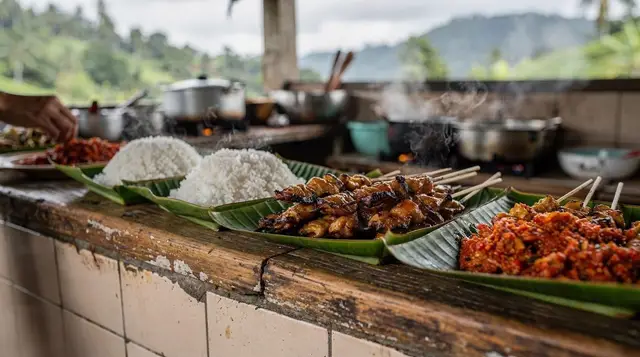
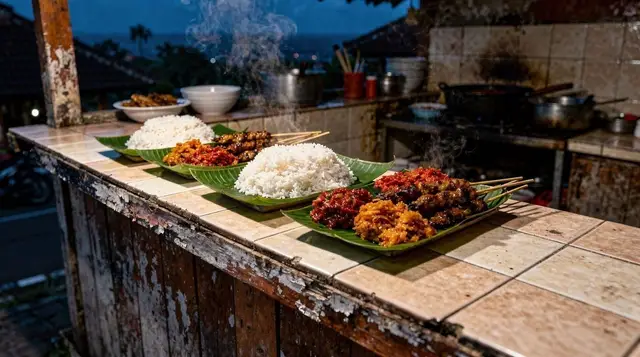
Expect a spice paste (base genep or a simplified version of it) ground by hand or with a stone mortar, which underpins most Balinese savoury cooking and is usually the single most useful technique taught. Beyond that, most classes cover a satay, a vegetable dish such as jukut urab (a spiced grated coconut salad), and often a simple dessert like black rice pudding. A few classes based in a full working kitchen, such as the Kamandalu Ubud Balinese cooking class, extend the menu further and cook in a more professional setting, which suits people who want a longer, more structured session.
What a good instructor actually adds
The instructor is the variable that’s hardest to judge from a listing page, and it’s the one that matters most once you’re actually in the kitchen. A good instructor explains why a technique works — why the spice paste is fried before liquid is added, why a particular leaf goes in whole rather than shredded — rather than just narrating steps to follow. A weaker instructor runs a tight, efficient session that produces the same food but teaches you noticeably less about it. Reviews that mention the instructor by name or describe specific things they explained are a better signal than reviews that just praise the food, since praising the food is true of almost every class in Ubud regardless of how much teaching actually happened.
Group size matters here too, more than most listings make obvious. A class of four or six people gets real one-on-one correction and explanation; a class of sixteen becomes closer to a demonstration with occasional supervised participation, even if it’s technically billed as hands-on. If the listing doesn’t state a maximum group size, it’s worth asking before booking, particularly if the whole point of the trip for you is genuinely learning to cook rather than having a pleasant morning out.
What isn’t worth the detour
Skip any class marketed heavily around a photo opportunity — rice paddy backdrops, matching aprons, a staged “traditional” welcome — where the actual cooking content feels secondary to the setting. These aren’t bad mornings, but they’re not really cooking classes in the sense of teaching technique, and you’ll pay a premium for the aesthetic rather than the substance. Also skip classes that promise an implausibly long dish list in a two-hour slot; something is being simplified or skipped to make that possible, and it’s rarely disclosed upfront.
Budget
Cooking classes sit in a modest middle ground compared with full-day tours: a group class with a market visit costs less than a private one, and both are cheaper than a multi-day cooking retreat, which isn’t what most travellers are looking for on a single Bali trip. The main cost variable is group size and whether a market visit and full lunch are included — a bare-bones demonstration without either will be the cheapest option you find, and it shows in what you get out of it. Private classes and those built around a longer market visit and a full multi-course lunch sit at the upper end of that range, and are usually worth it if learning technique matters more to you than saving on the morning.
When to go
Morning classes make the most sense if a market visit is involved, since produce and fish stalls are freshest and busiest early in the day and start thinning out by mid-morning. Outside of that, cooking classes are one of the more weather-proof activities in Bali — most run in a covered pavilion or indoor kitchen, which makes them a reasonable option to slot into a rainy-season itinerary when an outdoor day trip looks risky. See the guide to Bali in the rainy season if you’re planning around that.
Access and getting there
Most Ubud-based classes include hotel pickup from central Ubud and sometimes from South Bali, though a South Bali pickup adds real travel time each way given how spread out Bali’s road network is. If you’re staying in Ubud itself, getting to a class is straightforward; if you’re staying in Canggu or Seminyak, factor the drive into your morning and check the pickup radius before booking, since not every class collects from every area.
How this fits into a longer trip
A cooking class pairs naturally with a broader look at Balinese food and drink — the Balinese food guide and the where to eat babi guling guide are useful companions if you want to recognise what you cooked when you see it on a warung menu later in the trip. If markets and street food interest you beyond a single class, the street food safety guide and warung etiquette guide cover the practical side of eating well elsewhere on the island.
If coffee is on your list too, the honest look at Bali’s coffee plantations is worth reading before you book a combined coffee-and-cooking day, since the two are often bundled and not always to the visitor’s benefit. For fitting a class into a wider Ubud stay, the Ubud destination guide and a broader plan like Bali in 7 days both have room for a half-day cooking session without crowding out the rest of Ubud’s highlights.
Frequently asked questions about Choosing a Bali Cooking Class
Do I need any cooking experience to join?
No. Classes are built for complete beginners, and instructors adjust pace and explanation for people who’ve never handled a mortar and pestle before.
Can I choose vegetarian or vegan dishes?
Group classes usually run a fixed menu with limited substitution; a private class can generally accommodate dietary needs directly, so mention it when booking either way.
Is a market visit really worth paying extra for?
If you care about understanding the food rather than just eating it, yes. It’s the single detail most correlated with a class actually teaching you something you’ll remember.
How long does a typical class run?
Most run around half a day once you include the market visit, cooking, and the meal you eat afterwards, though exact timing varies by operator and format.
Will I actually be able to cook these dishes at home?
With a hands-on class and a real market visit, more realistically than with a demonstration class. The spice paste technique is the most transferable skill you’ll take home.
Is it worth doing more than one cooking class on a trip?
Generally not, unless your specific interest is regional variation. One well-chosen hands-on class with a market visit covers the core techniques; a second class tends to repeat rather than add much.
Are these classes suitable for kids?
Many are, though a private booking gives more flexibility to adjust pace and tasks for children than a fixed-format group class does.
What should I wear?
Comfortable, casual clothing you don’t mind getting a little food on; aprons are provided at most venues, but closed-toe shoes are sensible if any part of the session involves an outdoor kitchen area.
Do these classes take pictures or provide a recipe booklet?
Many do, either as printed recipe cards or a digital send-out afterwards, but it varies by operator, so check the listing if that matters to you rather than assuming it’s standard.
Bali food & drink tours on GetYourGuide
Verified deep-linked GetYourGuide tours. Book through these links and we earn a small commission at no cost to you.
These are our own photographs of Bali, not the operator's pictures of this tour — open the tour page to see those.