The Truth About Bali's Instagram Spots
Every famous Bali photo you’ve seen — the jungle swing suspended over a valley, the mirrored Gate of Heaven at Lempuyang, the infinity pool seemingly floating above rice terraces — is real. The disappointment some visitors feel isn’t because the spots are fake; it’s because the photo format itself, a tight crop with no context, systematically hides the queue, the staff, and the dozens of other visitors waiting for the exact same shot.
This piece is an honest look at what these spots are actually like to visit, not a case against visiting them. Most are genuinely worth seeing, provided you go in with realistic expectations about the crowd and the choreography involved in getting the photo, rather than the spontaneous, solitary moment the image alone suggests. That gap between expectation and reality is really the whole subject of this piece — not whether these places are worth seeing, which for most of them they genuinely are, but whether you arrive already knowing what the experience of getting the shot actually involves.
The swing photos: real settings, managed queues
Bali’s various jungle and cliff swings, concentrated heavily around Ubud, are genuine structures in genuinely striking settings — the valley views and jungle canopy are real, not composited. What the photos don’t show is the operational reality: staff managing a queue, a fixed, brief window per visitor to get the shot, and often several nearly identical swing setups operating in parallel to handle demand. A guided private tour including a jungle swing stop at least removes the uncertainty of arranging entry and timing yourself, even if it doesn’t eliminate the underlying queue system.
Lempuyang’s mirrored gate: the most famous example of the gap between photo and experience
The so-called Gate of Heaven at Lempuyang temple, with its reflection created by a handheld mirror or reflective surface held beneath the camera, is probably the single clearest example of a Bali photo spot where the finished image and the actual visit diverge most. In person: a genuine queue, often a long one, managed by staff who move each visitor through a brief, practised routine — hand pose, angle, a few seconds — before the next person steps up.
The reflection effect itself is achieved with a simple prop, not photography skill, which surprises visitors expecting some technical secret. Beyond the mirrored shot, Lempuyang is also a genuine, working temple complex with its own significance in Balinese Hinduism, and visitors who treat the whole site with the same rushed, photo-only mindset that the queue encourages often miss the parts of the visit that have nothing to do with the camera at all.
Infinity pools and villa shots: staged more than most visitors realise
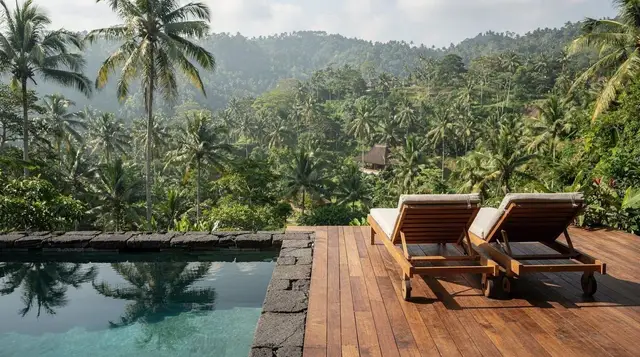
The floating infinity pool photos overlooking rice terraces are usually taken at specific villas or cafés built and positioned deliberately for exactly this shot, often requiring a paid entry or a minimum spend at the associated café. The angle in the photo is frequently the one specific spot in the whole property that creates the effect, shot from a narrow position most other guests aren’t using at that exact moment — which is a very different picture from suggesting the whole property looks and feels like an empty infinity pool at all times.
A well-run Ubud photo-focused tour typically includes a stop at one of these venues with the timing already worked out, which removes the trial and error of discovering which specific angle and time of day actually produces the shot you’ve seen online.
A side-by-side look at what the photo shows versus what you’ll experience
| Spot | What the photo shows | What’s just outside the frame |
|---|---|---|
| Jungle or cliff swing | A solitary rider suspended over a dramatic valley | Staff managing a queue, a brief timed turn, nearby duplicate swing rigs |
| Lempuyang Gate of Heaven | A perfectly mirrored temple gate with Mount Agung behind | A long queue, a staff member holding the mirror prop, a fast-paced handoff to the next visitor |
| Infinity pool over rice terraces | An empty pool seemingly floating above the landscape | A specific narrow camera angle, an entry fee or minimum spend, other guests nearby |
| Rice terrace viewpoint | A vast, empty green landscape | Vendors, ticket booths, and other visitors doing the same shot metres away |
Seeing this pattern laid out makes the underlying dynamic obvious: none of these photos are fabricated, but all of them are cropped tightly enough to remove the very normal reality of a popular attraction — other people, and the logistics required to manage them. It’s a useful reminder for evaluating any heavily photographed travel destination, not just these specific Bali spots, since the same cropping dynamic applies almost everywhere a single iconic image drives outsized demand. Once you expect that going in, most of these spots stop feeling like a letdown and start feeling like exactly what they are: popular, well-run attractions doing a good job of processing high demand.
Why these specific spots became famous in the first place
It’s worth understanding the mechanism behind how a handful of locations became disproportionately iconic relative to Bali’s actual breadth of scenery. Early, striking photos from these exact spots spread widely on social platforms, and the resulting demand created a feedback loop: more visitors wanting the same shot, more operators setting up to serve that demand, and the spot’s fame compounding well beyond what the underlying view or setting alone would have generated organically.
It’s a genuinely self-reinforcing cycle — the more a location appears in others’ travel photos, the more visitors arrive specifically seeking to recreate that exact image, which in turn generates more of the same photos feeding back into the cycle, largely independent of whether the location is actually the single best example of that kind of view on the island. This is a pattern repeated at popular photo locations worldwide, not something specific to Bali, but it’s worth knowing because it explains why comparable, less crowded alternatives often exist nearby, simply without the same viral history behind them.
Alternatives with a similar feel but far fewer crowds
If the queue itself is the main deterrent rather than the type of shot, several less-famous locations around Bali offer a genuinely comparable aesthetic without anything like the same crowd. Smaller, less-publicised swings exist around Ubud’s outskirts and in Sidemen, often at a fraction of the busiest spots’ visitor volume. Rice terrace views around Jatiluwih and Sidemen offer scenery comparable to Tegalalang’s most photographed section, again with considerably fewer people in the frame.
None of these alternatives carry quite the same name recognition, which is precisely why they stay quieter. Asking locals or your accommodation for their own favourite quieter viewpoint, rather than relying solely on what shows up first in a search, often turns up exactly this kind of comparable alternative that hasn’t yet been absorbed into the same viral cycle.
What isn’t worth the detour
Skip any spot advertising itself purely as a photo backdrop with an entrance fee and nothing else to see or do — several have popped up around Bali specifically to capitalise on the Instagram trend, offering a manufactured setting with little of the genuine landscape or culture that makes the island’s real highlights worthwhile. If a location’s entire appeal is a single camera angle rather than anything to actually experience once you’re there, it’s a weaker use of a limited trip than sites with more substance beyond the photo itself.
Getting a good photo without the frustration
Arriving as early as possible is consistently the single best lever across every spot on this list — queues build through the morning and are typically shortest at opening. A guided Instagram highlights tour that plans the day around beating the crowds at multiple spots removes the guesswork of sequencing an efficient route yourself.
Bringing a second person to help direct angles, rather than relying entirely on staff at a busy spot, also speeds up your own turn and reduces the pressure of a rushed staff-managed session. Dressing with the shot in mind matters more than most visitors plan for in advance — flowing fabric, a single strong colour rather than a busy pattern, and comfortable footwear for walking between multiple spots in a single outing all make a visible difference in the final images without requiring any technical photography skill.
How this fits into planning your trip
For the specific truth behind Bali’s best-known photo location, read Lempuyang Gates of Heaven: the truth before you go, and is the Bali swing worth it and best photo spots in Bali for a wider list beyond the handful covered here.
Bali Instagram spots: honest covers similar ground from a slightly different angle, and the Lempuyang reflection photo goes deeper into that one specific, iconic shot. If your itinerary includes Ubud specifically, best photo spots in Bali pairs well with a wider look at ubud vs canggu when deciding how much of your trip to weight toward photo-focused stops versus other priorities.
Frequently asked questions about Truth About Bali’s Instagram Spots
Is it worth visiting these spots if I don’t care about the photo itself?
Some, yes — Lempuyang temple has genuine cultural and scenic value beyond the mirrored-pool shot specifically, though several purely photo-oriented spots have little else to offer if the image isn’t the point for you.
How early should I arrive to avoid the worst queues?
As close to opening as realistically possible. Queues build steadily through the morning at nearly every well-known spot on this list.
Are these photo spots free, or do they charge entry?
It varies — some are included in a broader temple or attraction entrance fee, while others, particularly villa and café infinity pools, charge specifically for photo access or require a minimum spend.
Is the mirror trick at Lempuyang difficult to do myself?
No, it’s a simple prop technique rather than a technical skill, and staff at the site typically handle it as part of the standard visitor routine.
Do these spots look different in person than in photos?
The immediate frame looks similar; what differs is everything outside that frame — the queue, other visitors, and the managed, brief nature of your own turn.
Is it disrespectful to prioritise photos at spots with genuine religious significance, like Lempuyang?
Not inherently, provided you’re respectful of the site’s actual purpose and other visitors there for religious reasons, and follow standard temple etiquette throughout your visit.
Which single spot is most worth the hype?
Opinions vary, but Lempuyang’s combination of genuine temple significance and the photo itself makes it the most frequently recommended, provided expectations about the queue are set correctly beforehand.
Can I get a good photo without paying for a professional photographer?
Yes, in most cases — staff at these spots are experienced at directing visitors through the same routine used for professional shoots, and a phone camera in the right hands at the right angle produces a comparable result.
Are these spots worth visiting outside peak tourist season?
Yes, and the crowds noticeably thin during quieter months, making the whole experience considerably more relaxed without the compressed queues of peak season.
Is it worth booking a specific tour just for photo spots, or better to visit independently?
A guided tour helps with sequencing and timing across multiple spots in one day, which is useful if photos across several locations are a genuine priority, but independent visits work fine for a single spot with an early arrival.
Photo shoots & romantic experiences on GetYourGuide
Verified deep-linked GetYourGuide tours. Book through these links and we earn a small commission at no cost to you.
These are our own photographs of Bali, not the operator's pictures of this tour — open the tour page to see those.