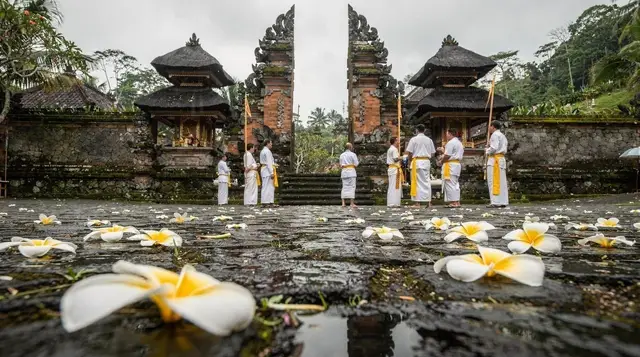
Galungan and Kuningan: Bali's Recurring Ten-Day Festival
What are Galungan and Kuningan, and will they affect my trip?
Galungan and Kuningan are linked Balinese Hindu ceremonies that mark the ten-day period when ancestral spirits are believed to visit the island, celebrating the triumph of good (dharma) over evil (adharma). They return every 210 days on the Balinese pawukon calendar, not on fixed Gregorian dates, so they can land in any month. Expect bamboo penjor poles lining the roads, temples in full ceremonial dress, and a livelier, more devotional atmosphere island-wide — genuinely worth timing a trip around if your dates allow, rather than something to avoid.
Galungan and Kuningan are the pair of ceremonies most likely to change the visual character of a Bali trip without anyone warning you in advance, simply because they don’t follow a calendar most visitors think to check. Where Nyepi is a single, dramatic day of enforced silence, Galungan and Kuningan work the opposite way: they unfold over roughly ten days, filling the island with decoration, ceremony, and a noticeably fuller temple calendar, without shutting anything down or requiring visitors to change their behaviour.
The two ceremonies are linked. Galungan opens the period, marking the day ancestral spirits are believed to descend and visit their family homes, and it celebrates the mythological victory of dharma (good) over adharma (evil). Kuningan, ten days later, closes the period and marks the spirits’ return to the heavens.
Between the two dates, the entire island visibly participates: family compounds are cleaned and decorated, offerings multiply, and every road seems to sprout tall, curved bamboo poles hung with woven palm ornaments. If you’re building a longer trip and want to understand how this period sits alongside Bali’s other ceremonies, the best time to visit Bali guide is a useful companion to this one, since it treats the ceremonial calendar as one factor among several rather than in isolation.
Because the dates move every year, this guide focuses less on “when” — check the specific dates for your travel year before relying on anything else you read — and more on what you’ll actually see, how it might affect logistics, and why it’s worth building into a trip rather than working around. Treat any specific date mentioned elsewhere online with some caution unless it’s clearly labelled for your travel year, since a date correct for one year is reliably wrong for the next.
Galungan and Kuningan at a glance
| What it marks | Ancestral spirits visiting (Galungan) and departing (Kuningan), and the victory of good over evil |
| When | Every 210 days, on the Balinese pawukon calendar — dates shift yearly, can fall in any month |
| Duration | Roughly ten days between Galungan and Kuningan, with build-up before and wind-down after |
| Visible signs | Penjor bamboo poles along every road, temples in full ceremonial dress, families in traditional clothing |
| Effect on visitors | None mandatory — no restrictions like Nyepi — but expect busier temples and roads on the key dates |
What penjor actually are, and why they matter
The single most visible sign that Galungan is approaching is the appearance of penjor: tall, gracefully curved bamboo poles, often ten metres or more, planted outside every family compound and lining entire streets. Each is decorated with young coconut leaves, rice stalks, fruit, and woven palm ornaments, and the curve at the top is meant to represent Mount Agung, Bali’s most sacred mountain. Families put real effort and cost into their penjor, and the visual effect of an entire village or town lined with them is one of the more striking things a visitor can see on the island without needing to enter a single temple.
The ten days, roughly explained
The lead-up to Galungan involves days of preparation with specific customary names — cleaning family compounds, making special foods, preparing offerings — that build toward Galungan day itself, when families gather, visit temples, and welcome the ancestral spirits believed to return home for the occasion. The days following Galungan are a period when spirits are believed to remain on the island, and temple activity stays elevated throughout. Kuningan, ten days after Galungan, is when the spirits are believed to return to the heavens, marked with its own offerings and rituals, often using yellow rice (kuning, which gives the day its name) as a specific ceremonial element.
What you’ll actually see as a visitor
Expect penjor everywhere, family members in full traditional dress — men in udeng headcloths, women in kebaya and sarong — moving between home and temple, and a general sense of an island dressed up and paying attention to something beyond the everyday tourist calendar. Temples that might otherwise feel quiet or purely photogenic during Galungan and Kuningan fill with genuine worship activity, offerings piled high, and gamelan music drifting from courtyards.
It is, for a visitor willing to observe respectfully rather than treat it as a photo opportunity, one of the more genuine windows into contemporary Balinese religious life that the ordinary tourist calendar doesn’t offer. Unlike a staged cultural performance built for tourists, nothing about Galungan and Kuningan is choreographed for an audience — the offerings, the dress, and the temple visits happen because families are observing a genuine religious obligation, and visitors are, at best, welcome witnesses rather than the intended audience.
Temples and traffic on the key dates
Galungan day itself and the days immediately around it see noticeably heavier traffic near major temples, as families travel to visit ancestral and community temples as part of the observance. If your itinerary includes a well-known temple like Besakih or Tirta Empul and it happens to coincide with Galungan or Kuningan, expect a busier, more crowded, and more devotionally focused atmosphere than an ordinary day — which can be either a highlight or a complication depending on what you were hoping to see.
A guided day like a 6-hour car charter around Ubud with a driver who knows the local ceremonial calendar is a practical way to navigate the period, since drivers typically know which routes and temples will be busiest on a given day.
What isn’t worth the detour
Don’t chase a single “best” village for penjor-spotting — the decorations appear island-wide, and Ubud’s surrounding villages, the roads through Gianyar, and countless smaller communities all put up equally impressive displays without the crowds that a widely publicised “best spot” would attract. It’s also not worth trying to attend a family’s private home ceremony uninvited; the public temple ceremonies and the simple experience of driving or walking through decorated streets already give a genuine, respectful window into the period without needing access to something not meant for outside visitors.
Budget considerations
Galungan and Kuningan don’t carry a direct cost for visitors the way a ticketed festival might — there’s no entry fee to the general atmosphere, and most temples that are normally open to tourists remain so, sometimes with a slightly different vibe rather than a different price. The main budget-relevant effect is indirect: if the period coincides with a popular temple visit, a private driver who can navigate the busier roads and time the visit well is worth the modest extra cost over a self-drive scooter trip, purely for the reduced hassle.
How Galungan and Kuningan fit into the wider calendar
Unlike Nyepi, which is a single fixed-length event every year, Galungan and Kuningan recur every 210 days, which means the island experiences the cycle roughly one and three-quarter times per Gregorian year, with the dates drifting steadily earlier each cycle relative to the solar calendar.
That drift is why the ceremony can land in any month over a multi-year span, and it’s also why checking the specific date for your travel year matters more here than for almost any other item on Bali’s calendar. The Balinese ceremonies guide covers how this fits alongside Nyepi and the island’s other major observances, and how Nyepi affects your trip is worth reading too if your dates might touch both.
Getting around during the period
Day-to-day transport isn’t restricted, but expect extra traffic around temples and family compounds in the days immediately before and during Galungan specifically, as families travel to visit relatives and temples. Roads in and around Ubud, Gianyar, and other culturally dense areas feel this more than the beach-focused south coast, where the observance is present but less visually dominant. Building a little extra time into any temple-focused day during this window, the same way you would for peak season traffic, avoids frustration if a normally quick route turns out busier than expected.
How this fits into a longer trip
If your dates happen to overlap with Galungan or Kuningan, it’s worth treating it as a highlight to plan toward rather than an inconvenience to route around — a Bali 10 days itinerary or Bali 14 days itinerary has enough length to include a temple visit timed for the ceremonial period alongside the rest of a normal sightseeing schedule.
Pairing a temple day with something more low-key, like a batik-making class in Ubud or an Ubud zipline and garden tour with lunch, gives the day some balance between the ceremonial and the recreational. For temple etiquette specific to a period when temples are at their busiest and most active, the temple etiquette and dress code guide is worth reading beforehand.
Traditional dress and what families wear
During Galungan and Kuningan, it’s common to see far more Balinese people than usual dressed in full traditional attire even outside temple visits — men in udeng headcloths and safari-style shirts, women in lace kebaya blouses with sarong and sash, moving between family compounds and temples throughout the day.
This is worth noticing as part of the broader texture of the period rather than something to photograph up close without asking; for many families it’s the one stretch of the 210-day cycle where formal dress is worn this consistently and this publicly. Shops selling kebaya fabric, sashes, and udeng headcloths see a visible uptick in business in the days beforehand, another small but genuine sign that the whole island is gearing up for the same event at once, well before the penjor themselves start appearing along the roads.
Regional differences across the island
The core observance is consistent island-wide, but the visual intensity varies by area. Ubud and the surrounding villages of Gianyar regency tend to feel the most saturated with decoration and temple activity, partly because of the sheer density of family compounds and temples in a relatively small area. The south coast tourist strip — Kuta, Seminyak, Canggu — still shows penjor and increased temple activity, but it registers less strongly against the area’s already busy, commercial character.
East Bali, with its concentration of significant temples including Besakih, sees some of the most substantial ceremonial activity of the whole island during this window, worth factoring in if a temple-heavy day trip is already part of your plans. If your route takes you through several regions during the ten-day window, you’ll likely notice the differences yourself simply by comparing how saturated the roadside decoration feels from one area to the next, without needing to seek out a single standout location.
Frequently asked questions about Galungan and Kuningan
Do I need special permission to visit a temple during Galungan?
No special permission, but expect a busier, more active atmosphere than usual, and be prepared to dress appropriately (sarong and sash) exactly as you would on any temple visit. Some inner areas may be reserved for ceremony participants specifically.
Is it disrespectful to take photos during the ceremonies?
Not inherently, but be considerate: ask before photographing individuals closely, avoid using flash near active ceremonies, and be mindful that you’re witnessing genuine religious practice rather than a staged cultural show.
How is Galungan different from Nyepi?
Nyepi is a single day of enforced total silence and stillness; Galungan and Kuningan span roughly ten days of visible decoration, temple activity, and family observance, with no restriction on movement or normal island life.
Can I see penjor outside of Ubud, or is that the best area for it?
Penjor appear across the entire island during the period, from Ubud’s surrounding villages to the south coast to East Bali. There’s no single best area; it’s more about being present anywhere in Bali during the window.
Will restaurants and shops be closed during Galungan and Kuningan?
No, unlike Nyepi, normal business continues throughout. Some family-run businesses may close briefly on Galungan day itself if the owners are observing at home or at temple, but this is the exception rather than the rule.
How do I find the exact dates for my travel year?
The dates are published well ahead of time by Balinese calendar sources and are widely available online closer to your travel dates; because the cycle isn’t tied to the Gregorian calendar, it’s worth checking a source specific to your travel year rather than assuming from a previous year’s dates.
Is Galungan a good time to visit Besakih specifically?
It can be a remarkable time to visit given the elevated ceremonial activity, but expect significantly heavier crowds and traffic than an ordinary day, and be prepared for parts of the complex to be more focused on active worship than sightseeing.
Does the 210-day cycle mean Galungan happens twice in some years?
Yes — because 210 days is shorter than a Gregorian year, the cycle can complete more than once within a twelve-month span over time, which is part of why the dates drift steadily earlier each time relative to the solar calendar.
Is it worth rearranging flight dates specifically to catch Galungan?
If the ceremonial atmosphere genuinely interests you and your dates have some flexibility, yes — it adds a layer to a trip that an ordinary week doesn’t offer, without any of the logistical complications that come with timing a trip around Nyepi’s closures instead. Unlike Nyepi, there’s no downside to the timing overlapping with the rest of your plans — no closures, no restricted movement — which makes it one of the lowest-risk, highest-reward calendar events to plan around if the dates happen to line up with an otherwise flexible trip.
Seasonal experiences on GetYourGuide
Verified deep-linked GetYourGuide tours. Book through these links and we earn a small commission at no cost to you.
These are our own photographs of Bali, not the operator's pictures of this tour — open the tour page to see those.