What Nyepi Is Actually Like If You're Caught in Bali
Nyepi, the Balinese day of silence marking the Hindu Saka new year, is unlike almost anything else a visitor will experience in Southeast Asian travel: an entire island, airport included, deliberately stopping for 24 hours. It’s worth understanding upfront that this isn’t comparable to a quiet public holiday elsewhere — the scale and enforcement of the shutdown genuinely has no equivalent most visitors will have encountered in prior travel.
It falls in March or April depending on the specific year’s lunar calendar, and it isn’t a symbolic gesture or a quiet, optional local observance — it’s a genuinely comprehensive shutdown, enforced by community wardens (pecalang) patrolling the streets, that affects every visitor present regardless of their own beliefs or preferences.
This piece describes what actually happens, hour by hour, for visitors caught in Bali during Nyepi, since the reality is different enough from a normal “quiet holiday” that arriving unprepared genuinely catches people out. Reading through it before your trip, particularly if your dates are still flexible, is worth the ten minutes it takes.
The evening before: ogoh-ogoh parades
The night before Nyepi itself is almost the opposite of what follows — villages across the island parade large, elaborate papier-mâché effigies called ogoh-ogoh through the streets, representing malevolent spirits, accompanied by music, crowds and a genuinely festive, energetic atmosphere. Each village typically builds its own ogoh-ogoh over the preceding weeks, often as a genuinely impressive piece of community craftsmanship, and the specific designs vary considerably from year to year and place to place, meaning no two Nyepi eves look quite the same even within the same town.
This is a public, visitor-welcoming event in most areas, and it’s worth deliberately seeking out if your trip coincides with Nyepi, since it’s one of the more striking cultural spectacles Bali offers and stands in stark contrast to the silence that follows the very next morning. Arriving early to a good vantage point along the parade route is worth the effort, since the best-known routes draw sizeable crowds of both locals and visitors.
Nyepi day itself: what actually stops
From sunrise the following day, the island observes four key restrictions collectively known as Catur Brata Penyepian: no fire or lights, no work, no travel, and no entertainment or indulgence. These four restrictions are deliberately comprehensive rather than a loose set of suggestions, and together they’re intended to strip away the ordinary business of daily life entirely for the full duration of the observance.
In practical terms for visitors, this means staying inside your accommodation for the full 24 hours, no roaming the streets, and even limiting or shielding visible light after dark, since a genuine, island-wide blackout is part of the observance. Even bright phone screens near a window after dark are worth dimming or covering, in keeping with the general spirit of the restriction rather than treating it as a rule that stops precisely at your own front door. Ngurah Rai airport closes entirely for the duration — no arrivals, no departures — which is the detail that most affects any visitor whose travel dates happen to fall on this specific day.
The community wardens enforcing it
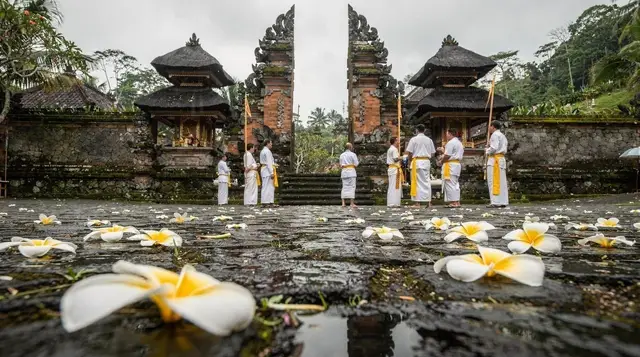
Pecalang, traditional community security wardens recognisable by their distinctive dress, patrol villages and streets throughout Nyepi to ensure the restrictions are observed, and their presence is a real, not symbolic, part of the enforcement across the island. Visitors are expected to remain within their hotel or villa grounds; even shielded pool areas may have restrictions on visible activity depending on the specific area and how strictly local custom is observed there.
Checking directly with your accommodation about their specific expectations, rather than assuming a single island-wide standard applies everywhere identically, is the most reliable way to know exactly what’s permitted during your stay. It isn’t an occasion to test boundaries out of curiosity — respecting the observance is both a legal and a genuinely important cultural expectation.
How hotels and accommodation handle it
Most hotels and villas prepare specifically for Nyepi, often providing a set meal plan or in-house dining option for the day, since guests can’t leave the property and outside delivery isn’t available. Some properties also organise their own low-key activities within the grounds, such as a shared meditation session or a quiet communal reading area, aimed at giving guests something structured to do without breaching the spirit of the observance.
Pool areas often remain accessible within many properties, though quietly and without loud music or visible activity from outside the grounds, in keeping with the spirit of the day even where the letter of the restriction is somewhat flexible for tourists specifically. Checking your specific accommodation’s Nyepi arrangements in advance, rather than assuming a standard hotel-day routine, avoids an unpleasant surprise.
Planning your trip around Nyepi’s dates
If your travel dates are flexible, checking the specific Nyepi date for your travel year before booking flights avoids the airport closure catching you out entirely. If Nyepi falls within a trip you’ve already planned, treat it as a distinct, deliberate day within the itinerary rather than trying to schedule activities around it — book accommodation with a comfortable stay-in experience in mind, and plan the days immediately before and after around the ogoh-ogoh parades and your onward travel respectively.
Using the days immediately surrounding Nyepi for a slower-paced activity, such as a zipline and garden tour or a full-day private car charter around Ubud, makes sensible use of the time before settling into the observance itself. A multi-day tour booked for the days surrounding Nyepi, rather than overlapping it, is worth timing carefully once you know the exact date.
A practical 48-hour timeline
| When | What’s happening |
|---|---|
| Two days before | Villages prepare ogoh-ogoh effigies; a good time to stock up on snacks and supplies |
| The evening before | Ogoh-ogoh parades through the streets, a public, festive event |
| Nyepi day, from sunrise | Full 24-hour observance begins: no fire/light, no work, no travel, no entertainment |
| Nyepi day, throughout | Airport closed, streets empty, pecalang wardens patrolling, visitors confined to accommodation |
| The following morning | Restrictions lift, normal island life and travel resume |
Seeing it laid out this way makes clear why Nyepi rewards deliberate planning rather than treating it as a single isolated inconvenience — the day before and the day after both shape how smoothly the observance itself goes, particularly around stocking up on anything you might need since nothing is open once the silence begins.
Why the observance matters so much in Balinese Hindu belief
Nyepi marks the Saka new year and is rooted in the idea of collective introspection and purification — the silence and stillness are meant to convince malevolent spirits that the island is uninhabited, encouraging them to move on rather than settle for the coming year, while also giving residents a genuine, enforced pause for reflection. Understanding this underlying purpose, rather than experiencing the day purely as a logistical inconvenience, tends to change how visitors relate to the experience — many describe the enforced stillness, once they stop fighting it, as a genuinely rare and valuable pause from the usual pace of travel and daily life alike.
What long-term residents and repeat visitors say about it
Travellers who’ve experienced Nyepi more than once often describe an initial adjustment period of restlessness giving way, by the afternoon, to something closer to genuine calm — the absence of traffic noise, artificial light, and the usual hum of a tourist destination in full swing is a rare enough experience that many find it worth deliberately planning a return trip around. Others, more honestly, describe finding a full day confined to a hotel room genuinely difficult, particularly with children or on a tight itinerary, which is worth factoring into your own expectations rather than assuming everyone experiences it the same way.
What isn’t worth worrying about
Don’t assume Nyepi ruins a trip that happens to include it — many visitors describe it as one of the more memorable, unusual parts of their entire Bali experience precisely because it’s so different from a normal day of travel. Equally, don’t treat it lightly or assume the restrictions are loosely enforced for tourists; the observance is taken seriously, and the community wardens’ role is genuine rather than a token gesture for visitor benefit.
How this fits into planning your trip
Read Nyepi: day of silence for the fuller cultural context, and how Nyepi affects your trip for the specific practical planning implications covered here in more depth. Balinese ceremonies: what to expect and Galungan and Kuningan cover other recurring points in the Balinese calendar worth knowing about if your trip might overlap with either.
If you’re in Ubud specifically around this time, a batik-making class booked for the days before Nyepi is a good, culturally relevant way to use the time leading up to the observance.
Frequently asked questions about What Nyepi Is Actually Like If You’re Caught in Bali
Does Nyepi fall on the same date every year?
No, it follows the Balinese Saka lunar calendar, so the specific date shifts annually, generally falling somewhere in March or April. Check the exact date for your travel year before booking.
Can I fly into or out of Bali on Nyepi itself?
No — Ngurah Rai airport closes entirely for the full 24-hour period, with no arrivals or departures permitted regardless of airline or ticket type.
Am I allowed to leave my hotel room during Nyepi?
You can generally move within your accommodation’s grounds, but not onto public streets, and loud activity or visible lights are discouraged even within many properties in keeping with the observance.
Is Nyepi observed the same way across the whole island?
The core restrictions are observed island-wide, though the strictness of enforcement and the specific accommodations made for tourists can vary somewhat between more touristed areas and quieter villages.
What happens if I need medical assistance during Nyepi?
Emergency services do operate during Nyepi for genuine medical situations, and hospitals remain accessible, though routine, non-urgent trips outside your accommodation are not permitted.
Is the ogoh-ogoh parade safe and welcoming for tourist spectators?
Yes, generally — it’s a public celebration that welcomes visitor spectators in most areas, though it can get crowded, so standard precautions around large gatherings apply.
Should I actively try to be in Bali during Nyepi, or avoid it?
It depends on what you want from your trip. Many travellers deliberately plan to be there for the cultural experience, while others, particularly those with tight itineraries or connecting flights, prefer to avoid the disruption to their schedule.
Can I use my phone or internet during Nyepi?
Personal device use within your accommodation is generally tolerated, though some areas historically restricted even internet access as part of the observance. Check current local guidance, since practices can vary by year and specific region.
Do I need to bring my own food for Nyepi day?
Most hotels and villas provide meals for guests during Nyepi given that outside delivery and dining aren’t available, but confirming your specific accommodation’s arrangements in advance is worth doing rather than assuming.
Is it worth extending a trip specifically to include Nyepi?
For travellers genuinely curious about the cultural experience, yes — it’s a distinctive, once-a-year event unlike anything else on a standard Bali itinerary, provided you go in with realistic expectations about the confinement involved.
Seasonal experiences on GetYourGuide
Verified deep-linked GetYourGuide tours. Book through these links and we earn a small commission at no cost to you.
These are our own photographs of Bali, not the operator's pictures of this tour — open the tour page to see those.