Balinese Ceremonies: What to Expect
Will I actually encounter a Balinese ceremony during a typical trip?
Very likely, in some form. Small daily offerings are everywhere regardless of timing, and Bali's 210-day pawukon calendar means temple anniversary ceremonies (odalan) are happening somewhere on the island on almost any given week. Larger island-wide events like Galungan, Kuningan, or Nyepi are less frequent but genuinely trip-shaping if your dates happen to overlap with one.
Balinese Hindu religious life runs on a rhythm most visitors never fully see coming, built around a calendar system that generates far more ceremonies, at far more frequent intervals, than the handful of famous dates — Nyepi, Galungan — that make it into most guidebooks. Small offerings appear on pavements every single morning regardless of any special occasion. Larger temple ceremonies happen on a rolling cycle tied to each temple’s own anniversary. And island-wide events reshape daily life in ways ranging from a single quiet day to a genuinely significant disruption to transport and normal routine.
Understanding this rhythm, even in outline, changes how you interpret what you see on the ground. A closed road, a procession of women carrying elaborate offering towers on their heads, or an unusually large gathering at a village temple are not random occurrences — they are almost always tied to a specific point in the ceremonial calendar, and recognising that turns a confusing interruption into something genuinely worth pausing to observe respectfully.
This guide covers the main types of ceremony a visitor is likely to encounter, from the smallest daily offerings to the more elaborate cremation ceremonies that occasionally draw curious tourist attention, along with the etiquette that applies to each.
Balinese ceremonies at a glance
| Frequency | Daily offerings everywhere; temple anniversaries (odalan) roughly every 210 days per temple; island-wide events at their own less frequent intervals |
| What you might see | Offerings on pavements, processions, temple gatherings, occasionally a cremation ceremony or wedding |
| Etiquette | Modest dress, respectful distance, no interrupting a procession, ask before photographing people directly |
| Disruption | Road closures for processions and Nyepi are the most likely to affect a visitor’s plans directly |
| Best response | Observe quietly from a respectful distance rather than approaching or inserting yourself into the event |
Daily offerings: canang sari
The most ubiquitous ceremonial element you will see, every single day regardless of any special occasion, is the canang sari — small woven-palm trays filled with flowers, rice, and incense, placed outside homes, shops, and temples as a daily act of gratitude and balance in Balinese Hindu practice. These appear on pavements, doorsteps, car dashboards, and temple grounds continuously, replenished fresh each morning, and the single most important piece of etiquette around them is simply not stepping on one, which is easy to do without noticing amid Bali’s busy pavements if you are not paying attention.
Temple anniversaries: odalan
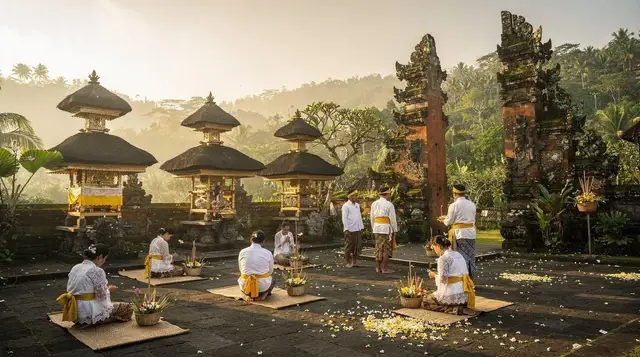
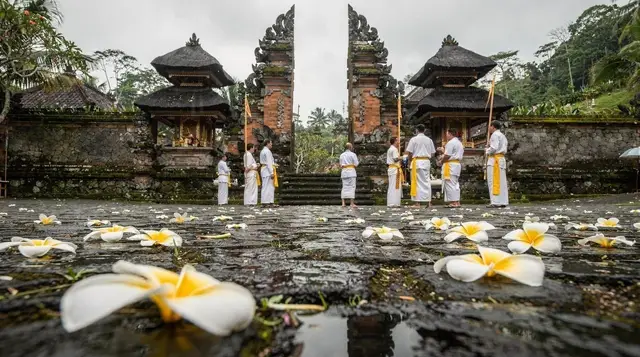
Every temple in Bali celebrates its own anniversary, called odalan, on a cycle tied to the 210-day pawukon calendar rather than the standard 365-day solar year most visitors are used to. Because there are tens of thousands of temples across the island, each running its own independent cycle, an odalan ceremony is happening somewhere in Bali on almost any given day, though you are only likely to encounter one directly if you happen to visit a specific temple during its particular celebration. If you arrive at a temple mid-odalan, expect a considerably livelier, more crowded atmosphere than an ordinary day, with worshippers in ceremonial dress and offerings piled higher than usual.
Galungan and Kuningan
Galungan and Kuningan are two of the most significant recurring events in the Balinese Hindu calendar, also following the 210-day pawukon cycle, marking the victory of dharma over adharma and honouring ancestral spirits respectively. Streets across the island fill with tall, curved bamboo poles called penjor, decorated with offerings and palm-leaf ornaments, planted outside homes for the duration of the celebration — a visually striking sight that transforms even quiet residential streets into something genuinely festive.
If your trip happens to overlap with this period, expect a noticeably more decorated, ceremonially active island than an ordinary visit, and read the dedicated Galungan and Kuningan guide for the specifics of what to expect.
Ngaben: cremation ceremonies
Balinese Hindu cremation ceremonies, known as ngaben, are among the more elaborate and visually striking rituals a visitor might encounter, involving a colourful, tower-like structure called a bade that carries the body in procession before cremation.
Because ngaben ceremonies are sometimes expensive to hold individually, families occasionally combine several into a single communal ceremony, which can draw considerable local attendance and, at some larger events, curious tourist observation from a respectful distance. If you happen to witness one, treat it with the same gravity you would a funeral procession anywhere in the world — solemn observation from the sidelines, appropriate dress, and no inserting yourself into the procession for a photograph.
Melasti: purification before Nyepi
In the days leading up to Nyepi, Balinese Hindu communities conduct melasti processions, carrying sacred temple objects to the sea or another significant water source for ritual purification, often involving large groups walking in traditional dress along routes that can close roads temporarily. It is one of the more visually impressive processions a visitor might encounter, and it is worth watching respectfully from the roadside if your travel dates happen to coincide, though it is also worth planning around potential road closures if you have a scheduled transfer or activity nearby on those days.
Weddings and tooth-filing ceremonies
Beyond the temple-centred calendar, individual life-cycle ceremonies also punctuate Balinese social life, including weddings and the traditional tooth-filing rite of passage marking the transition to adulthood, both typically celebrated with considerable community involvement and colourful ceremonial dress. Travellers staying in guesthouses or villages sometimes find themselves informally invited to observe or even participate in a neighbour’s family ceremony, which, when the invitation is genuine, can be one of the more memorable cultural experiences of a trip — approached, as with any ceremony, with appropriate dress and respectful behaviour throughout.
Learning about ceremonies through a guided experience
For travellers who want structured context around Balinese ceremonial life rather than relying on chance encounters, a guided cultural day such as the Ubud Balinese culture and nature private full-day tour typically includes explanation of offerings, temple practices, and the wider ceremonial calendar as part of the itinerary.
For something more hands-on, the Ubud Balinese offering-making and purification ritual experience lets visitors actually learn to construct a canang sari themselves under local guidance, which tends to build a considerably deeper appreciation for the daily offerings you will otherwise simply be stepping around for the rest of your trip.
Cultural performances tied to ceremonial tradition
Some of Bali’s performing arts, including the Barong dance depicting a mythical battle between good and evil spirits, draw directly on the same cosmological themes underpinning many ceremonies, even when staged specifically for visitors rather than as part of an active ritual. The Ubud Barong dance, temple and Balinese house tour is a reasonable way to see this performance tradition alongside a look at a traditional Balinese family compound, giving useful context for the wider religious and social framework these ceremonies sit within.
The pawukon calendar, briefly explained
Much of Bali’s ceremonial rhythm traces back to the pawukon, a 210-day calendar system running alongside the standard solar calendar, structured around ten different concurrent weeks of varying lengths that combine to produce specific named days with their own significance.
This is why temple anniversaries and events like Galungan recur roughly every seven months rather than annually, and why the exact solar-calendar date of these events shifts from year to year rather than falling on a fixed day the way many Western holidays do. Understanding this system, even in outline, explains why checking current dates for any ceremony you want to witness or plan around matters more in Bali than checking a fixed annual calendar would for equivalent celebrations elsewhere.
A full-day cultural immersion option
For travellers who want to go deeper than a single guided stop, some operators offer fuller immersion days combining several elements of Balinese ceremonial and cultural life — offering-making, a purification ritual, and a temple visit — into a single structured itinerary. A Balinese purification ritual experience with a lunch option is one such format, pairing a guided ritual with time to reflect over a traditional meal, giving a more rounded, unhurried introduction to this side of Balinese life than a rushed single-stop visit typically allows.
What isn’t worth the anxiety
Do not feel you need to memorise the full calendar or anticipate every possible ceremony before arriving — Balinese hospitality toward foreign visitors is generally warm and patient, and genuine curiosity approached with basic respect is almost always well received. The core etiquette that matters across every type of ceremony described here is consistent: modest dress, respectful distance, no interrupting processions, and treating solemn events, particularly cremations, with the same gravity you would extend anywhere else in the world.
Budget
Most ceremonies a visitor might encounter carry no direct cost to observe respectfully from the sidelines. If you want structured learning through a guided cultural tour or a hands-on offering-making experience, expect a modest cost bundled with transport and instruction, comparable to other half-day Ubud-area cultural activities.
How this fits into your wider Bali trip
Ceremonial life is woven through almost every part of a Bali trip, from the offerings you step around daily to the larger events that may reshape a specific day of your itinerary. Read the how Nyepi affects your trip guide if your dates fall near the Day of Silence, and the Bali temple etiquette guide for the dress code that applies at any temple ceremony you encounter.
A base in Ubud tends to offer the most frequent chance encounters with village-level ceremonies, and this kind of cultural texture is worth building time for within a longer stay such as the Bali, 7 days itinerary rather than a rushed shorter trip.
Where am I most likely to encounter a ceremony during my trip?
A base in Ubud tends to offer the most frequent chance encounters with village-level ceremonies, though offerings and smaller rituals are visible island-wide regardless of where you stay, including at major sites like Besakih.
Frequently asked questions about Balinese Ceremonies
Will my trip definitely coincide with a ceremony?
Small daily offerings, yes, guaranteed. Larger temple anniversaries happen somewhere on the island constantly given the 210-day cycle across thousands of temples, though you are only likely to directly encounter one at a specific site you happen to visit during its celebration.
Is it appropriate to photograph a ceremony?
Photographing from a respectful distance is generally acceptable for larger public processions, but close, unacknowledged photography of individuals, particularly during solemn events like cremations, should be avoided or done only with clear permission.
Can tourists attend a Balinese wedding or ceremony if invited?
Yes, and it can be a genuinely rewarding experience if the invitation is sincere, typically extended informally through a guesthouse host or local acquaintance. Appropriate modest dress and respectful behaviour are expected as they would be at any ceremony.
What should I do if a procession blocks my route?
Wait for it to pass rather than attempting to push through or drive around it if the road is genuinely closed. Processions have effective right of way, and drivers and other pedestrians are expected to accommodate them.
Are cremation ceremonies open to tourist observation?
Some are, particularly larger communal ceremonies, though this varies by event and community. If in doubt, ask a local guide or your accommodation rather than assuming access, and always observe with appropriate solemnity if permitted.
How do Galungan and Kuningan differ from Nyepi?
Galungan and Kuningan are festive, decorative celebrations involving penjor poles and family gatherings, while Nyepi is the opposite in tone — a single day of enforced island-wide silence and stillness. Both are significant but shape a visit very differently.
Temple & culture tours on GetYourGuide
Verified deep-linked GetYourGuide tours. Book through these links and we earn a small commission at no cost to you.
These are our own photographs of Bali, not the operator's pictures of this tour — open the tour page to see those.