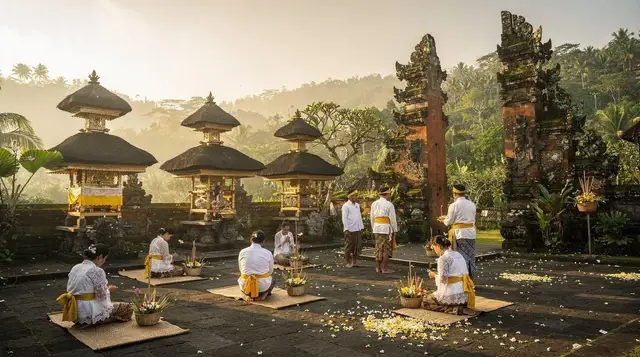
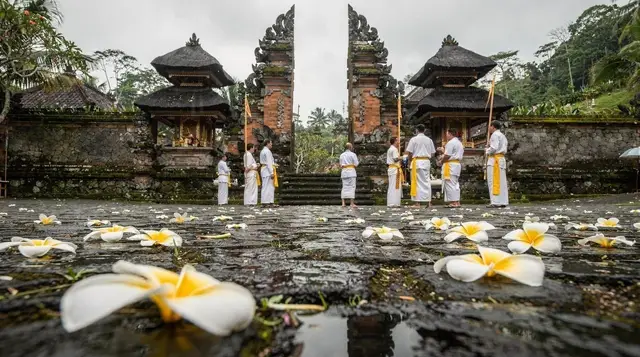
Nyepi: Bali's Day of Silence
What actually happens on Nyepi, and can I still travel that day?
No air travel and no leaving your accommodation for a full 24 hours — Bali's international airport closes completely, streets empty out, and even tourists are required to stay within their hotel grounds with lights and noise kept to a minimum. It is a genuinely unusual experience rather than an inconvenience to avoid entirely, but it does mean building your travel dates around it rather than trying to move through Bali on that specific day.
Nyepi, the Balinese Day of Silence, is one of the more genuinely unusual annual events anywhere in the world open to observation by international travellers: for a full 24 hours, the entire island of Bali comes to a complete stop. No flights, no traffic, no work, no entertainment, and — after dark — no visible lights anywhere, including inside hotels. It marks the Balinese Saka new year and falls in March or April depending on the lunar calendar, shifting date from year to year rather than landing on a fixed day.
For visitors, Nyepi is not simply a quiet public holiday to work around — it is an active, enforced restriction that applies to tourists as much as locals. Bali’s international airport closes entirely for the full 24-hour period, a rare example globally of an international airport shutting down for a religious observance rather than weather or an emergency, and streets are patrolled by traditional community security officers called pecalang to ensure compliance. Understanding what this actually means practically, rather than treating it as a minor inconvenience, is essential if your travel dates fall anywhere near it.
The day itself sits within a wider sequence of ceremonies and observances, bookended by a lively, very public parade the night before and a return to normal social life the day after, which together give Nyepi a shape considerably richer than the single quiet day most descriptions focus on.
Nyepi at a glance
| When | March or April, exact date shifts yearly based on the Saka lunar calendar |
| What closes | The international airport, all shops and businesses, essentially all public activity |
| Restrictions | No fire or light, no work, no travel, no entertainment — enforced for both locals and tourists |
| Where tourists can go | Nowhere outside hotel grounds; most hotels maintain minimal, curtained lighting after dark |
| Surrounding events | Ogoh-ogoh parade the evening before; Ngembak Geni social visits the day after |
The four restrictions: Catur Brata Penyepian
Nyepi’s observance is built around four specific restrictions, collectively known as Catur Brata Penyepian: no lighting fires or using light, no working, no travelling, and no indulging in entertainment or pleasure. These apply island-wide and are taken seriously enough that even hotels catering specifically to tourists dim or curtain their lights after dark, and guests are expected to remain within hotel grounds rather than venturing out, regardless of nationality or awareness of the custom. The intention behind the restrictions is a form of collective spiritual reflection and self-restraint, allowing the island a full day of stillness at the start of the new year.
The night before: ogoh-ogoh parades
The evening before Nyepi is almost the opposite of the day itself — villages across Bali parade large, elaborately constructed effigies called ogoh-ogoh, typically depicting demons or malevolent spirits, through the streets with music, crowds, and considerable energy.
The parades are intended to draw out and symbolically expel negative spirits ahead of the island’s day of stillness, and they are genuinely spectacular to witness, with months of community effort going into building the often enormous, creatively designed figures. If your trip coincides with Nyepi, making a point of catching an ogoh-ogoh parade the evening before is one of the more memorable cultural experiences available on the island, and it stands in useful contrast to the silence that follows.
Ngembak Geni: the day after
The day following Nyepi, known as Ngembak Geni, marks a return to normal activity, traditionally associated with social visits, extended family gatherings, and a general resumption of ordinary life after the enforced stillness. For visitors, this is when the island effectively reopens — shops, restaurants, and transport resume, though the airport typically restarts operations on a staggered basis rather than instantly returning to a full schedule, so building in a buffer day either side of Nyepi is a sensible precaution for anyone with a tight onward connection.
Planning your trip around Nyepi
Given the airport closure and the total activity shutdown, Nyepi genuinely reshapes any trip whose dates overlap with it, and the practical planning question is less “should I avoid Nyepi” and more “how do I structure my dates around it deliberately.” Some travellers choose to be already settled somewhere comfortable, ideally with a nice view and a good book, treating the day as an enforced, unusually peaceful pause rather than lost time. Others plan their arrival or departure to avoid the airport closure window entirely, particularly if their trip is short and every day matters for sightseeing.
Making the most of the days around Nyepi
Since Nyepi itself involves no activity, travellers often use the days immediately before or after to pack in cultural experiences that pair well with the reflective spirit of the season. A hands-on batik-making class in Ubud or an authentic Ubud waterfalls, temples and artisan villages tour are reasonable ways to fill the days surrounding Nyepi with genuine cultural content, given that the day itself leaves no room for any organised activity at all.
A village-based cultural day either side of Nyepi
For a broader look at Balinese craft and community life before or after the Day of Silence itself, the all-inclusive Celuk village tour covering culture, food and relaxation is a useful way to spend a day with a cultural focus that complements, rather than competes with, the reflective tone of the Nyepi period. A more private option, the one-day private Ubud tour through Wana Ayu and Jelijih Tenganan, offers a similarly paced alternative for travellers who prefer a smaller group setting.
Why the restrictions apply to tourists too
A common question from first-time visitors is why an entire island, including its international guests, observes restrictions tied to a specific religious tradition rather than exempting tourism zones. The answer lies partly in the spiritual logic of Nyepi itself — the day is meant to represent a kind of collective invisibility to negative forces, and any visible activity, including lit hotel windows or moving vehicles, is considered to undermine that collective effort.
There is also a practical dimension: with the airport closed and public infrastructure at a standstill, there is genuinely nowhere for tourists to go even if the restrictions did not formally apply to them, which is part of why hotels prepare guests for the day so thoroughly in the lead-up.
What hotels typically provide during Nyepi
Most hotels and resorts plan carefully for Nyepi, since they are hosting guests through a day when normal services are restricted. Expect curtained or dimmed lighting after dark, meals typically still served but with quieter service and reduced options, and staff briefing guests in advance on what is and is not permitted. Pools and hotel grounds generally remain accessible during daylight hours, even if leaving the property entirely is not, so the day is rarely as confining as “24 hours in a hotel room” might sound — more a quiet, reflective day spent within the grounds of wherever you are staying.
A cultural full-day option for the lead-up
For travellers wanting to build a fuller cultural day into the period just before Nyepi, when the island’s energy is building toward the ogoh-ogoh parade, a broader itinerary such as the two-day Ubud waterfalls, temple and adventure tour is a reasonable way to see more of the region’s natural and cultural sights while the anticipation for the parade builds across the island.
What isn’t worth the anxiety
Do not treat Nyepi as a reason to avoid visiting Bali altogether during that period — most travellers who experience it describe it as one of the more memorable, distinctive parts of their trip rather than a wasted day, provided they plan around the restrictions rather than fighting them. It is also not worth trying to negotiate an exception to the restrictions with hotel staff or local authorities; the observance is taken seriously island-wide, and no amount of persuasion changes the enforced restrictions for that day.
Budget
There is no direct cost associated with Nyepi itself beyond the accommodation you would already be paying for regardless of the date. The main financial consideration is flight flexibility — since the airport closes entirely, any flights scheduled on Nyepi are rescheduled well in advance by airlines, and building awareness of the date into your booking decisions avoids any last-minute scrambling.
When Nyepi falls each year
Nyepi’s date shifts annually based on the Saka lunar calendar, typically falling in March or April, and it does not correspond to a fixed date on the standard solar calendar. Checking the specific date for your travel year well in advance is essential, both for flight planning and for understanding how it might reshape a trip that overlaps with it.
How this fits into your wider Bali trip
Nyepi is worth building deliberately into your itinerary planning rather than discovering by surprise once you arrive. Read the how Nyepi affects your trip guide for the more detailed practical logistics of flights and accommodation around the date, and the Balinese ceremonies guide for the wider ceremonial calendar Nyepi sits within.
If your dates are flexible, the Bali in shoulder season guide can help you decide whether to build a trip around Nyepi or avoid the overlap entirely. Basing yourself in Ubud for the days around Nyepi tends to offer a particularly rich cultural experience given the town’s concentration of ceremonial and artistic activity, and it fits well within a longer stay such as the Bali, 7 days itinerary.
Do all shops and restaurants close for Nyepi?
Effectively yes, across the island, with the exception of essential services within hotel properties catering to already-checked-in guests. Do not expect to find open restaurants, shops, or convenience stores outside your accommodation on the day itself.
Does Galungan follow the same kind of restrictions as Nyepi?
No, they are very different in tone. Galungan and Kuningan are festive, decorative celebrations with no travel restrictions, unlike Nyepi’s enforced island-wide silence and stillness.
Frequently asked questions about Nyepi
Can I fly into or out of Bali on Nyepi itself?
No. The international airport closes completely for the full 24-hour period, and airlines reschedule affected flights well in advance rather than attempting to operate on the day.
Do tourists really have to stay inside during Nyepi?
Yes, this is genuinely enforced by community security patrols (pecalang), not simply a suggestion. Hotels typically brief guests on the restrictions and expect compliance for the full period.
Is the ogoh-ogoh parade worth planning a trip around?
Many travellers consider it one of the highlights of visiting Bali during this period — a loud, colourful, community-driven event that contrasts sharply with the silence that follows the next day.
What happens if I am already on the island when Nyepi begins?
You simply remain wherever you are staying for the full 24-hour period, with hotels generally well prepared to accommodate guests through the restrictions, including meals and basic services delivered quietly within the property.
Is Nyepi the same date every year?
No, it follows the Saka lunar calendar and shifts date annually, typically falling somewhere in March or April. Always check the specific date for your travel year.
Are there exceptions to the Nyepi restrictions for emergencies?
Genuine medical emergencies are accommodated through designated emergency services, but this is not a loophole for general travel or sightseeing, and the restrictions otherwise apply without exception.
Temple & culture tours on GetYourGuide
Verified deep-linked GetYourGuide tours. Book through these links and we earn a small commission at no cost to you.
These are our own photographs of Bali, not the operator's pictures of this tour — open the tour page to see those.