Bali Street Food Safety: A Practical Guide
Is street food actually safe to eat in Bali?
Generally yes, at busy stalls with high turnover where food is cooked fresh in front of you rather than sitting out for extended periods. Denpasar's markets, particularly around Badung, are where the most genuinely local street food is concentrated, and a guided food tour is a reasonable way to sample widely on a first visit without needing to judge every stall yourself.
Denpasar, Bali’s provincial capital and largest city, is where the island’s most genuinely local street food scene is concentrated, largely because it’s where Balinese people themselves shop and eat rather than a place built primarily for tourists. Badung Market, one of the largest traditional markets on the island, and the streets around it are dense with stalls selling everything from fresh produce to cooked specialities, and navigating it well is less about caution and more about knowing what to look for.
That said, “street food” covers a wide range of actual risk levels, from a stall cooking skewers over hot coals in front of you to pre-prepared dishes that have been sitting out since morning, and treating all of it the same — either with blanket avoidance or blanket enthusiasm — misses the point. This guide covers how to actually judge street food safety in practice, where Denpasar’s scene fits into a wider Bali trip, and when a guided tour is worth the cost over exploring independently.
Bali street food safety at a glance
| Where it’s concentrated | Denpasar, particularly around Badung Market and nearby night market streets |
| Best safety signal | High turnover — food cooked fresh in front of you or sold quickly from a small batch |
| Cost | Inexpensive by most international standards |
| Best time | Evening for night markets; daytime for Badung Market itself |
| First-visit option | A guided food tour removes most of the guesswork for newcomers |
The turnover principle, applied to street stalls
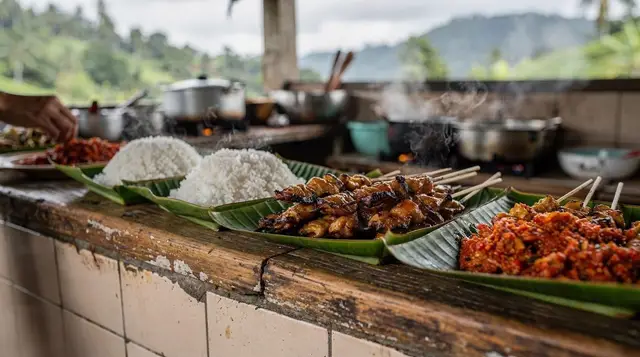
The single most useful habit for judging street food safety is watching how quickly a stall moves through its stock. A satay vendor grilling skewers to order over hot coals, a noodle stall stir-frying each portion fresh in a wok, or a fruit stall cutting produce as you order are all lower-risk by nature of the cooking method itself — heat applied directly and immediately, with minimal time for food to sit at unsafe temperatures. Pre-cooked dishes displayed for browsing, more common at some market stalls than at dedicated street-food carts, carry more risk if they’ve been sitting for extended periods without proper heating or refrigeration, so it’s worth paying closer attention to those specifically.
Reading a stall before you order
Beyond turnover, a few other quick signals are worth checking before committing to a stall you’re unfamiliar with. Look at how the vendor handles raw and cooked ingredients — separate utensils and surfaces for raw meat versus ready-to-eat items is a good sign, while cross-contamination between the two is worth noting. A visible source of clean water for rinsing utensils and hands matters too, even if it’s a simple setup rather than anything resembling a commercial kitchen. None of this requires deep expertise; a minute or two of observation before ordering, especially at a stall you haven’t tried before, tells you most of what you need to know.
Guided tours: the lower-effort way to sample widely
If Badung Market and Denpasar’s street food scene feel overwhelming on a first visit, a guided food tour solves most of the navigation problem in one go, since an experienced local guide already knows which stalls to trust and which dishes are worth prioritising among dozens of unfamiliar options. A tour like the heritage street food tour in Denpasar’s Badung Market walks you through the market itself with a guide curating stops, which is considerably more efficient than wandering alone trying to guess what’s good.
For an evening-focused version, the Denpasar evening walking tour with street food tasting covers the city’s night-time food scene specifically, which has a different character and different specialities from the daytime market. A more broadly curated option, the best street food tour with a local guide, is built around maximising variety across a single outing.
What’s actually different about Denpasar’s food scene
Unlike Ubud or the southern beach towns, where a fair amount of the food scene has adapted specifically to visitor expectations, Denpasar’s markets and street stalls operate primarily for a local customer base. That means more genuinely regional Indonesian and Balinese dishes on offer, less English signage, and a pace and atmosphere that can feel considerably more intense for first-time visitors than a curated tourist-facing food street. It’s also, for exactly those reasons, where you’re most likely to encounter dishes and flavours you simply won’t find at a more polished restaurant elsewhere on the island.
Building tolerance if street food is new to you
If you’re not used to eating street food anywhere, easing into Denpasar’s scene gradually rather than sampling everything on day one tends to work better than diving in all at once. Start with a couple of stalls cooking food fresh over direct heat, note how your system responds over the following day, and expand from there. This isn’t a food-safety precaution so much as a practical way to build confidence and tolerance for an unfamiliar range of spices, oils, and preparation styles, and most travellers find they’re eating far more widely and confidently by the second half of a typical trip.
A structured multi-stop tasting
For travellers who want a clear sense of exactly what they’re getting rather than an open-ended wander, a tour built around a fixed number of tastings takes some of the uncertainty out of the day. A tour such as the Denpasar market food tour with seven must-try tastings is structured this way, giving a defined, curated sampling across the market rather than an unstructured browse. This style suits travellers who want breadth and a guide’s judgement on what’s worth stopping for, rather than a more open-ended, self-directed exploration.
What isn’t worth the detour
Skip any stall with food that’s clearly been sitting out uncovered for an extended period with little sign of turnover, regardless of how good it smells or how cheap it looks — this is exactly the pattern most associated with real food-safety risk, at a street stall just as much as at a sit-down warung. It’s also not worth trying to cover the entirety of Badung Market in a single rushed visit; the market is large and dense, and a guided tour or a more focused, unhurried self-guided visit to one section serves you better than attempting to see everything at once.
Night markets vs the daytime Badung Market
| Daytime Badung Market | Evening night market streets | |
|---|---|---|
| Atmosphere | Dense, primarily a working produce and goods market | More food-focused, casual browsing pace |
| What’s on offer | Fresh produce, some cooked stalls, traditional goods | A wider concentration of ready-to-eat street food |
| Best for | Seeing how locals actually shop, a few cooked-food stops | A dedicated street-food-focused evening out |
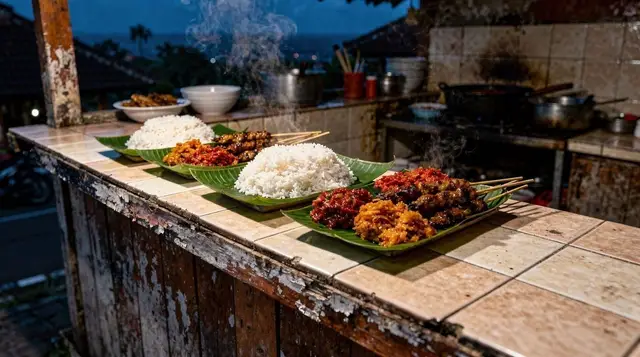
A tour like the Denpasar night market food tour with pick-up and drop-off removes the transport logistics from an evening visit entirely, which is worth the convenience if you’re staying some distance from central Denpasar.
What it costs
Street food in Denpasar’s markets is inexpensive by most international standards, reflecting its role as everyday eating for local residents rather than a premium tourist experience. Guided tours cost considerably more, since you’re paying for a guide’s local knowledge, curated stops, and often transport, but they meaningfully reduce the time and uncertainty involved in navigating an unfamiliar market alone on a first visit.
When to go
Badung Market operates primarily during the day, with its busiest, freshest period generally in the morning as produce and cooked-food stalls restock. Night market streets, by contrast, come alive in the evening and run into the night, offering a genuinely different atmosphere and food selection from the daytime market. There’s no strong seasonal pattern to either; this is a year-round activity regardless of when you’re visiting.
Getting there and getting around
Denpasar is Bali’s provincial capital and sits centrally enough to reach reasonably easily from most southern tourist areas by Grab, Gojek, or a private driver, though it’s a longer trip from Ubud or the east coast. Within the market and surrounding streets, walking is the only practical way to explore, and the area can be dense and a little disorienting on a first visit, which is part of why a guided tour appeals to many first-time visitors specifically.
How this fits into a longer trip
A Denpasar street food outing pairs well with a day that doesn’t otherwise have much planned, since it’s a self-contained few hours rather than something that needs to anchor a longer itinerary. The Balinese food guide gives wider context on specific dishes worth knowing, and the warung etiquette and food safety guide covers related principles that apply just as much to sit-down warungs as to street stalls. The where to eat babi guling guide is worth reading too, since some of the same specialist warung logic applies to well-known street stalls.
For a broader take on food-safety concerns generally, the Bali belly: what actually causes it post is useful background before a street-food-heavy day, and the choosing a Bali cooking class post is worth a look if you’d rather learn to make some of what you’ve tried rather than just eating it. The Denpasar destination guide covers the wider city beyond just its food scene.
What to bring on a street food outing
A small amount of preparation makes a street food day considerably more comfortable. Bring cash in small denominations, since most stalls can’t break large notes and card payment isn’t standard. Wet wipes or hand sanitiser are genuinely useful given the informal nature of most stalls, and comfortable, closed shoes matter more than you’d think in a busy, sometimes uneven market environment. If you’re prone to sun exposure, a hat and water are worth carrying too, particularly for a daytime Badung Market visit rather than an evening night-market outing.
Frequently asked questions about Bali Street Food Safety
Is Badung Market safe for a first-time visitor to explore alone?
Yes, though it can feel dense and disorienting without any guidance. A guided tour removes most of the uncertainty if it’s your first visit to a large Indonesian market.
What’s the biggest food-safety risk with street food specifically?
Pre-cooked dishes that have been sitting out for extended periods without proper heat or turnover, more than food cooked fresh to order over direct heat.
Is Denpasar worth visiting just for the food, or is there more to see?
The food scene is the strongest draw for most visitors, though Denpasar has other sights worth a look if you’re spending a full day there rather than a single evening.
How is Denpasar’s street food different from what I’d find in Ubud or Seminyak?
Denpasar’s markets serve primarily local customers, so the food skews more regional and traditional, with less adaptation for tourist palates than in more visitor-heavy areas.
Do I need cash for street food stalls?
Yes, almost universally. Carry small denominations, since vendors often can’t break large notes and card payment isn’t standard at most stalls.
Is a guided tour worth it if I’m comfortable exploring markets independently?
If you already have experience navigating similar markets elsewhere and enjoy figuring it out yourself, you can absolutely explore independently and save the cost of a guide.
What should I do if I have dietary restrictions?
Street food can be trickier to navigate with restrictions than a restaurant menu, since ingredients aren’t always listed. A guided tour can help by asking vendors directly on your behalf if you communicate your needs beforehand.
Is it rude to take photos of vendors and their stalls?
It’s generally fine to ask first, and most vendors are used to visitors taking photos of food, though a quick, polite gesture asking permission before photographing a person directly is good practice.
Bali food & drink tours on GetYourGuide
Verified deep-linked GetYourGuide tours. Book through these links and we earn a small commission at no cost to you.
These are our own photographs of Bali, not the operator's pictures of this tour — open the tour page to see those.