Balinese Food: An Honest Guide to What to Actually Eat
What's the single best way to actually try real Balinese food, not just tourist versions?
A night market or a proper local warung serving Balinese specifically (rather than generic Indonesian) food gets you closer to what locals actually eat than most restaurant menus aimed at tourists. A hands-on cooking class is the best structured option if you want to understand the ingredients and technique behind the food rather than just eat it.
Most restaurant menus aimed at tourists in Bali lean heavily on a small set of dishes — nasi goreng, mie goreng, gado-gado — that are genuinely Indonesian but not specifically Balinese, and not what most Balinese families are actually cooking at home or serving at a ceremony. Balinese cuisine has its own distinct character, built around spice pastes, ceremonial pork and duck dishes, and a reliance on fresh coconut, lime leaf, and galangal that doesn’t always survive translation onto an easy tourist menu. Finding it takes a bit more intention than ordering from whatever’s printed in English at your hotel restaurant.
That doesn’t mean it’s hidden or hard to access — it means knowing what to look for and where. Specific dishes like babi guling (spit-roasted pig) and lawar (a mix of minced meat, vegetables, and spices, traditionally made with fresh blood) carry real ceremonial weight in Balinese Hindu culture, and eating them properly usually means finding a specialist warung rather than a general restaurant. This guide covers the core dishes worth knowing, where and how to actually find them, and where a cooking class genuinely adds value over just eating.
Balinese food at a glance
| Signature dishes | Babi guling (spit-roasted pig), lawar, bebek betutu (slow-cooked duck), sate lilit, nasi campur Bali |
| Where to find it | Specialist warungs (often open only until the day’s portion sells out), night markets, and organised food tours |
| Cost | Warung meals are inexpensive by most standards; cooking classes and guided food tours cost more but include instruction or a guide |
| Best time | Lunchtime for babi guling specialists, who frequently sell out by early afternoon; evening for night markets |
| Watch for | Genuinely spicy sambal at some warungs — ask before you commit if you’re not used to real Indonesian heat |
The core dishes worth knowing
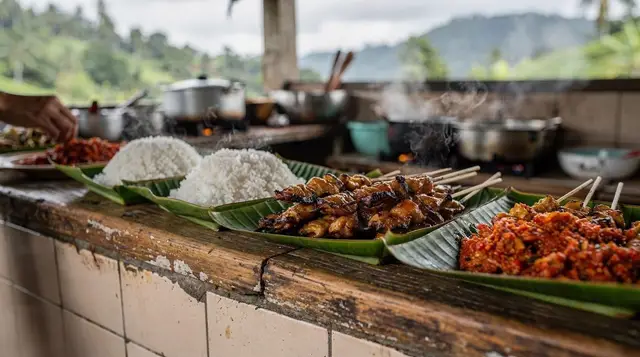
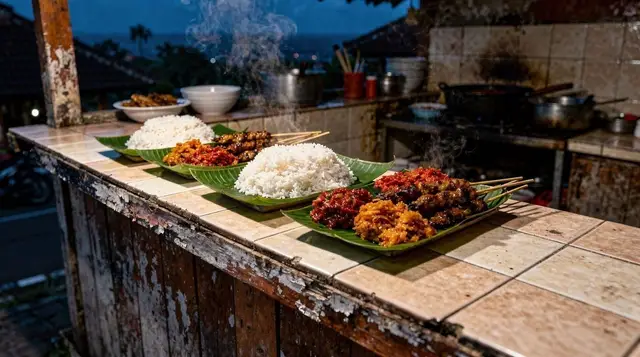
Babi guling is the dish most associated with Bali specifically: a whole pig stuffed with a turmeric-heavy spice paste and slow-roasted, traditionally prepared for ceremonies but now available daily at specialist warungs across the island, many of which sell out well before dinner and effectively function as a lunch-only business.
Lawar, often served alongside it, is a more polarising dish for visitors — a mix of minced meat, grated coconut, vegetables, and spices, traditionally made with fresh blood for its distinctive dark colour and flavour, though vegetable-only versions exist and are worth asking about if that puts you off. Bebek or ayam betutu, duck or chicken slow-cooked in banana leaf with a similarly intense spice paste, and sate lilit, minced spiced meat wrapped around lemongrass skewers rather than the more familiar cubed satay, round out the dishes most worth actively seeking out over the generic Indonesian menu items available everywhere.
Where to actually find it: warungs vs restaurants
| Specialist warung | Tourist-facing restaurant | |
|---|---|---|
| What you get | Often a single dish done well, cooked the traditional way, frequently with limited daily portions | A broader menu, usually including both Balinese and generic Indonesian or international dishes |
| Atmosphere | Simple, local, sometimes plastic chairs and no English menu | More polished, English menus, higher prices |
| Best for | Trying one specific dish properly | A more relaxed meal with a wider choice, especially if travelling with picky eaters |
Neither is objectively better — a good tourist-facing restaurant can serve genuinely well-made Balinese food, and a specialist warung’s narrow focus is exactly why it does one dish so well. What matters is knowing which you’re choosing and why, rather than defaulting to whichever is closest to your hotel.
Night markets: the most reliable way in
If you only do one food-focused activity in Bali, a night market visit with a local guide is one of the more efficient ways to sample a genuine range of Balinese and wider Indonesian street food in a single evening, since guides typically know which stalls are worth stopping at among dozens of options that can be overwhelming to navigate alone.
A guided outing like the Ubud night market food tour covers exactly this, walking you through a working local market rather than a tourist-oriented food court. A similar option, the Ubud night market and village food tour, extends the evening with a stop in a nearby village alongside the market itself.
For a more private version of the same idea, the traditional night market food tour from Ubud, private covers similar ground with a smaller group and more flexibility on pace, which is worth the extra cost if you’d rather not navigate a crowded market as part of a larger tour group.
Cooking classes: worth it if you want to understand, not just eat
A hands-on cooking class is the clearest way to actually understand what goes into Balinese cooking — the base spice paste (bumbu) that underpins most savoury dishes, the specific use of ingredients like galangal, kencur, and fresh turmeric, and techniques like wrapping and steaming in banana leaf that don’t translate from a menu description alone. A class such as the Ubud cooking class with a Balinese chef typically starts with a market visit to select ingredients before moving into hands-on preparation, which connects the market experience directly to what ends up on your plate.
For a more intimate, home-based version, the private authentic Balinese cooking class in Ubud takes place in a genuine home kitchen setting rather than a dedicated tourist cooking school, which some travellers find gives a more grounded sense of how the food is actually made day to day.
Ceremonial food vs everyday food
It’s worth understanding that a fair amount of what tourists come to think of as “Balinese food” originates in ceremonial cooking rather than everyday home meals. Babi guling and lawar in particular have strong roots in temple ceremonies and family celebrations, traditionally prepared communally by groups of men as part of the event itself rather than as restaurant fare.
Warungs specialising in these dishes today have essentially adapted a ceremonial tradition into a daily commercial one, which is worth keeping in mind both out of respect for the dishes’ origins and because it explains why some warungs treat the cooking process — the specific spice paste, the roasting method — with a level of care that goes beyond a typical restaurant kitchen. Everyday Balinese home cooking, by contrast, tends to be simpler: rice, a vegetable dish or two, perhaps a small amount of fish or chicken, and considerably less of the elaborate preparation that goes into the ceremonial specialities most visitors specifically seek out.
Rice culture and why it matters to the food
Rice underpins Balinese food and life more deeply than a simple side dish suggests — the island’s subak irrigation system, recognised by UNESCO at Jatiluwih specifically, has shaped both the landscape and the rhythm of meals for centuries, with rice traditionally treated as sacred rather than merely functional. A typical Balinese meal, nasi campur, is built around a mound of rice with a selection of smaller dishes arranged around it — vegetables, a protein, sambal, sometimes a boiled egg — rather than a single main course, and understanding that structure helps make sense of menus that otherwise look like an unstructured list of small dishes.
What isn’t worth the detour
Skip restaurants advertising “traditional Balinese buffet” aimed squarely at large tour groups — the food is often kept warm for hours and represents a diluted, crowd-pleasing version of the real dishes rather than anything close to how they’re actually made and served locally. It’s also not worth seeking out a specific famous babi guling warung if it means arriving well past lunchtime; many genuinely sell out early, and a backup plan at a second, less-hyped warung nearby often serves you better than a long wait or a sold-out disappointment.
What it costs
Warung meals, including specialist babi guling stalls, are inexpensive by most international standards and represent some of the best value eating on the island. Guided night market tours and cooking classes cost considerably more, since you’re paying for a guide’s knowledge, ingredients, and often instruction time, not just the food itself. A private cooking class or food tour costs more again than a shared group version, trading a higher price for a smaller group and more flexible pace.
When to go
Food itself isn’t seasonal in the way outdoor activities are, but timing within the day matters considerably. Babi guling specialists typically operate as a lunch business, often selling out by early-to-mid afternoon, so plan a midday visit rather than assuming you can eat there for dinner. Night markets, by contrast, run in the evening and are worth timing for a slightly earlier arrival if you want first pick of the freshest offerings before the busiest crowds descend.
Getting there and getting around
Food experiences are spread across the island rather than concentrated in one area, though Ubud in particular has become something of a hub for cooking classes and food-focused tours given its concentration of both traditional markets and instructors catering to visitors. Getting between a market, a specific warung, and your accommodation is straightforward with Grab, Gojek, or a private driver in the more built-up areas; in quieter villages, a scooter or arranged transport works better given more limited ride-hailing availability.
How this fits into a longer trip
Food is one of the easiest threads to weave through almost any Bali itinerary rather than needing its own dedicated day. For a deeper look at specific dishes and where to find them, read the where to eat babi guling guide, the warung etiquette and food safety guide, and the Bali coffee and luwak truth guide for the drinks side of the picture. If cooking classes specifically interest you, the Ubud cooking classes guide goes into much more detail on choosing between operators than fits here.
Travellers spending time outside Ubud should also read the where to eat in Canggu and Seminyak guide and the Bali street food safety guide for a wider island perspective, plus the Indonesian drinks: arak and jamu guide if traditional drinks interest you alongside the food. For a first-hand account of choosing a cooking class well, the choosing a Bali cooking class post and the Bali belly: what actually causes it post are both worth reading before your trip.
Frequently asked questions about Balinese Food
What is the single most essential Balinese dish to try?
Babi guling is the dish most closely associated with the island specifically, though if you don’t eat pork, bebek betutu (slow-cooked duck in spice paste) offers a similarly ceremonial, deeply flavoured alternative worth seeking out instead.
Is Balinese food very spicy?
It can be, particularly the sambal served alongside most dishes, but the base dishes themselves are often more about complex spice-paste flavour than pure heat. Ask before ordering if you’re unsure, and treat sambal as optional rather than mixed in by default.
Are cooking classes worth it if I don’t plan to cook Balinese food at home?
Yes, if your interest is understanding the food rather than replicating it later. The market visit and hands-on technique give context that simply eating the finished dishes doesn’t provide.
Is street food in Bali safe to eat?
Generally yes at busy stalls with high turnover, since food that’s freshly cooked and quickly sold carries less risk than food sitting out for extended periods. The Bali street food safety guide covers this in more practical detail.
What’s the difference between nasi campur and nasi goreng?
Nasi campur is a plate of rice with a selection of smaller dishes arranged around it, closer to how a typical Balinese meal is actually structured. Nasi goreng is fried rice, a widely available Indonesian dish rather than a specifically Balinese one.
Do I need to book a food tour in advance, or can I just show up?
Popular guided food tours, particularly in Ubud, are worth booking ahead, especially in high season, since group sizes are often kept deliberately small to preserve the experience at individual stalls.
Is lawar safe for someone with dietary restrictions?
Ask specifically before ordering — traditional lawar can contain raw blood and isn’t suitable for everyone, but vegetable-based versions exist at many warungs and are usually available on request.
Can vegetarians eat well with Balinese food?
Yes, though it takes a bit more asking than at an international restaurant. Rice, vegetable dishes, and tempeh or tofu-based preparations are widely available, even if the most famous ceremonial dishes are meat-focused.
Bali food & drink tours on GetYourGuide
Verified deep-linked GetYourGuide tours. Book through these links and we earn a small commission at no cost to you.
These are our own photographs of Bali, not the operator's pictures of this tour — open the tour page to see those.