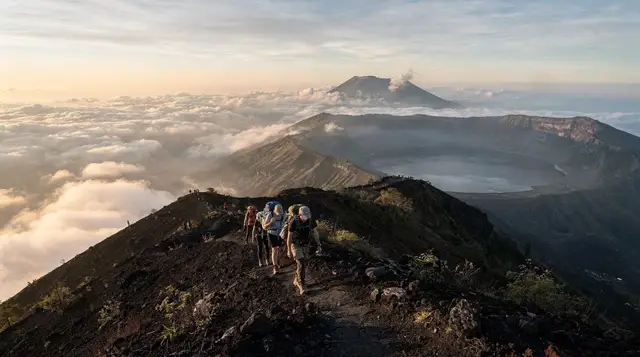
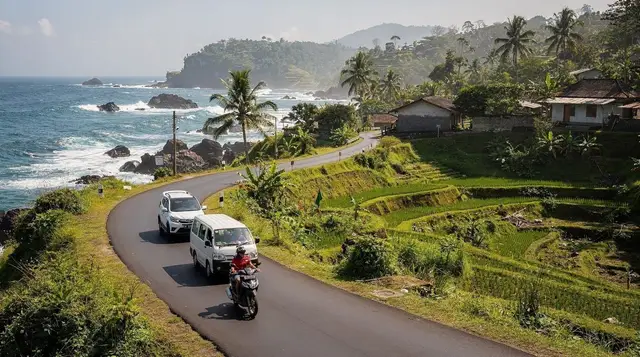
Banyuwangi is the town most travellers pass through rather than stay for, and there is an honest logic to that: it sits at Java’s easternmost tip, directly across the narrow strait from Bali, and functions as both the ferry port for the Gilimanuk crossing and the closest reasonably sized base to the Ijen Crater trailhead. For a huge share of visitors, Banyuwangi is a name on an overland itinerary rather than a destination chosen for its own sake.
That framing undersells the wider regency, even if the town centre itself is unremarkable. Banyuwangi’s administrative area stretches from the Ijen volcanic complex in the north down through savanna landscapes and a genuinely remote stretch of southern coastline, including one of the more celebrated surf breaks in Indonesia. Travellers who budget only a single night here, purely to sleep before or after the Ijen trek, miss a side of East Java that gets far less tourist traffic than Bali or even Bromo.
The honest starting point is to treat Banyuwangi as infrastructure first and destination second — book it because you need a base for Ijen or the ferry crossing, and then decide, once you understand what else the region offers, whether an extra day or two for Baluran, Alas Purwo, or the coast is worth adding to your route.
Banyuwangi at a glance
| Where | Easternmost regency of Java, directly across the Bali Strait from Gilimanuk |
| Cost | Modest; the town itself is inexpensive, with the larger cost being organised tours into the surrounding national parks |
| Time needed | One night minimum as an Ijen base; two to three days to add Baluran or Alas Purwo |
| Access | Ferry from Gilimanuk, Bali; overland from Surabaya or Malang; a small airport with limited domestic connections |
| Best time | Dry season for reliable trekking and park roads; avoid the worst of the wet season if Ijen or Baluran are priorities |
Why most travellers pass through rather than stay
The town centre of Banyuwangi itself is a working provincial hub rather than a curated tourist destination — administrative buildings, markets, and a modest waterfront, without the resort infrastructure of South Bali. Most visitors arrive specifically to sleep before an Ijen predawn departure or to catch the ferry, and that is a perfectly reasonable way to use it. The mistake is assuming there is nothing more to the area, when the more interesting landscapes sit a drive away from the town centre itself rather than within it.
Ijen from the Banyuwangi side
Banyuwangi sits considerably closer to the Ijen trailhead at Paltuding than bases on the Malang or Surabaya side of East Java, which makes it the more efficient launch point if Ijen is your priority rather than a wider Bromo-inclusive loop. A dedicated Ijen Blue Fire Tour departing from Banyuwangi keeps the overnight logistics tight, with a shorter transfer to the trailhead than tours originating further west. See the Ijen Crater page for the full detail on the trek itself, including timing, gear, and what to expect from the sulfur miners you will pass on the trail.
Baluran National Park, the “Africa of Java”
North of Banyuwangi town, Baluran National Park earns its nickname for a savanna landscape that looks strikingly unlike the rest of tropical Java — open grassland, scattered acacia-like trees, and a dormant volcano rising over it all, with wild deer, buffalo, and a range of birdlife visible from the park’s tracks. It is a genuinely different register of scenery from the volcanic and rice-terrace landscapes that dominate most of this trip, and a two-day Banyuwangi adventure including Baluran National Park is a reasonable way to combine it with an Ijen trek or the coastal drive without needing to arrange each leg separately.
Alas Purwo and the G-Land surf break
Alas Purwo National Park, on the peninsula forming Banyuwangi’s southeastern tip, holds dense monsoon forest, a sacred cave used for meditation retreats, and access to Plengkung Beach — better known internationally as G-Land, one of the more celebrated left-hand surf breaks anywhere in Indonesia. It draws a small, dedicated crowd of experienced surfers rather than the volume of visitors that Bali’s breaks see, precisely because it is genuinely remote and requires real planning to reach. The Alas Purwo National Park and G-Land Beach tour is the standard way to see the park’s forest and cave sites even if you are not there specifically to surf.
The far south: Sukamade turtle beach
Further south still, Sukamade beach is known for sea turtle nesting, with guided night visits organised through the park authority during nesting season. It is one of the more logistically demanding add-ons in the region — the access road is rough and the drive long — and it is not something to bolt onto an Ijen itinerary lightly. Travellers with a genuine interest in wildlife and a few extra days to spare, rather than a checklist mentality, get the most out of this stretch of the regency. Sukamade sits far enough from the main road network that a dedicated overnight, rather than a rushed day trip layered onto an Ijen itinerary, is the only way to see it without an exhausting amount of driving in a single day.
Combining Banyuwangi with a Bali crossing to Menjangan
Because Banyuwangi sits directly across the strait from Bali’s own West Bali National Park, some operators run combined tours that cross to Menjangan Island for snorkelling as part of a Banyuwangi-based day, an unusual but logical pairing given the short ferry hop involved. The Banyuwangi day tour with Menjangan Island snorkelling is worth considering if you want a beach and reef day to offset an otherwise volcano- and forest-heavy East Java stretch. See Menjangan Island for more on the diving and snorkelling itself.
Osing culture and local festivals
Banyuwangi is home to the Osing people, an ethnic group distinct from both the Javanese majority further west and the Balinese across the strait, with their own language, customs, and performing arts. The Gandrung dance, a traditional welcome performance with roots in the regency’s agricultural rituals, is the most visible expression of this culture for visitors who happen to catch a local festival or cultural event during their stay.
It is not something built into standard Ijen-focused itineraries, so travellers with a genuine interest in local culture beyond the volcanic and wildlife sights should ask specifically at their accommodation about any performances or village events coinciding with their visit, since none of it runs on a predictable tourist schedule the way Bali’s cultural shows do.
Choosing between Banyuwangi and Malang as your East Java base
Travellers planning an East Java loop often have to decide whether to base primarily around Banyuwangi or Malang, and the honest answer depends on direction of travel and priorities. Banyuwangi wins on Ijen access and proximity to Bali via the ferry, plus the wilder national park landscapes described above. Malang wins on general comfort, food variety, and its own proximity to both Bromo and Tumpak Sewu, with a noticeably better range of accommodation for a multi-night stay. Many travellers end up using both — Banyuwangi as the entry point from Bali and Ijen base, Malang as the exit point toward Bromo and Tumpak Sewu, or vice versa depending on which direction the loop runs.
Travellers assembling a longer multi-day route sometimes prefer a single coordinated booking over stitching together Ijen, Baluran, and onward transport separately, and the two-day sustainable eco-village tour around Banyuwangi is one option that pairs the volcanic and natural sights with a look at rural Osing village life, giving a more rounded picture of the regency than an Ijen-only overnight allows.
What isn’t worth the detour
Do not treat Banyuwangi town’s limited in-town sights as worth dedicated sightseeing time; the value here is almost entirely in the surrounding national parks and the Ijen access, not the town centre. G-Land is also not worth chasing unless you are a genuinely experienced surfer or specifically interested in Alas Purwo’s forest and cave sites — the access difficulty is real and disproportionate for casual curiosity. Sukamade, similarly, is not a worthwhile detour outside turtle nesting season or without a proper multi-day allowance.
Budget
Banyuwangi itself is inexpensive relative to Bali’s tourist centres, with modest accommodation and food costs. The larger expenses come from organised tours into Baluran, Alas Purwo, or Sukamade, and from Ijen trek logistics, all of which typically bundle transport, park fees, and a guide into a single price. Multi-day combined tours that link Ijen with Baluran or a wider East Java loop cost more upfront but save considerably on arranging each leg of transport independently in an area with limited public transport infrastructure.
When to go
Dry season, April through October, is the sensible window for the Ijen trek, Baluran’s park roads, and the drive into Alas Purwo, all of which become more difficult in heavy rain. Turtle nesting at Sukamade follows its own seasonal pattern rather than the general dry-wet split, so check current timing with a park-affiliated operator if that is specifically your reason for visiting. The Gilimanuk-Ketapang ferry runs year-round regardless of season, though queues lengthen considerably around major Indonesian holidays.
Getting there and getting around
The ferry crossing from Gilimanuk in Bali to Ketapang near Banyuwangi is short but can involve a lengthy wait during holiday periods, and it is the standard way travellers coming from Bali reach East Java overland. From Banyuwangi town, reaching Ijen, Baluran, or Alas Purwo all require a private vehicle or organised tour; there is no practical public transport network connecting these sites for tourists. Public buses and trains connect Banyuwangi to Surabaya and beyond, but for the national parks and Ijen specifically, a driver or tour operator is the realistic option. See Gilimanuk for more on the Bali-side port itself.
How Banyuwangi fits into a longer trip
Banyuwangi works as the eastern anchor of an East Java loop rather than a standalone stop, pairing naturally with Ijen Crater, Mount Bromo, and Tumpak Sewu if you continue west, or with Malang as a base for the return leg.
The Bali and Java volcanoes, five days itinerary is built around exactly this kind of loop starting from a Bali ferry crossing. Read the Bali to East Java overland guide for the practical logistics of the crossing itself, and the Ijen Crater blue fire guide if the trek is your main reason for coming this far east.
What currency and cash situation should I expect in Banyuwangi?
The same as elsewhere in Indonesia away from Bali’s tourist hubs — Indonesian rupiah, with cards accepted at larger hotels but cash needed for warungs, local transport, and most park entrance fees. Withdraw what you expect to need before heading into the national parks, where ATMs are scarce.
Frequently asked questions about Banyuwangi
Is Banyuwangi safe and comfortable for an independent traveller?
Yes, it is a functioning provincial town with adequate infrastructure for a night or two, though it lacks the tourist-oriented polish of Bali’s resort areas. Most travellers find it perfectly workable as a base.
How long does the ferry crossing from Bali actually take?
The crossing itself is short, but total time including boarding and disembarking, plus potential queueing during busy periods, can add up to considerably more than the sailing time alone.
Is Baluran National Park worth visiting if I am not a dedicated wildlife watcher?
The savanna landscape itself is visually distinctive enough to be worth a look even for casual visitors, not just committed birdwatchers or wildlife photographers, given how different it looks from the rest of Java’s typically dense, volcanic terrain.
Can I surf at G-Land without prior experience?
No — G-Land is a serious, powerful reef break suited to experienced surfers, and its remoteness means help is not close at hand if something goes wrong. Beginners are much better served by Bali’s more accessible breaks.
Do I need a guide for Alas Purwo National Park?
A guide or organised tour is the practical way to see the park’s forest trails and the meditation cave, given limited signage and the size of the protected area.
Is one night in Banyuwangi enough before an Ijen trek?
It is enough purely for the trek logistics, since the departure happens in the middle of the night regardless of how long you have rested. If you want to add Baluran or the southern coast, budget an extra day or two beyond that single Ijen-focused night.
How do I get from Banyuwangi to Mount Bromo?
There is no direct short route; reaching Bromo from Banyuwangi means an overland journey toward Probolinggo or Malang, typically arranged as part of a combined multi-day East Java tour rather than a simple day trip.
Is there anything to do in Banyuwangi town itself in the evening?
Not much beyond local warungs and a modest waterfront; the town is not built around evening entertainment for tourists. Most visitors treat the evening as an early night ahead of a predawn Ijen departure rather than expecting nightlife.