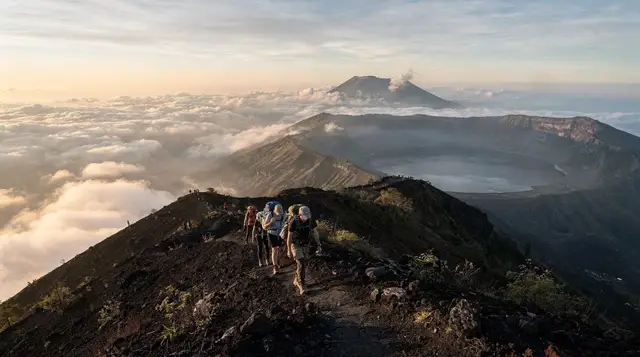
Ijen is a working volcano with an active sulfur mining operation inside its crater, and that combination is what makes the visit unlike almost anywhere else you will trek on this trip. The blue fire that draws most people up here in the middle of the night is the visible combustion of sulfuric gases escaping vents near the crater floor, only visible in darkness, which is why every trip up the mountain starts absurdly early rather than at a civilised hour.
The other half of Ijen’s identity is the mining itself. Men still carry raw sulfur out of the crater in baskets slung over their shoulders, a physically brutal job that predates the tourist trail by decades and continues alongside it. Meeting miners on the path, sometimes selling small sulfur souvenirs shaped into ornaments, is as much a part of the Ijen experience as the crater lake or the blue flames, and it is worth approaching that encounter with some awareness of what the job actually costs the people doing it.
Beyond the mining and the fire, Ijen’s crater lake is itself a genuine natural feature worth the climb: a wide, pale turquoise body of highly acidic water held in the caldera, visible properly once daylight arrives. Most visitors end up seeing both the fire in darkness and the lake at dawn on the same trip, which is part of why the timing of the ascent matters so much.
Ijen Crater at a glance
| Where | Ijen volcanic complex, on the border of Banyuwangi and Bondowoso regencies, East Java |
| Cost | Entrance permit plus transport; organised overnight tours from Banyuwangi or Bali bundle both |
| Time needed | A full night: departure around midnight, summit and crater descent before sunrise, return by mid-morning |
| Access | Overland or by ferry crossing from Bali to Banyuwangi, then a night drive and hike; most travellers join an organised tour rather than arranging logistics solo |
| Best time | Dry season for stable trail conditions; a moonless, clear night gives the darkest and most visible blue fire |
Why the trek starts at midnight
The blue fire is only visible in genuine darkness, and it fades from view as soon as ambient light increases, so tours are timed to have you at the vents while it is still pitch black. That means a wake-up call somewhere around midnight, a drive to the Paltuding trailhead, and then a steep uphill hike in the dark before the crater descent even begins. It is disorienting the first time, and the temptation to skip the alarm is real — but the whole point of the exercise collapses if you arrive after the sky starts to lighten.
The blue fire itself
What you are actually seeing is combusting sulfuric gas escaping from vents under pressure, which ignites on contact with the air and burns with a blue tint rather than the orange of normal fire. It is not, contrary to some marketing photos, a wall of blue flame visible from a distance — it is a set of localised, flickering blue flares close to the vents, more striking in person than in most photographs taken with a phone camera, since it needs a longer exposure and a steady hand to capture properly. Standing near it in the dark, with the smell of sulfur thick in the air and miners working nearby with headlamps, is the part of the experience people tend to describe as unforgettable regardless of how the photos turn out.
Meeting the sulfur miners
The miners you pass on the trail are doing genuinely hard, low-paid physical labour, carrying loads of raw sulfur out of the crater on foot, sometimes offering to carry your bag or sell small carved sulfur trinkets for extra income. It is common practice to tip a miner who helps you or to buy a small souvenir directly from them, and doing so channels a little money straight to people doing one of the toughest jobs on the mountain rather than only to the tour operator. Treat photography of the miners with the same courtesy you would want yourself — ask, or at minimum acknowledge them, rather than treating the encounter as a photo opportunity alone.
The crater lake at sunrise
Once dawn breaks, the pale turquoise crater lake becomes visible properly for the first time, and for many visitors this daylight view rivals the blue fire as the memorable part of the trip. The lake’s colour comes from its extreme acidity, and it sits within a caldera rim that gives a genuine sense of scale once you can actually see the terrain around you rather than just headlamp beams. Photographers who arrive prepared to stay through sunrise, rather than turning back immediately after the blue fire fades, tend to come away with the stronger set of images.
Choosing between a Banyuwangi base and a trip from Bali
Ijen sits close enough to Banyuwangi that a trek from there involves a shorter drive than one starting from Bali, which crosses by ferry before the overland leg even begins. Both are viable, and which suits you depends on how your wider East Java or Bali trip is shaped. A dedicated Ijen Crater and blue fire trekking tour from Banyuwangi keeps the logistics tight if you are already based on that side.
If you are coming straight from Bali without a Banyuwangi stay planned, an overnight Ijen Crater volcano trip departing from Bali handles the ferry crossing and overland transfer as part of the package, which removes a lot of the logistical headache of doing it independently.
Combining Ijen with Mount Bromo
Ijen and Mount Bromo are the two headline volcano treks of East Java, and a meaningful share of visitors do both on the same overland loop given how close they sit to each other relative to the rest of Indonesia. A combined two-day Ijen Crater and Bromo Mountain tour is the standard way to link them without doubling back through the same towns twice, though it makes for a genuinely tiring couple of days given both start in the small hours. If your schedule allows only one, Ijen offers the blue fire and crater lake, while Bromo offers the more classic volcanic sunrise-over-a-sea-of-sand view described on the Mount Bromo page.
Pairing Ijen with the Banyuwangi coast
Travellers with an extra day sometimes extend beyond the volcano circuit into Banyuwangi’s coastal and national park attractions, an option covered well by the Ijen Crater, Menjangan Island and Baluran National Park tour, which trades a second volcano day for wildlife and beach scenery instead. It is a reasonable way to break up back-to-back predawn wake-ups if the whole trip is starting to feel like a series of alarms rather than a holiday.
Independent trekking versus a guided tour
It is technically possible to arrange the permit, transport, and hike independently, but almost nobody who has done it both ways recommends it over a guided option. The value of a guide here is less about navigation on the main trail, which is well-worn, and more about real-time knowledge of gas conditions, pacing for a group with mixed fitness levels, and the transport logistics of a midnight departure and dawn return. Given how little the guided option typically costs relative to the value of not troubleshooting a 2am transport failure alone in rural East Java, most travellers find the guided route worth it even if they are comfortable independent travellers everywhere else on this trip.
What isn’t worth the detour
Skip any operator promising a “no crater descent required” easy version if seeing the blue fire up close is the actual goal — from the rim alone you will see very little of the phenomenon that makes the trip worthwhile. It is also not worth attempting solo without local knowledge of the current trail and gas conditions; sulfuric gas levels at the vents can shift with wind direction, and guides on site track this in real time in a way an independent visitor cannot. Finally, if you are not prepared for genuine physical exertion in the cold and dark, this is not the easiest volcano trek on the trip to substitute for a gentler alternative.
Group size on a given night varies with season, and July to August tends to bring the largest crowds at the viewing area, which can mean queuing for a clear vantage point near the vents even in the dark. Travelling in the shoulder months either side of peak season generally means a calmer crater floor and more room to actually take in the phenomenon rather than jostling for position.
Budget
Costs run to an entrance permit at the trailhead plus transport, and most travellers book an organised overnight tour that bundles both along with a driver, guide, and sometimes a gas mask rental. Tours from Banyuwangi tend to run less than those originating in Bali, purely because the transfer distance is shorter. A modest tip for a miner who assists you on the trail, or a small purchase of a sulfur souvenir directly from one, is a reasonable and appreciated extra cost worth budgeting for.
When to go
Dry season, roughly April to October, gives the most reliable footing on both the ascent and the crater descent, and reduces the chance of a tour being cancelled for weather. Within that window, a moonless or lightly clouded night gives the darkest sky and the most visible blue fire, since strong moonlight can wash out the same effect that daylight does, just less severely. Whatever the season, arriving at the vents well before any hint of dawn is non-negotiable if the blue fire itself is your priority.
Getting there and getting around
From Bali, reaching Ijen means crossing the strait by ferry from Gilimanuk to Ketapang near Banyuwangi, followed by an overland transfer to the Paltuding trailhead — a combination that makes an organised tour considerably easier than arranging each leg independently in the middle of the night. From Banyuwangi itself, the drive to Paltuding is shorter and more direct. Once at the trailhead, the ascent and crater descent are entirely on foot; there is no vehicle or cable option to shortcut either leg. See the Bali to East Java overland guide for the wider logistics of the crossing if you are planning to combine Ijen with other East Java stops rather than a single overnight there-and-back.
How Ijen fits into a longer trip
Ijen makes the most sense as part of a dedicated East Java loop rather than a single overnight bolted onto a Bali-only stay, since the ferry crossing and overland transfers add up regardless of how many stops you make once you are on that side. The Bali and Java volcanoes, five days itinerary is built around exactly this kind of loop, pairing Ijen with Mount Bromo, Tumpak Sewu, and a base in Banyuwangi or Malang depending on your route direction.
Before committing to the trek, read the Ijen Crater blue fire guide for a closer look at the phenomenon itself, and the what to pack for a volcano trek guide so the cold and the gas exposure do not catch you unprepared. The blog piece on why your Bali sunrise trek starts at 2am is a useful primer on the general logic of predawn volcano tourism in this part of Indonesia even though it is framed around Bali’s own volcanoes.
Frequently asked questions about Ijen Crater
Is the Ijen blue fire visible year-round?
The phenomenon itself, driven by the volcano’s gas emissions, is present year-round, but visibility depends on darkness and weather. Cloud cover, rain, or a very bright moon can all reduce how dramatic it looks on a given night.
Do I need a gas mask for the crater descent?
Strongly recommended rather than strictly mandatory. Sulfuric fumes near the vents are genuinely irritating to eyes and airways, and most trailhead vendors or tour operators rent basic masks cheaply.
How physically demanding is the Ijen trek?
Demanding enough that a baseline level of fitness matters — it is a steep uphill hike followed by a steep, loose-footing descent into the crater, done mostly in darkness and cold. It is achievable for most reasonably fit travellers but is not a casual stroll.
Can I do Ijen as a day trip from Bali without staying overnight in East Java?
Some tours run it as a very long single push from Bali and back, but it means minimal sleep and a lot of driving on top of the trek itself. Basing in Banyuwangi for at least one night makes for a considerably less punishing experience.
Is it safe to buy souvenirs from the sulfur miners?
Yes, and it is a reasonable way to put a little money directly toward people doing hard physical labour on the mountain. Small sulfur carvings are the typical item on offer.
What should I wear for the trek?
Layers are essential — a warm jacket for the cold ascent in the dark, which you will likely shed as the sun rises and the temperature climbs. Proper closed shoes with grip matter more here than on most of Bali’s easier walks.
Can Ijen be combined with Mount Bromo in one trip?
Yes, and many travellers do exactly that given how close the two sit within East Java’s volcanic belt, though back-to-back predawn treks make for a genuinely tiring couple of days.
Is Ijen suitable for children?
The combination of a steep night hike, sulfur fumes, and a very early start makes Ijen a demanding outing for younger children. Most operators recommend it for older kids and adults who can manage a genuinely tough trek rather than a family-friendly volcano visit.