Malang is East Java’s second-largest city and, for most travellers assembling a Bromo-and-beyond itinerary, the most practical base in the whole region. It sits at a genuinely cooler elevation than the coastal towns, has a far wider range of accommodation, food, and general infrastructure than Banyuwangi or the small villages closer to the volcanoes themselves, and it puts both Mount Bromo and Tumpak Sewu within a manageable overland drive. None of this makes Malang glamorous in the way Ubud or Seminyak are, but it makes it functional in a way that genuinely improves a tiring multi-day volcano circuit.
Beyond its role as a staging post, Malang has its own identity worth a look if you have any spare time between tours: a legacy of Dutch colonial-era architecture scattered through the older parts of the city, a lively night market and street food scene, and a noticeably younger, more studenty energy than most of the towns on this trip, thanks to a large university population. It will never be the headline stop on a Bali-and-beyond itinerary, but travellers who budget an extra day here rather than treating it purely as a bed between tours tend to come away with a more rounded impression of East Java than the volcano photographs alone give.
The city’s elevation also brings a genuinely different climate from the coast, cooler and often noticeably fresher, especially in the evenings — a change that many travellers, several weeks into a hot, humid Indonesia trip, find more welcome than they expected going in.
Malang at a glance
| Where | East Java, inland at a cooler elevation, roughly equidistant from Mount Bromo and Tumpak Sewu |
| Cost | Moderate to low; a wide range of accommodation from budget to mid-range, generally cheaper than comparable options in Bali |
| Time needed | One to two nights as a pure logistics base; three or more if adding the city itself and nearby Batu |
| Access | Domestic flights, trains, and buses from Surabaya and Jakarta; overland from Bali via the Gilimanuk-Ketapang ferry and a longer transfer |
| Best time | Dry season for reliable road and trail conditions on volcano and waterfall day trips |
Why Malang beats Banyuwangi for most East Java itineraries
The comparison comes up constantly for travellers planning a Bali-plus-East-Java loop, and the honest answer favours Malang for most itineraries. It sits considerably closer to both Bromo and Tumpak Sewu than Banyuwangi does, cutting down the driving time on what are already early, tiring days. It also has a meaningfully better range of hotels, guesthouses, restaurants, and general city comforts, which matters after a predawn volcano trek when a proper hot shower and a decent meal go a long way. Banyuwangi only pulls ahead if Ijen specifically, or the ferry crossing from Bali, is your main priority — see the Banyuwangi page for that side of the comparison.
Using Malang as a Bromo base
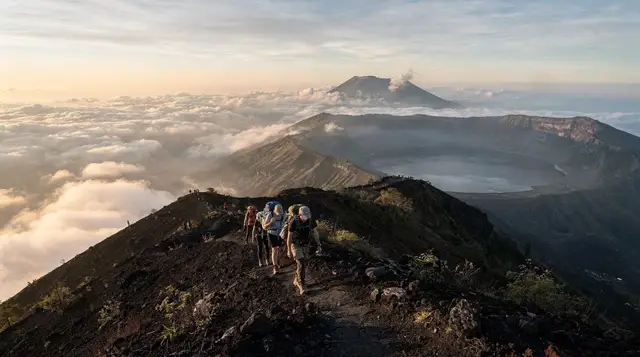
A straightforward one-day Mount Bromo sunrise tour departing from Malang is the most common way travellers use the city, with a predawn pickup, the jeep convoy across the sand sea, and a return by mid-morning, leaving the rest of the day free.
For a fuller version that adds a waterfall stop, the two-day Bromo sunrise and Madakaripura waterfall tour from Surabaya or Malang extends the standard itinerary without requiring a full relocation to a different base. See the Mount Bromo page for the detail on what the sunrise viewpoint and crater walk actually involve.
Using Malang as a Tumpak Sewu base
Malang is also the standard launch point for Tumpak Sewu, given the waterfall’s location within reasonable driving distance and the local guiding expertise concentrated in the city’s tour operators. The private day trip to Tumpak Sewu waterfall from Malang is the simplest version, while travellers wanting to linger can consider the Tumpak Sewu page’s camping option for a slower, overnight version of the same trip.
Combining Bromo, Tumpak Sewu and Ijen from Malang
For travellers with several days to give East Java properly, a combined loop covering all three headline sights is the standard way to make the most of a Malang base without doubling back through the city repeatedly. The three-day tour covering Tumpak Sewu, Bromo and Ijen from Malang strings the full circuit together into a single coordinated booking, which is considerably easier than arranging three separate day trips with different operators. It is a genuinely demanding few days given the predawn starts involved at both Bromo and Ijen, so pace expectations accordingly.
The city itself: colonial architecture and the night market
Malang’s older districts retain a scatter of Dutch colonial-era buildings, tree-lined streets, and a general architectural character distinct from Bali’s temple-and-thatch aesthetic, reflecting the city’s history as a Dutch administrative and hill-station town. In the evenings, the city’s street food and night market scene is genuinely worth exploring, with a range of East Javanese specialities that differ meaningfully from the Balinese food most travellers will have eaten for the preceding stretch of their trip. It is not a curated tourist attraction in the way Ubud’s markets are increasingly styled to be — it is simply a working city’s evening food scene, which some travellers find more rewarding for exactly that reason.
Batu and the cooler highlands nearby
A short distance from Malang, the town of Batu sits at an even higher, cooler elevation and has developed into something of a domestic tourism hub, with theme parks, apple orchards, and viewpoints over the surrounding volcanic terrain. It is more oriented toward Indonesian family tourism than international visitors, which makes it an interesting, low-key contrast if you have a spare day and want to see a side of East Java tourism that has little to do with the international backpacker trail running through Bromo and Ijen.
Food worth seeking out in Malang
East Javanese cuisine has its own distinct character from the Balinese food most travellers will have eaten for the preceding stretch of their trip, with dishes built around different spice profiles, noodle traditions, and regional specialities rarely found on menus further west.
Malang’s night markets and long-running local eateries are the place to try this rather than the international-menu restaurants clustered near hotels, and asking a homestay host or guide for a specific recommendation tends to produce a better meal than picking the first busy-looking stall. Coffee culture is also strong here, tied into the wider East Java highlands coffee-growing region, and a slower morning with a local coffee before an afternoon city walk is a reasonable way to use a non-tour day in Malang.
A practical note on pacing a multi-stop East Java loop
Because Bromo, Tumpak Sewu, and Ijen are frequently combined into a single trip, and because two of the three involve predawn starts, it is worth deliberately building at least one lower-key day into a Malang-based itinerary rather than stacking every day back to back. Travellers who try to fit all three major sights plus a city day into a tight three-night stay often report the trip feeling more like an endurance exercise than a holiday by the final morning. Spacing a Tumpak Sewu day, which starts at a comparatively civilised hour, between the two predawn volcano treks is one straightforward way to break up the pattern without adding extra nights to the overall itinerary.
What isn’t worth the detour
Treating Malang as nothing more than a place to sleep between tours is the most common way travellers undersell it — the night market and food scene deserve at least one evening’s attention if your schedule allows it. On the other hand, Batu’s theme parks are not worth a dedicated day for most international travellers whose time in East Java is limited to a volcano-and-waterfall circuit; they are better suited to a longer, more leisurely stay or families specifically seeking that kind of attraction. Batu is a reasonable half-day add-on rather than a full day for most international visitors, given the theme parks are the main draw and most travellers on this trip are prioritising the volcanic and waterfall sights instead.
Budget
Malang runs noticeably cheaper than Bali’s tourist centres for equivalent accommodation and food quality, which makes it a sensible base for travellers watching costs on a longer Indonesia trip. Day tours to Bromo, Tumpak Sewu, or combined multi-day circuits are the main added expense, and booking a combined multi-site tour generally works out more cost-effective than arranging each leg separately given the shared transport and guiding costs.
When to go
Dry season, April to October, is the reliable window for the surrounding volcano and waterfall access that most travellers come to Malang for in the first place. The city itself is pleasant more or less year-round given its elevation moderates both the heat of the dry season and the intensity of wet-season humidity compared with the coast, but the day trips built around it are still weather-dependent in the ways described on the Bromo, Tumpak Sewu, and Ijen pages.
Getting there and getting around
Malang has its own domestic airport with connections to Jakarta and other major Indonesian cities, plus rail and bus links to Surabaya, which is the more significant transport hub for the wider region. From Bali, reaching Malang means the Gilimanuk-Ketapang ferry crossing followed by a substantial overland journey, which is why most Bali-based travellers build Malang into a multi-day East Java loop rather than treating it as a standalone weekend trip.
Within the city, taxis and ride-hailing apps cover most needs, while day trips to Bromo, Tumpak Sewu, and Ijen are almost universally arranged through organised tours given the driving distances and specialist local knowledge involved. See the Bali to East Java overland guide for the wider logistics.
How Malang fits into a longer trip
Malang works as the central hub of an East Java loop, connecting Mount Bromo and Tumpak Sewu on one side with Ijen Crater and Banyuwangi on the other, depending on which direction your route runs. The Bali and Java volcanoes, five days itinerary is built around exactly this kind of loop. Read the Mount Bromo sunrise guide and the Tumpak Sewu waterfall guide before booking either day trip from Malang.
Is Malang walkable, or do I need transport for everything?
The older colonial district and night market areas are reasonably walkable in the cooler evening hours, but the city as a whole is spread out enough that ride-hailing apps are the practical way to cover longer distances, including transfers to and from tour pickup points. Ride-hailing apps operate reliably throughout the city, making it straightforward to reach the night market, the older colonial quarter, or a tour pickup point without needing to arrange a private driver for every short trip.
Frequently asked questions about Malang
How many nights should I spend in Malang?
Two nights is a sensible minimum if you are doing both a Bromo tour and a Tumpak Sewu tour, since both involve early starts and a full day out. Add a third if you want an evening free to explore the city’s food scene without a tour the next morning.
Is Malang colder than the rest of East Java?
Yes, noticeably, thanks to its elevation. It is a welcome change for travellers who have spent weeks in Bali’s coastal heat, though it is not genuinely cold by most standards — more a pleasant, mild evening temperature than anything requiring heavy layers within the city itself.
Can I fly directly into Malang from Bali?
Domestic flight connections exist but are limited and often route through Surabaya or Jakarta rather than flying direct, so most travellers find the overland route via the Gilimanuk-Ketapang ferry more practical if arriving from Bali.
Is Malang worth visiting for its own sake, not just as a base?
To a modest degree, yes — the colonial architecture and night market give it a distinct character worth an evening, though it is not a destination most travellers would fly to Indonesia specifically to see on its own merits.
How far is Malang from Mount Bromo?
Close enough that a return day trip with a predawn departure is entirely standard, though exact driving time depends on which side of the caldera your tour approaches from.
Should I book Bromo and Tumpak Sewu as separate day trips or one combined tour?
A combined multi-day tour generally works out more efficient and often more cost-effective than two separately booked day trips, particularly if you also want to add Ijen, since it consolidates transport and guiding under a single operator.