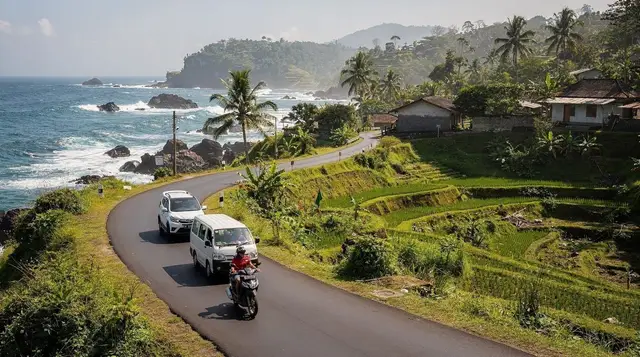
Sanur sits on Bali’s east-facing south coast, protected by an offshore reef that keeps the water calm almost year-round in a way that Kuta, Legian and Canggu’s exposed west-facing beaches simply can’t match. That single geographic fact shapes everything about how Sanur functions: it’s the beach town families actually choose for young children, the base long-stay expats and older travellers gravitate toward, and the departure point most visitors use for a boat out to Nusa Penida or Nusa Lembongan.
It’s also, by South Bali standards, quiet. There’s no beach club scene here, no surf break drawing a young crowd, and the promenade running along the seafront feels more like a genuine small town than a tourist strip built from scratch. That will not suit everyone — if nightlife or surf are the point of your trip, Sanur will feel slow — but for exactly the travellers it does suit, it’s one of the more consistently well-liked bases on the island.
This guide covers what Sanur actually offers beyond being a boat harbour: the beach itself, the boat logistics to the Nusa Islands, what a family day here looks like, and how it compares to South Bali’s louder beach towns.
Sanur at a glance
| Where | South Bali, east coast, facing the Nusa Islands |
| Cost level | Mid-range; calmer pace but not necessarily cheaper than Kuta |
| Time needed | 2-4 days, or a single night if using it purely as a boat transit base |
| Access | A taxi, Grab or Gojek ride from Ngurah Rai Airport (DPS) |
| Best time | Year-round for the beach itself; dry season for the smoothest boat crossings |
A beach that’s actually calm
The reef running offshore breaks up incoming swell before it reaches the sand, which means Sanur’s water stays notably flatter and calmer than the surf beaches further west. That makes it one of the better spots on the south coast for swimming with young children, for anyone uneasy in rougher water, or simply for a relaxed float rather than dodging waves.
The trade-off is that Sanur isn’t a surf destination in any meaningful sense — the same calm water that makes it family-friendly means there’s little to no swell for surfing. Surfers based in Sanur for other reasons typically make the short trip to Kuta, Canggu or Uluwatu when they want to actually get in the water on a board. What it does offer instead is easy access to gentler water activities.
A glass-bottom boat trip out from Sanur is a low-effort way to see some reef life without snorkelling gear, and works well with kids or non-swimmers. For those wanting something a little more active, a short wakeboarding session off Sanur takes advantage of the calm, protected water in a different way. For a broader picture of good family beaches across the island, see the family-friendly beaches guide.
The main departure point for the Nusa Islands
Sanur’s harbour is the busiest fast-boat departure point on Bali’s south coast for Nusa Penida and Nusa Lembongan, and for a lot of visitors, that’s the entire reason they end up here, even briefly. Boats run frequently through the morning and into the early afternoon, and the crossing is short enough to make a day trip genuinely workable, though an overnight stay on the islands is the better option if you want to see more than the most obvious spots.
A fast boat transfer between Sanur and Nusa Penida is the standard way across, and booking ahead rather than turning up at the harbour is worth doing in peak season when the busiest departures fill up. If Nusa Lembongan is the target instead, the routes and operators differ slightly — the fast boats to Nusa and Gili guide covers the full range of options and how to choose between them.
Diving and snorkelling from a calmer base
Sanur’s protected water and boat access make it a workable base for diving trips rather than just a swimming beach. A open water diver course run between Sanur and Nusa Penida is a common way to get certified while based somewhere calmer than a dedicated dive town. For snorkelling closer to shore without a boat trip to the islands, a guided one-hour snorkelling session in Sanur is a low-commitment option. For a wider view of diving across the island, including the sites Sanur serves as a base for, see the best diving in Bali guide.
The promenade: Sanur’s actual daily rhythm
Sanur’s beachfront promenade is one of the more pleasant stretches of paved walking path on the south coast, running for a genuine distance along the sand past hotels, small restaurants and the occasional temple. It’s used as much by local families and joggers as by tourists, which gives it a noticeably different feel from the tourist-oriented strips further south.
Small temples sit directly along the route in places, a reminder that this is a functioning neighbourhood rather than a purpose-built resort strip. A slow walk here in the early morning or toward sunset is, for a lot of visitors, the actual highlight of a Sanur stay rather than any single booked activity. Sunrise, in particular, tends to be a quieter and arguably more rewarding time to walk it than sunset, since Sanur faces east across the strait toward the Nusa Islands and Mount Agung’s silhouette beyond.
Sanur versus the louder South Bali beaches
| Kuta / Legian / Seminyak / Canggu | Sanur | |
|---|---|---|
| Water | Exposed, surf-friendly | Reef-protected, calm |
| Pace | Busy, tourist-strip energy | Slower, small-town feel |
| Best for | Surfing, nightlife, dining scenes | Families, boats to Nusa Islands, quiet stays |
| Nightlife | Ranges from loud to polished | Minimal |
Neither side of this comparison is better in the abstract; Sanur simply serves a different kind of trip, and travellers who’ve tried both usually have a clear preference once they know what each offers.
Local craft and coconut oil making
Away from the beach and the boat harbour, Sanur retains a slower, more residential character than most of South Bali, and a handful of small-scale craft activities reflect that. A coconut oil making class in Sanur is a hands-on look at a traditional process rather than a packaged tourist experience, and works well as a lower-key alternative to a beach club day if you want something more grounded in local daily life.
Activities like this tend to run in smaller groups than the bigger tourist draws further south, partly because Sanur simply doesn’t get the same volume of short-stay visitors that Kuta or Seminyak do. That smaller scale is generally a point in their favour rather than a limitation.
A base for older travellers and long-stayers
Sanur has a long-established reputation, going back decades, as the part of South Bali that older travellers and long-term expats gravitate toward, and the infrastructure reflects it: a higher proportion of longer-stay apartments and villas, a calmer daily rhythm, and fewer venues built around a young, short-break crowd. It isn’t marketed as a retirement destination in any formal sense, but the pattern is consistent enough that it’s worth mentioning for anyone planning a longer, slower stay in Bali rather than a short holiday.
That same quality makes it a sensible choice for anyone recovering from jet lag on arrival, or winding down before a long flight home, without the noise and density of Kuta or the traffic of Canggu working against you.
What isn’t worth the detour
Sanur’s small night market stalls along the promenade are pleasant for a browse but rarely offer anything you cannot find elsewhere on the island for a similar price, so it’s worth treating as an evening stroll rather than a dedicated shopping trip. The handful of tourist-oriented “cultural” dinner shows that some hotels package for guests also tend toward a generic, watered-down version of Balinese performance rather than anything you couldn’t see done better and more authentically elsewhere.
If you’re coming to Sanur purely hoping for a lively nightlife scene, it genuinely will not deliver — that’s not an oversight in the town’s development, it’s simply not what Sanur is built around, and travellers expecting otherwise are usually disappointed by their own mismatched expectations rather than any real fault in the place.
Budget in Sanur: roughly what to expect
Sanur sits in a similar mid-range bracket to Legian for accommodation and dining, without Seminyak’s premium for beach clubs and design-led restaurants, since that scene doesn’t really exist here. Boat tickets to the Nusa Islands are priced separately from accommodation and vary by operator and route, so it’s worth comparing a couple of options rather than booking the first one you see at the harbour. Longer-stay apartments and villas, common in Sanur given its expat population, can also work out considerably better value than nightly hotel rates for stays beyond a week or two. See the Bali budget guide for the wider island picture.
Weather and crowds through the year
Sanur’s reef-protected water stays swimmable year-round in a way exposed beaches don’t, which makes it a more weather-resilient choice for a family beach day regardless of season. Dry season, roughly April through October, still offers the smoothest boat crossings to the Nusa Islands, since the open strait beyond the reef is more exposed to swell than Sanur’s own shoreline. July, August and the Christmas–New Year period bring more visitors, though Sanur’s overall pace stays calmer than the main South Bali strips even at its busiest.
Getting to and around Sanur
Sanur sits a reasonable distance from Ngurah Rai Airport, comparable to Seminyak, and a taxi, Grab or Gojek covers the transfer without needing to pre-book unless you’re arriving very late. Within Sanur itself, the promenade and main streets are genuinely walkable, a rarity in South Bali, and a bicycle is a common and pleasant way to cover slightly longer distances along the flat coastal road.
For onward travel to the harbour for a Nusa Islands boat, most accommodation sits within an easy ride of the departure points, and hotels can usually arrange transport as part of a boat booking. See the getting around Bali guide for the wider picture of transport options across the island.
How this fits into a longer trip
Sanur works naturally as a stepping-off point for the Nusa Islands, whether that’s Nusa Penida itself, Nusa Lembongan, or Nusa Ceningan across the small bridge from Lembongan. Travellers planning a dedicated islands trip often follow the three-day Nusa Islands itinerary, using Sanur as the base for both ends of the crossing.
It also pairs well with Denpasar nearby for a day of culture and food away from the beach, and offers a genuinely different register from Kuta or Canggu if you’re splitting a South Bali stay between a livelier base and a calmer one. For families weighing up where to spend a Bali trip more broadly, the Bali with kids guide covers how Sanur fits alongside the island’s other family-friendly options.
Frequently asked questions about Sanur
Is Sanur good for swimming with kids?
Yes, it’s one of the better options on the south coast for this specifically, thanks to the reef that keeps the water calm and shallow close to shore.
Do I need to stay in Sanur to catch a boat to Nusa Penida?
No, boats can be booked from elsewhere in South Bali with transport included, but staying in Sanur removes the need for an early transfer before a morning departure.
Is Sanur boring compared to Kuta or Seminyak?
It depends what you’re looking for. Sanur has little in the way of nightlife or beach clubs, but that’s the trade-off for a genuinely calmer pace, not a shortcoming for travellers who want exactly that.
How long does the boat to Nusa Penida take from Sanur?
The crossing is short enough to make a day trip workable, though exact conditions and operator affect the timing, and rough seas can occasionally cause delays or cancellations.
Is Sanur walkable?
Yes, more so than most of South Bali. The promenade and main streets are genuinely pleasant on foot, and a bicycle covers longer distances easily along the flat coastal road.
Is Sanur suitable for a base if I want to explore all of South Bali?
It works, though it’s noticeably calmer and a little further from the nightlife-focused towns, so factor in slightly longer transfer times if you plan to spend most evenings elsewhere.
Is Sanur good for solo travellers?
It can be, particularly for a quieter, more reflective stretch of a trip, though solo travellers wanting a social scene will generally find more energy in Kuta or Canggu.
Can I dive or snorkel directly from Sanur, or do I need to go to the islands?
Both are possible. Sanur offers its own guided snorkelling close to shore, and dive courses often use the calmer water here for training before heading out to sites around Nusa Penida.