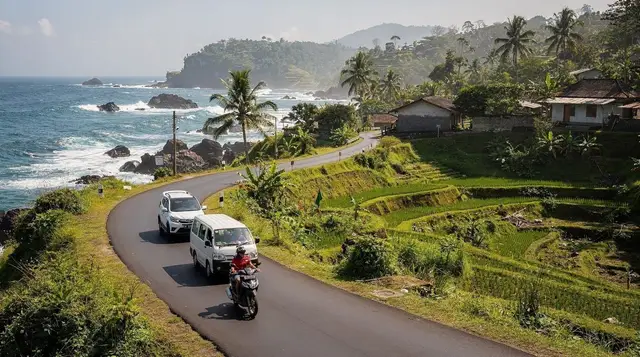
Jimbaran sits on a wide, gently curving bay a short distance south of the airport, and that single fact shapes almost everything about how people use it. It is where a lot of first nights and last nights in Bali happen by default, because the flight lands late or leaves early and nobody wants a long transfer at either end. What keeps it on the map beyond that convenience is a genuinely distinct evening ritual: rows of tables set directly on the sand, grilled fish and prawns arriving by the plateful, and a sunset that most of the bay’s restaurants are angled to catch.
That said, Jimbaran is not a single experience. By day it is a working fishing town with a market that still functions as a market, not a photo opportunity dressed up as one. By evening the same stretch of beach becomes a long run of competing seafood restaurants, each with touts working the road to pull you toward their tables. Both sides are worth knowing about before you arrive, because the gap between the daytime and the evening version of Jimbaran catches a lot of visitors who only ever see one of them.
Jimbaran also sits at the northern edge of the Bukit Peninsula, close enough to Uluwatu that a lot of evening tours bundle the two together — temple and dance in the late afternoon, dinner on the Jimbaran sand once the sun is down. That pairing is common enough that it is worth deciding early on whether you want Jimbaran as a standalone evening or as the tail end of a longer Uluwatu day, since the logistics differ.
Jimbaran at a glance
| Where | Jimbaran Bay, south Bali, just south of the airport and north of the Bukit Peninsula |
| Cost | A beachfront seafood dinner runs noticeably higher than an equivalent meal inland, priced mostly by weight of seafood ordered; a fish market visit itself is free to wander |
| Time needed | An evening for the dinner; a half day if you add the market and some beach time |
| Access | Short drive or transfer from the airport; a longer but manageable drive from Kuta, Seminyak, or Ubud |
| Best time | Dry season for a clear, uninterrupted sunset; any evening works, but book ahead in high season |
The seafood dinner, and how it actually works
The tables-on-the-sand format is the thing most people come for, and it is worth understanding the mechanics before you sit down. You typically choose your seafood — fish, prawns, squid, crab — priced by weight, then it is grilled and brought out with rice and a handful of side dishes. The setting is the draw as much as the food: bare feet in the sand, candles or fairy lights once it gets dark, and the sun going down over the bay if you time it right.
Where it gets complicated is the touting. Walk along the beach road at dusk and you will be approached repeatedly, each tout insisting their restaurant has the best tables or the best price. Prices and seafood quality vary more than the pitch suggests, and the difference between a good table and a mediocre one often comes down to which restaurant you land in rather than luck with the food itself.
Booking ahead through an organised option removes most of that friction. A package like the Jimbaran beach sunset candlelight dinner secures a table at a set restaurant with a fixed format, so you are not negotiating on the sand at sunset with a group of touts working you from three directions. For something with a slightly higher bar, the Jimbaran sunset seafood dining experience for two is built specifically around the couples-dinner version of the evening, with a table position and format arranged in advance.
The fish market, before the tourists show up
Jimbaran’s fish market, sometimes called Kedonganan after the neighbouring village, runs as an actual working market rather than a staged attraction, which means the interesting version of it is early. Boats come in, the catch gets sorted and sold, and the whole thing has largely wound down by the time most visitors are awake. If you want to see it as a working market rather than a quiet row of stalls, that means an early start.
A guided version solves the timing problem and adds the context that is easy to miss walking through alone. The Jimbaran fish market tour with seafood tasting covers the market itself and then has your catch cooked and served, which turns an early wander into a full breakfast or brunch outing rather than just a look around.
Jimbaran as a base versus Jimbaran as a stop
Plenty of people never stay in Jimbaran at all and just pass through for dinner, which is a perfectly reasonable way to use it. But it also works as a base in its own right, particularly for the first or last couple of nights of a trip. The appeal is proximity to the airport combined with a noticeably calmer atmosphere than Kuta or Seminyak — fewer bars, less nightlife, and a beach that isn’t dominated by surf schools and beach clubs.
| Jimbaran | Kuta / Seminyak | |
|---|---|---|
| Atmosphere | Quiet, resort and seafood-restaurant focused | Busy, nightlife and shopping focused |
| Airport distance | Very short | Short to moderate, depending on exact area |
| Beach use | Sunset dinners, calmer swimming | Surfing, beach clubs, sunbathing crowds |
| Evening options | Seafood restaurants, hotel bars | Wide range of bars, clubs, restaurants |
That trade-off is the whole decision in a sentence: Jimbaran gives you calm and convenience, Kuta and Seminyak give you variety and energy. Neither is objectively better — it depends on what kind of evening you actually want on a given night of the trip.
What isn’t worth the detour
Skip any tout who approaches you well before the beach itself, on the main road, insisting they can get you a better table than anywhere else — the genuine price and quality differences between restaurants are real, but they are not something a street tout can accurately represent, and the pressure tactic itself is a signal to walk on. It is also not worth treating Jimbaran as a full day’s itinerary on its own; beyond the market and the beach, there isn’t a lot to fill daylight hours with, and most visitors are better served combining it with Uluwatu or the wider Bukit Peninsula for a fuller day.
What it costs
Budget for the seafood dinner to be one of the pricier meals of a Bali trip, since it is priced by weight and the beachfront setting itself carries a premium over an equivalent inland warung. A group sharing a selection of fish, prawns, and squid, plus rice and sides, ends up costing meaningfully more than a typical local meal, though still modest by the standards of a beachfront dinner in most other destinations. The fish market itself costs nothing to walk through if you’re not buying, and a guided tasting tour bundles the market visit with a cooked meal for a single price. Airport transfers and short local transport are a minor add-on either way.
When to go
The dry season, roughly April to October, gives the most reliable run of clear sunsets, which matters more here than at most Bali destinations since the sunset itself is a large part of why people come. The wet season from November to March still allows for dinners on most evenings — the rain tends to arrive as short, heavy bursts rather than washing out an entire evening — but a cloudy or rain-affected sunset is a real possibility worth accepting going in. High season, particularly July, August, and the Christmas and New Year period, means booking tables ahead rather than turning up and hoping.
Choosing which restaurant strip to eat at
Jimbaran’s beachfront restaurants cluster into a few distinct stretches along the bay, and they are not interchangeable despite looking similar from the road. Some sections lean toward larger, more established restaurants with fixed menus and steadier service; others are smaller, family-run operations where the catch and the price both depend more on the day. Neither is inherently better, but knowing that the strip isn’t one uniform experience helps explain why two visitors can have very different opinions of “the Jimbaran seafood dinner” after eating a few hundred metres apart.
If the sunset itself matters more to you than any particular restaurant’s reputation, prioritise a table with a clear, unobstructed view over the water and get there with enough daylight left to see it. If food quality and consistency matter more, a booked package removes the guesswork, since you know in advance what you’re getting rather than judging a menu board in the dark with a tout standing next to you.
Is it worth building a whole evening around?
Getting there and getting around
Jimbaran’s biggest practical advantage is how close it sits to Ngurah Rai airport, making it a genuinely short transfer for arriving or departing flights compared with almost anywhere else in south Bali. An airport transfer for check-in or check-out in the Jimbaran area is a straightforward way to handle that leg without negotiating a taxi at arrivals.
From further afield — Kuta, Seminyak, Canggu, or Ubud — Jimbaran is reachable by private driver, Grab, or Gojek, with the drive time depending heavily on traffic and time of day. There is no train or metro option anywhere on the island. If you’re combining Jimbaran with Uluwatu and the wider Bukit Peninsula in one outing, a private driver for the day makes more sense than trying to string together on-demand rides between stops, especially once evening traffic builds up around dinner time.
How this fits into a longer trip
Jimbaran pairs naturally with an Uluwatu day, since the temple and Kecak dance performance there wraps up close to sunset, right when Jimbaran’s dinner scene gets going. It also sits at the northern edge of the wider Bukit Peninsula, so travellers spending a few days on the peninsula’s beaches often use Jimbaran as their evening base. Read the Uluwatu Temple and Kecak dance guide if you’re stacking both into one evening, and the Bukit Peninsula’s hidden beaches guide if you want to fill a full day on the peninsula before finishing at Jimbaran.
For travellers deciding where to base themselves for the whole trip, the where to stay in Bali guide and the Kuta vs Seminyak vs Canggu comparison put Jimbaran’s quieter character in context against the busier south Bali options. If Jimbaran is bookending your trip around a flight, the Bali airport guide is worth reading alongside it. A 3-day Bali itinerary or first-timer 7-day itinerary both work well with a Jimbaran evening slotted in near the start or end.
Frequently asked questions about Jimbaran
Do I need to book a seafood dinner in advance?
Not strictly, but it removes a lot of the on-the-sand negotiation with touts, and during high season the closest-to-the-water tables fill up. Booking ahead is the lower-stress option, especially for a sunset-timed evening.
Is Jimbaran good for swimming, or just for dinner?
The bay is calmer than the surf beaches further south, which makes it reasonable for swimming, though it isn’t the main draw the way the dinners are. Most visitors treat the beach as a daytime add-on rather than the primary reason to come.
How early do I need to go to see the fish market properly?
Early. The market operates as a genuine working market tied to when the boats come in, and it winds down well before most tourists are up. A guided early tour is the most reliable way to catch it in full swing.
Is Jimbaran a good base for a whole Bali trip?
It works well for a few nights, especially bookending a trip around flights, but it lacks the range of restaurants, nightlife, and activities that Kuta, Seminyak, or Canggu offer for a longer stay. Many travellers use it for the first or last couple of nights and base elsewhere for the middle of the trip.
Can I combine Jimbaran with Uluwatu in one day?
Yes, and it’s a common pairing — Uluwatu Temple and the Kecak dance in the late afternoon, then dinner on the Jimbaran sand once the sun goes down. The drive between the two is short enough to make this comfortable.
Is the seafood dinner good value?
It’s priced at a premium compared with an inland meal, largely for the beachfront setting and sunset timing rather than the seafood itself being unusually expensive. Whether that’s good value depends on how much the setting matters to you — for most visitors, it’s a one-off splurge rather than a nightly habit.
What should I wear to a beach dinner?
Casual and comfortable is standard — you’ll likely be barefoot in the sand for at least part of the evening. Bring a light layer, since the breeze picks up once the sun goes down and there’s no shelter from it at a beachfront table.