Bali vs Thailand: How the Two Actually Compare
Should I choose Bali or Thailand for my Southeast Asia trip?
They're not close substitutes despite often being compared. Bali is a single Hindu-majority island — compact, culturally distinct, built around rice terraces, temples, and surf. Thailand is an entire country with far more geographic range — beaches, mountains, a different set of cities, and a Buddhist culture. Bali suits a shorter, more focused trip; Thailand suits a longer trip covering more ground. Neither is objectively better, and plenty of travellers end up doing both on separate trips rather than choosing once and for all.
Bali and Thailand get lumped together constantly in Southeast Asia trip planning, both as alternatives and as a package deal, but the comparison is a little lopsided from the start: Bali is one island within Indonesia, while Thailand is an entire country with its own islands, mountains, and cities spread across a far larger area. That difference in scale shapes almost everything else about how the two compare — what you can realistically see on a single trip, how much variety is available within a fixed number of days, and how the logistics of getting around actually work.
None of this framing is a knock against Bali or its capabilities as a destination. A single, well-developed island with decades of tourism infrastructure built specifically around it has real advantages over a country where “Thailand” might mean Bangkok, Chiang Mai, Phuket, or Koh Samui depending entirely on what the traveller wants. But it does mean the two aren’t quite comparing like for like, and a lot of “Bali vs Thailand” content glosses over that in favour of a simpler beach-versus-beach framing that doesn’t tell the full story. A more honest framing treats Bali as a strong single-destination choice and Thailand as a strong multi-destination choice, and lets the traveller’s available time do most of the deciding.
This guide compares the two honestly across culture, cost, logistics, and what each actually delivers for a first-time visitor, rather than pretending they’re interchangeable options solved by a coin flip. Read on for the specifics behind each of those categories rather than a simple verdict at the end. There isn’t a single winner here, only a better fit for a given trip.
Bali vs Thailand at a glance
| Bali | Thailand | |
|---|---|---|
| Scope | Single island within Indonesia | Entire country, far more geographic range |
| Culture | Hindu-majority, distinct temple culture | Buddhist-majority, different customs and history |
| Best trip length | 5–14 days covers the island well | 10 days to several weeks, depending on regions covered |
| Getting around | Scooter, private driver, Grab/Gojek | Domestic flights, trains, buses between regions |
| Signature draws | Rice terraces, volcanoes, temples, surf | Beaches, islands, mountains, Bangkok, night markets |
Scope and what each trip actually covers
A Bali trip, even a relatively short one, can realistically cover the island’s core highlights — South Bali’s coast, Ubud’s culture, a volcano trek, Nusa Penida — within a week or two, because everything sits within a few hours’ drive of everything else.
A Thailand trip covering a comparable range of experiences — Bangkok’s city energy, northern Thailand’s mountains and temples around Chiang Mai, and southern Thailand’s islands and beaches — needs considerably more time and typically involves domestic flights between regions, since the country’s geography doesn’t allow the same tight, drivable loop that Bali’s small size makes possible. That’s not a flaw in Thailand’s design; it’s simply a function of covering a much larger country properly. Bali simply doesn’t have the same problem to solve.
Cultural differences worth understanding
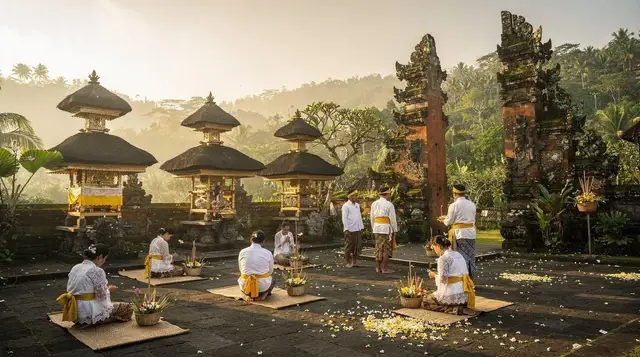
Bali’s Hindu identity sets it apart sharply from the rest of Indonesia and from Thailand alike — daily offerings on the street, a temple-dense landscape, and a ceremonial calendar (Nyepi, Galungan and Kuningan) that shapes island life in ways visitors notice quickly. Thailand’s Buddhist culture, expressed through its own distinct temple architecture, saffron-robed monks, and customs like the wai greeting, offers an equally rich but genuinely different cultural experience.
Learning even the basics of each culture’s expectations before arrival — how to dress at a temple, how to greet someone — makes a genuine difference to how a visit is received. Neither is “more authentic” than the other; they’re simply different traditions, and comparing them head to head misses what makes each worth experiencing on its own terms. Visitors who arrive expecting one culture to feel like a variation on the other are usually surprised by how distinct the daily texture of each actually is, from the specific rituals to the rhythm of a temple visit.
Beaches and islands compared
Bali’s beaches range from South Bali’s surf breaks to the black volcanic sand of the east coast, with the Nusa Islands offering a dramatic clifftop-and-turquoise-water contrast within easy boat range. Thailand’s beach and island scene is considerably larger in scope — the Andaman coast’s limestone karsts, the Gulf islands, and countless smaller island groups — giving it more raw variety for travellers whose trip is built primarily around beach-hopping.
For a shorter trip, Bali’s compactness makes it easier to see a genuinely representative sample of what’s on offer; for a longer trip, Thailand’s scale rewards travellers with more time to explore. Diving and snorkelling are strong in both destinations too — Bali’s Nusa Penida and Amed-Tulamben stretch against Thailand’s Similan Islands and Koh Tao, each with a loyal following among divers who rate them among the best in the wider region.
What isn’t worth the detour
Don’t choose Bali expecting Thailand’s sheer geographic variety within the same trip length — a single island, however well-developed, can’t match an entire country’s range, and pretending otherwise sets up disappointment. Equally, don’t choose Thailand for a short trip expecting to cover it as thoroughly as a compact island destination like Bali; trying to squeeze Bangkok, the north, and the southern islands into a week produces a rushed, transit-heavy trip that shortchanges all three.
And don’t overthink the “which is better” question too hard — for travellers with time for both, doing each properly on separate trips beats trying to force a single trip to deliver everything both destinations offer. The honest answer to “Bali or Thailand” is usually “it depends how much time you have and what you specifically want,” not a universal ranking that applies to every traveller equally.
Budget comparison
Both destinations offer a wide range of budgets, from backpacker-cheap to genuinely luxury, and neither is dramatically more expensive than the other overall. Bali’s accommodation and dining costs vary considerably by area — Seminyak and Uluwatu sit well above Ubud’s or East Bali’s more modest pricing — while Thailand shows a similar pattern between Bangkok’s or Phuket’s tourist-dense pricing and the north’s generally lower costs.
In both cases, moving even slightly away from the most famous, densely touristed spots tends to unlock noticeably better value without much sacrifice in quality. Flights are a meaningful factor too: reaching Bali typically means routing through a regional hub, while Thailand’s Bangkok functions as a major international gateway with generally more direct flight options from further afield.
That difference can meaningfully affect the total cost and duration of getting to your destination, and it’s worth pricing out both routes concretely rather than assuming Bali is automatically the harder or more expensive of the two to reach. Fare comparisons shift over time and by season, so it’s worth checking current pricing directly rather than relying on outdated assumptions about which destination is cheaper to fly to from your specific starting point.
Getting around each destination
Bali’s small size makes a private driver or scooter genuinely practical for covering most of the island within a standard trip length, without needing to fly internally. Thailand’s larger geography means covering multiple regions typically involves a mix of domestic flights, trains, and buses, adding both cost and planning complexity that a Bali trip generally avoids.
This difference alone is worth weighing heavily if minimising travel logistics matters to you — Bali’s compactness is a genuine practical advantage for a shorter, lower-hassle trip. Travellers who dislike planning multi-leg domestic transport within a single trip often find Bali’s self-contained scale a genuine relief compared with juggling flights, trains, and buses across a larger country.
Seasonality across both
Bali’s dry season runs roughly April to October, wet November to March, a pattern shared broadly across much of Thailand too, though Thailand’s larger geography means some regions experience meaningfully different weather patterns at the same time of year — the Gulf islands and the Andaman coast, for instance, don’t always share identical seasonal windows.
Checking region-specific weather for whichever part of Thailand you’re visiting matters more than it does for Bali, where the whole island follows a broadly consistent pattern. This is one of the more concrete, underrated advantages of Bali’s smaller scale: a single check of the best time to visit Bali guide covers the whole itinerary, whereas a Thailand trip spanning multiple regions may need separate seasonal checks for each leg.
How this fits into a longer trip
For travellers with enough time, combining Bali and Thailand on separate legs of a longer Southeast Asia trip is entirely reasonable, though treating them as two distinct, properly paced experiences rather than a single rushed combination tends to work better. A Bali 10 days itinerary or Bali 14 days itinerary gives Bali its own proper due before or after a separate Thailand leg.
For first-timers deciding between the two for a single trip, the how many days in Bali guide and Bali first time guide are useful for understanding what a well-paced Bali trip actually looks like before comparing it against a Thailand itinerary of similar length. The where to stay in Bali guide and best time to visit Bali guide round out the planning picture once Bali is the confirmed choice.
If Bali is the choice, easing into it with a hands-on activity like a batik-making class in Ubud or a zipline and garden tour with lunch gives an early, tangible sense of what sets the island’s culture apart from Thailand’s, beyond the beaches both destinations share. A multi-day option like a 2-day Bali escape covering hidden Ubud and Nusa Penida is a strong way to get a genuine feel for the island quickly if your Bali leg is shorter than you’d ideally like.
Food and daily life compared
Balinese cuisine — nasi campur, babi guling, sate lilit — sits within Indonesia’s broader culinary tradition, itself distinct from region to region across the archipelago, while Thai cuisine’s global reputation for balancing spicy, sour, sweet, and salty flavours is well earned and consistently strong across the country. Both destinations offer an enormous range from street-food-level pricing to destination fine dining, and neither disappoints a food-focused traveller.
Daily rhythms differ too: Bali’s temple-centred, offering-strewn streets create a specific atmosphere that Thailand’s Buddhist temples and markets don’t replicate, even though both cultures share a broadly warm, hospitality-driven approach to visitors that first-time travellers to either destination consistently remark on. Language also differs meaningfully — Bahasa Indonesia in Bali versus Thai in Thailand — though English is widely spoken in tourist areas across both destinations, so this rarely becomes a genuine obstacle for most visitors.
Wellness, yoga, and retreats
Bali, and Ubud specifically, has built an international reputation as a wellness and yoga destination over the past two decades, with a dense concentration of studios, retreats, and healers that’s hard to match elsewhere in the region. Thailand has its own strong wellness tourism sector, particularly around Chiang Mai and certain southern islands like Koh Phangan, with a slightly different character shaped by Thai massage traditions and a broader spread of retreat locations across the country rather than one concentrated hub.
Travellers specifically seeking a wellness-focused trip will find excellent options in both, though Bali’s Ubud remains the more singularly famous destination for this particular niche. That fame brings both benefits and downsides — a wide range of quality options in Ubud, but also more competition for space in the most in-demand studios and retreats during peak season, something Thailand’s more distributed wellness scene doesn’t experience to quite the same degree. Booking ahead solves most of that friction regardless of which destination you choose.
Frequently asked questions about Bali vs Thailand
Is Bali cheaper than Thailand overall?
Neither is consistently cheaper — both range from backpacker-budget to luxury, and the specific areas you choose within each matter more than the country-level comparison.
Which has better beaches, Bali or Thailand?
Thailand offers more raw variety given its larger coastline and island count, while Bali’s beaches, paired with its temple and rice-terrace culture, offer a more compact, varied single-island experience. Preference matters more here than any objective ranking.
Is Bali part of Thailand?
No — Bali is an island within Indonesia, an entirely separate country from Thailand, though the two are often mentioned together in Southeast Asia travel planning.
Which is easier for a first-time Southeast Asia visitor?
Bali’s compact size and well-developed single-island tourism infrastructure make it a slightly easier first stop logistically, while Thailand offers more range for visitors wanting to see multiple distinct regions on one trip.
Can I visit both Bali and Thailand on one trip?
Yes, though it’s worth budgeting real time for each rather than rushing through both — a combined trip works best with at least a week or more dedicated to each destination separately.
Do Bali and Thailand have similar visa requirements?
They’re separate systems administered by different countries, so check each directly rather than assuming they match — Indonesia’s visa-on-arrival/e-VOA system for Bali differs in specifics from Thailand’s own entry requirements.
Which has better food?
Both are genuinely strong, distinct culinary destinations — Balinese and broader Indonesian cuisine on one side, Thai cuisine’s own well-known range on the other. Neither outranks the other; they’re simply different traditions worth experiencing for their own sake.
Is Thailand’s nightlife better than Bali’s?
Thailand’s nightlife scene, particularly in Bangkok and certain islands, is generally larger and more varied given the country’s scale, while Bali’s nightlife concentrates more tightly around South Bali’s Seminyak, Canggu, and Kuta strips.
Popular Bali experiences on GetYourGuide
Verified deep-linked GetYourGuide tours. Book through these links and we earn a small commission at no cost to you.
These are our own photographs of Bali, not the operator's pictures of this tour — open the tour page to see those.